发动机舱对流换热CFD模拟的基础问题
2017-03-21刘桂兰赵兰萍杨志刚
刘桂兰++赵兰萍++杨志刚
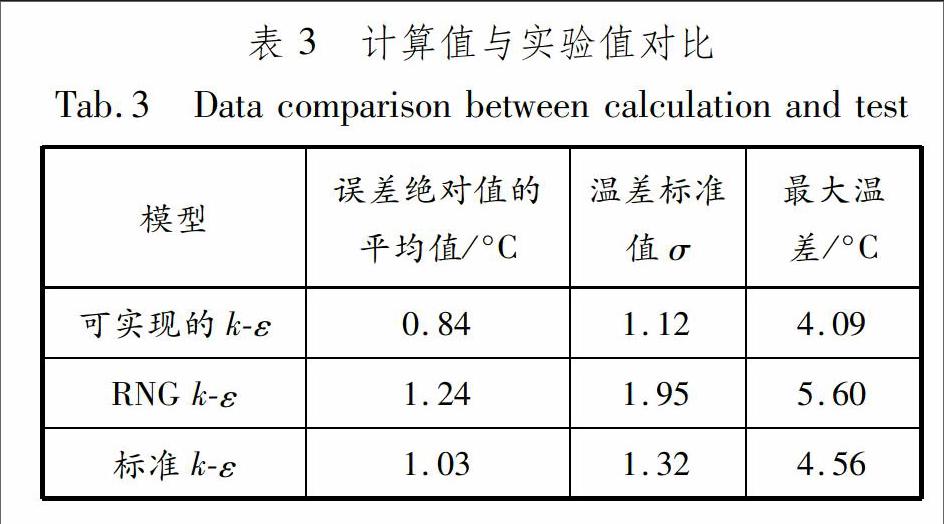

摘要: 为合理选择进出口尺寸及布置发动机舱各部件,进一步降低舱内最高温度,对比标准kε模型、RNG kε模型和可实现的kε模型等3种湍流模型及2种壁面函数对温度场模拟的精度.由模拟与实验对比可知:可实现的kε湍流模型、增强型壁面函数更适合模拟热流场.利用CFD计算不同进出口尺寸及换热器与发动机间距对舱内温度场的影响,结果表明进出口尺寸对舱内最高温度影响较大.
关键词: 汽车; 发动机舱; 热流场; 湍流模型; 壁面函数
中图分类号: U463.8文献标志码: B
Fundamental problems on CFD simulation of convective
heat transfer in underhood
LIU Guilana, ZHAO Lanpinga, YANG Zhigangb
(a. Institute of Refrigeration and Cryogenic Engineering; b. Shanghai Automotive Wind Tunnel Center,
Tongji University, Shanghai 201804, China)
Abstract: To further decrease the maximum temperature in underhood by the rational selection of inlet and outlet sizes and the layout of components in undehood, three turbulence models, including standard kε model, RNG kε model and realizable kε model, and two wall functions are used to simulate the temperature field of underhood. The comparison of simulation and tests indicates that realizable kε model and enhanced wall function are more suitable for simulation of heat flow field. A series of calculation using CFD are done, including different sizes of inlet and outlet and different distances between heat exchanger and engine, to analyze the influence on the underhood temperature. The results show that the size of inlet and outlet has great effect on the maximum underhood temperature.
Key words: automobile; underhood; thermal flow field; turbulent model; wall function
收稿日期: 2016[KG*9〗09[KG*9〗12修回日期: 2016[KG*9〗12[KG*9〗17
作者簡介: 刘桂兰(1990—),女,山东潍坊人,硕士研究生,研究方向为汽车空调,(Email)liuguilan_roly@163.com
通信作者: 赵兰萍(1967—),女,浙江嘉兴人,副教授,工学博士,研究方向为汽车空调与环境试验设备,(Email)lanpingzhao@tongji.edu.cn0引言
在汽车的燃油经济性和排放性能研究中,空气动力学和热管理扮演重要的角色,其中有实验和数值两大分析途径.近年来,CFD与实验相结合的技术一直是空气动力学开发的重要力量.国内外学者都对CFD在汽车发动机舱内的应用进行大量研究.FRANCHETTA等[1]利用简化的发动机舱模型进行CFD模拟,并利用粒子图像测速(Particle Image Velocimetry,PIV)实验进行验证,发现CFD模拟与PIV一致性较好,且与PIV实验相比可以节约90%的时间; KUMAR等[2]和HEINZELMANN等[3]对不同车型的发动机舱进行非定常的CFD计算,并利用实验进行验证;YANG等[4]利用CFD对发动机舱温度场和速度场进行模拟分析,找到发动机舱内流体温度最高的区域,并对发动机舱进行优化,降低发动机舱内……