中国省域FDI投资的时空区位演化过程研究
2016-11-09曾惠芳熊培银
曾惠芳+熊培银

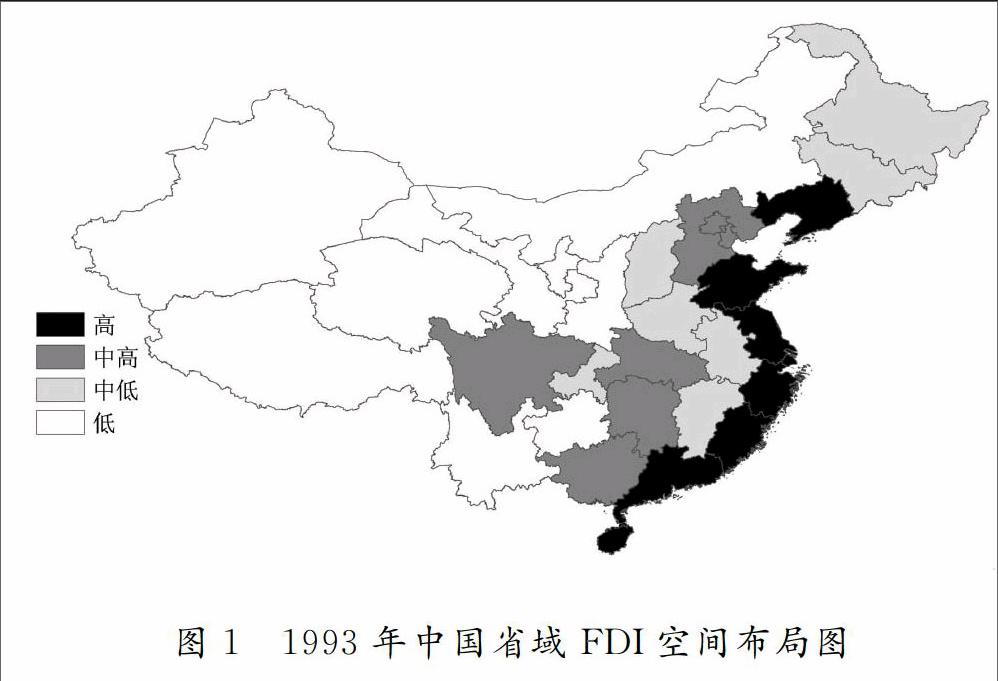
摘 要 采用1993-2014年中国31个省市的外商直接投资数据,利用了空间马尔可夫链方法和地理信息技术,研究了中国各省市外商直接投资的时空演化特征.按照FDI投资比重大小把各省市FDI演化特征划分为低、中低、中高和高4种类型,构建马尔可夫状态转移概率矩阵,利用空间Markov方法模拟了中国各省市FDI投资的时空演化过程.结果发现中国各省市FDI分布极不均衡,在1993-2002年期间主要分布在中国东部沿海地区,到2014年具有逐步向中西部转移的趋势.比较空间马尔可夫链的初始分布和极限分布发现,当处于低和中低状态时,极限概率小于初始概率,当处于中高和高状态时,极限概率大于初始概率;由此可以说明中国各省市FDI投资水平的提高正在稳步推进,而且FDI空间区位演化过程具有发散性.
关键词 外商直接投资;区位演化;空间马尔可夫链
中图分类号 F222.3 文献标识码 A
Abstract Based on the data set of inward foreign direct investment across the provincial regions of China over 1993-2014, this paper attempts to apply Markov chain and geographic information system technology to investigate the spatial and temporal dynamic characteristics of FDI agglomeration in China. Firstly, the FDI shares for different regions in China are classified into four different classes(low, middle-low, middle-high and high),which shows a very uneven FDI distribution pattern based on GIS technology. On the other hand, the estimation of Markov transition probability matrix offers more detailed insights into the mechanics of FDI evolution process in China during the research period. In addition, the evolutionary trends of FDI agglomeration are forecasted by computing the limited power of Markov transition probability matrix. Empirical results indicate that the probability of moving up the FDI ladder is somewhat higher than that of moving down. We can conclude that there is divergence of FDI in China.
Key words Foreign direct investment; Location evolution; Spatial Markov chain
1 引 言
改革开放以来,FDI的流入对中国区域经济发展产生了重大的影响,在加快地区工业化进程、促进贸易增长和建设市场化制度等方面,它都起着不可替代的作用.FDI的流向引导着国内资本、劳动力等多种资源的地区流动,导致各地区生产要素投入的显著差异,被认为是影响中国地区间经济差距的主要因素之一.
FDI的动态空间演化机制与区位影响因素有着密切的联系,良好的区位吸引FDI在特定地区形成聚集,而资本边际收益递减与技术扩散会促使FDI的空间形态由集中逐……
