肺癌患者射频消融术后CD4+T淋巴细胞亚群的变化
2016-07-11林堆贤梅宝富邓志锋陈俊辉
林堆贤 梅宝富 邓志锋 陈俊辉
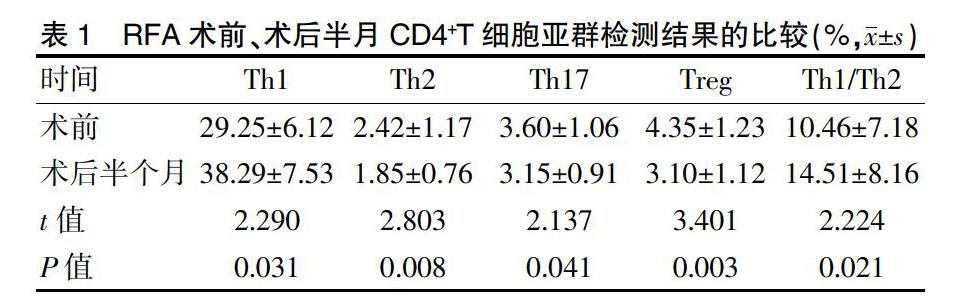
[摘要] 目的 探讨射频消融(RFA)对肺癌患者CD4+ T淋巴细胞亚群抗肿瘤免疫功能的影响。 方法 选取本院2012年8月~2014年8月收治的30例肺癌患者作为研究对象,给予RFA治疗,分别于术前、术后半个月采集外周血,比较治疗前后的Th1、Th2、Th17、Treg细胞水平。 结果 RFA术后半个月的外周血Th1水平及Th1/Th2比值显著高于术前,Th2、Th17、Treg水平显著低于术前,差异有统计学意义(P<0.05)。 结论 RFA能够改善肺癌患者CD4+T细胞亚群的抗肿瘤免疫功能。
[关键词] 肺癌;射频消融;CD4+ T淋巴细胞亚群;免疫功能
[中图分类号] R734.2 [文献标识码] A [文章编号] 1674-4721(2016)03(b)-0055-03
[Abstract] Objective To explore the influence of the radiofrequency ablation (RFA) on the anti-tumor immune function of CD4+ T lymphocyte subsets in patients with lung cancer. Methods 30 patients with lung cancer from August 2012 to August 2014 in our hospital were selected as the research group,the therapy of RFA was given.Peripheral blood was collected before and after operation half a month,the level of Th1,Th2,Th17,Treg cell was compared respectively. Results The level of Th1 and Th1/Th2 ratio after RFA operation at half a month was higher than that before operation,the level of Th2,Th17,Treg cell after RFA operation at half a month was lower than that before operation,with significant difference (P<0.05). Conclusion RFA can improve the anti-tumor immune function of CD4+ T lymphocyte subset in patients with lung cancer.
[Key words] Lung cancer;Radiofrequency ablation;CD4+ T lymphocyte subset;Immune function
肺癌是我国最常见的恶性肿瘤之一,在我国城镇居民肿瘤死亡原因中居于首位,大多数患者确诊时已经失去了手术切除的机会[1-2]。射频消融(radiofrequency ablation,RFA)的原理是应用频率在460~480 kHz之间的交变高频电流使肿瘤组织内离子发生高速震荡,互相摩擦,将射频能转化为热能,使局部温度达到60~100℃,导致肿瘤组织发生凝固性坏死[2]。2000年Dupuy等[3]首次报道利用RFA治疗肺癌。RFA具有安全性高、创伤小、疗效确切、术后恢复快等特点,已成为肺癌治疗的有效方法之一[2-4]。其在直接损毁肿瘤组织的同时,也可使CD4+ T淋巴细胞升高,改善机体的抗肿瘤免疫功能[5-6]。CD4+ T细胞为不均一细胞群,研究[7-8]显示,其主要有Th1细胞(辅助性1型T细胞,type 1 helper T cells)、Th2细胞(辅助性2型T细胞,type 2 helper T cells)、Th17细胞(IL-17 producing CD4+ T cells)、Treg细胞(调节性T细胞,regulatory T cell)4种不同的亚群。各淋巴细胞亚群介导不同的免疫功能,在体内又相互作用、相互影响。本研究通过检测Th1、Th2、Th17及Treg4种不同的CD4+ T细胞亚群,旨在探讨RFA对肺癌患者CD4+ T细胞抗肿瘤免疫功能的影响。
1 资料与方法
1.1 一般资料
选取2012年8月~2014年8月本科收治的30例肺癌患者作为研究对象,术前均进行穿刺活检或纤维支气管检查,病理确诊为肺癌,其中男19例,女11例;……
