钩藤碱对痴呆模型小白鼠学习记忆的干预作用研究
2016-05-14朱文娟程金生
朱文娟 程金生
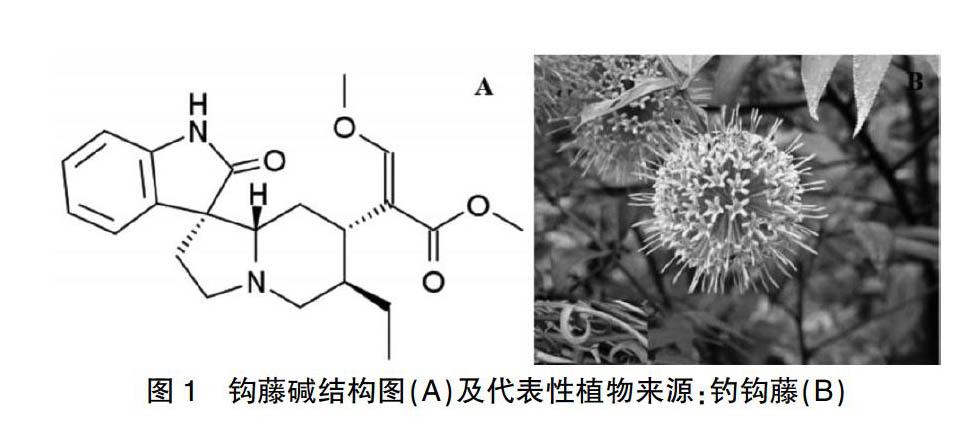
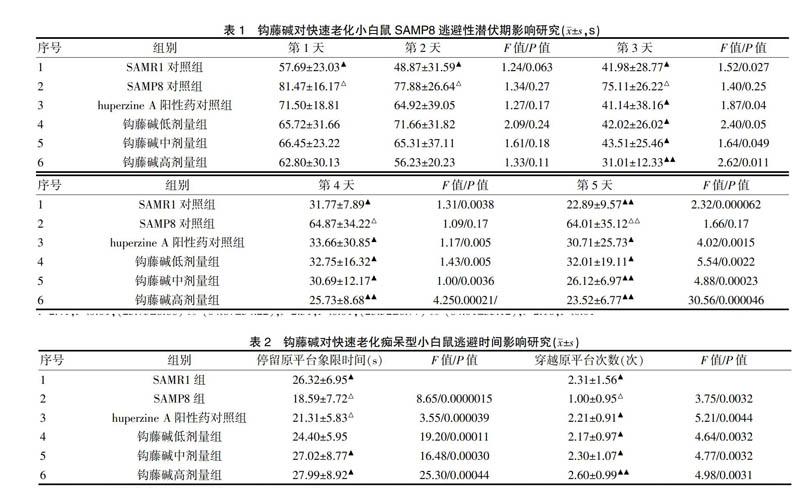
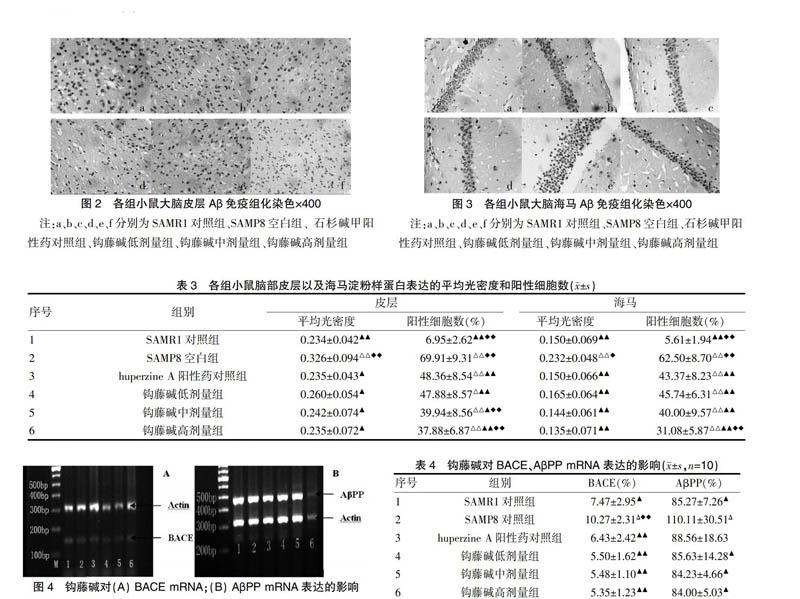
[摘要] 目的 研究猫爪草提取物钩藤碱对痴呆模型小白鼠学习记忆的干预作用。 方法 采用免疫组化分析及半定量反转录聚合酶链反应(reverse transcription-polymerase chain reaction,RT-PCR)测定钩藤碱(rhynchophylline,RH)对快速老化痴呆型小白鼠(SAMP8)脑内β位点APP裂解酶(β-site APP cleavage enzyme,BACE)、β-淀粉样蛋白前体(β-site amyloid precursor protein,AβPP)及淀粉样蛋白(amyloid-β,Aβ)沉积表达。 结果 在小鼠探索实验中,SAMP8组小鼠停留原平台象限时间(18.59±7.72)s,穿越平台次数为(1.00±0.95)次,而钩藤碱中剂量组两组对应时间分别为(27.02±8.77)s和(2.30±1.07)次。与对照组相比,钩藤碱实验组痴呆模型小白鼠在原来的平台各象限中的驻留时间显著变长,且另一方面,该实验组小鼠穿越原来的平台的次数有明显的增加。进一步研究发现钩藤碱各剂量能明显降低SAMP8脑内Aβ平均光密度值和免疫阳性神经元数,如SAMP8组皮层Aβ平均光密度值和免疫阳性神经元细胞数分别为(0.326±0.094)和(69.91±9.31),而钩藤碱中剂量组对应值分别为(0.242±0.074)和(39.94±8.56)。且采用钩藤碱干预后,SAMP8小白鼠脑内BACE、APP mRNA含量也呈现下降趋势,如钩藤碱高剂量组AβPP mRNA表达值为(84.00±5.03),与SAMP8组对应值(110.11±30.51)。以上效应均呈现一定的量效关系。 结论 钩藤碱能较好地抑制APP裂解酶、β-淀粉样蛋白前体及淀粉样蛋白的过度生成,从而保护小鼠的神经元免受淀粉样蛋白的神经毒性影响,进而改善快速老化痴呆模型小白鼠SAMP8的学习记忆能力。
[关键词] 阿尔茨海默病;小鼠;记忆;猫爪草
[中图分类号] R749.16;R332 [文献标识码] A [文章编号] 1673-9701(2016)06-0012-07
Intervention of rhynchophylline on the learning and memory abilities of a dementia mouse model
ZHU Wenjuan1 CHENG Jinsheng2
1.Department of Pathology, the 1st People's Hospital of Huzhou City in Zhejiang Province, Huzhou 313000, China; 2.School of Medicine, Jiaying University, Meizhou 514031, China
[Abstract] Objective To research the intervention of rhynchophylline extracted from root of catclaw buttercup on the learning and memory abilities of a dementia mouse model. Methods The expressions of beta-site APP cleaving enzyme (BACE), amyloid-β precursor protein(AβPP) and Aβ in senescence accelerated mouse prone 8(SAMP8) mouse brain were studied by immunohistochemical analysis and reverse transcription-polymerase chain reaction(RT-PCR) analysis etc. Results Comparing with the control group, in spatial exploration test of the RH-treated group, the staying time and the frequency of striding over primary terrace quadrant increased significantly. For example, the staying time of original platform and frequency of crossing original platform of SAMP8 group were(18.59±7.72) sec and(1.00±0.95) time, respectively. While for mid-dose of RH group, the data changed to(27.02±8.77) sec and(2.30±1.07) time, respectively. The Aβ mean optical density as well as the brain immunoreactive neurons of the RH cured group would decrease significantly comparing with SAMP8 group. For example, for SAMP8 group, mean optical density and the brain immunoreactive neurons were(0.326±0.094) and(69.91±9.31),while for mid-dose, mean optical density and the brain immunoreactive neurons would change to (0.242±0.074) and (39.94±8.56). The mRNA contents of BACE and AβPP also decline after rhynchophylline intervention. For example, for high-dose RH goup, the AβPP mRNA expression was (84.00±5.03), while for SAMP8 group, the data was (110.11±30.51). All of these effects showed a dose-effect relationship. Conclusion All the results in this work indicate that rhynchophylline can improve the learning and memory abilities in SAMP8 by inhibit the expression of BACE, AβPP and Aβ in SAMP8 brain, leading to protection of the neurons from the nuerotoxicity of Aβ.
[Key words] Alzheimer Disease; Mice; Memory; Root of catclaw buttercup
阿尔茨海默氏病(Alzheimer's disease,AD)的临床表现是患者的认知功能和记忆功能越来越差[1]。典型病理特征为脑部β淀粉样蛋白(Aβ)沉积并聚集形成老年斑(senile plaque,SP),且主要存在于与脑部与记忆和认知相关的特定区域[2]。……