一种改进型算法在用户端的性能评估的应用
2016-03-07楚广琳
摘要:未来高速宽带通信网络用户端的性能的好坏,直接决定了用户的网络体验。网络速度以及传输性能等参数尤其重要。因此,对用户端设备进行计算机建模就显得异常重要并且必要,它在一定程度上决定了未来网络布局的优劣。在此背景下,对调制器与接收器的性能进行了参数分析,并进行了详细的讨论。结合噪声指数以及信号增益对设备进行了算法优化,对未来的进一步设计与提高提供了必要的模型支撑。
关键词:算法优化;软件;性能评估;用户端;网络体验
中图分类号:TP311 文献标识码:A 文章编号:1009-3044(2015)35-0115-02
Abstract: In the future high speed communication network, the devices performance the future network will directly influence the web experience. The internet speed and the parameter designed in the transmission network are very important. Hence, modeling on users device is vital and necessary. It will influence the whole network distribution. Under this background, the parameters are detail analyzed and discussed. After the establishing the model, the noise figure and signal gain are optimized by the algorithm, providing supports on next redesign and improvement.
Key words: Optimization on algorithm; software; performance evaluation; user; web experience.
1 概述
为了适应未来的网络需求,优化接入网的用户端是必要的。降低用户端的体积以及设备的成本显得格外重要。最近一些研究显示,半导体集成光放大器(SOA)应用于用户端的调制器,并且对其进行高速调制,在中心局 (CO) 进行上行信号的接收[1-4],实现了给予每个用户10 Gb/s的网络速度。在此,本文对用户端的调制器进行优化,对SOA器件进行数学建模,对其模型进行分析,对未来的接入网器件进行优化设计以实现最大化的利用接入端器件。
2 数学建模
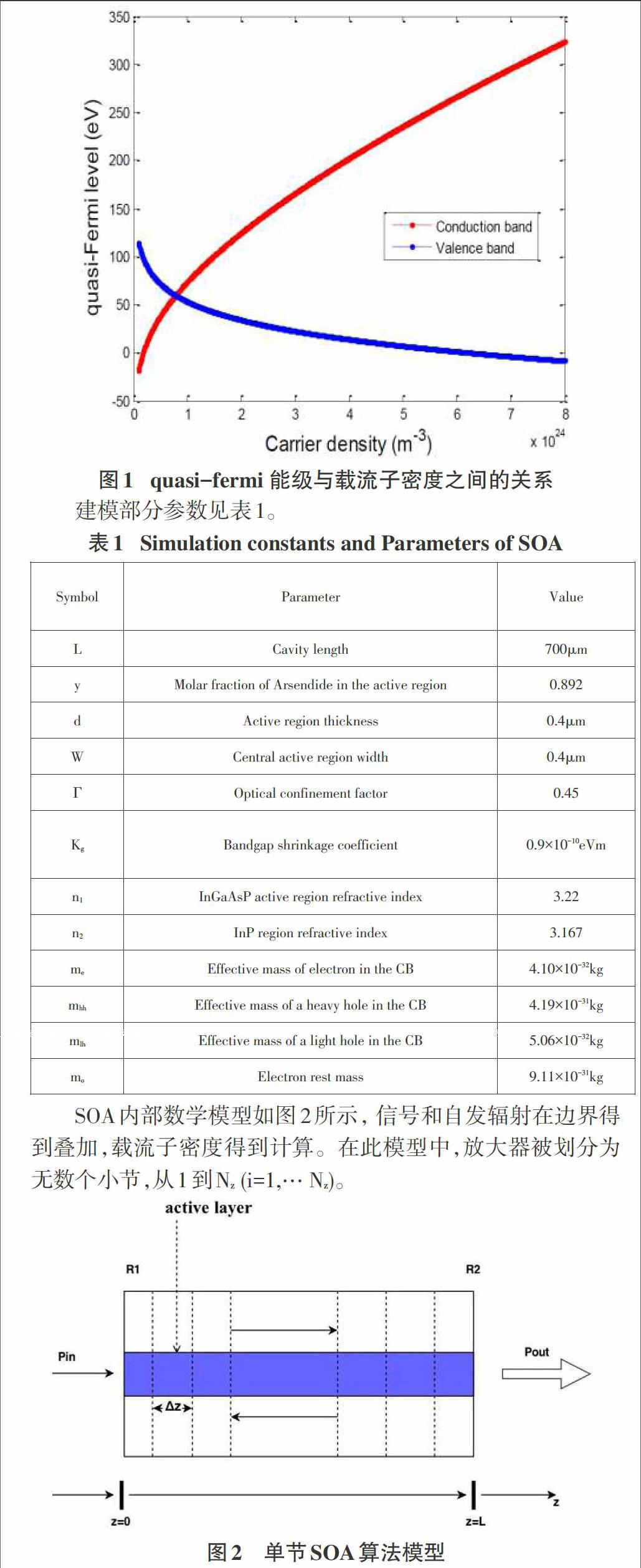
首先对模型进行分析,通常情况下,SOA的波导选择性掩埋生长在InP材料上。 注入信号之后,自发放大辐射就积累了噪声并影响了调制性能。据此,根据已有参数,建立费米能级模型并得到如图1所示关系。从图1得知,导带(conduction band)与价带(valence band) 的特性不同[7],其相应的费米能级与载流子密度分别正相关和反相关。因此合理的控制导带和价带的能量,就能控制好半导体光放大器的性能[5]。……