系统性护理干预在局部麻醉患者中的临床应用
2016-02-27沈毅
沈毅
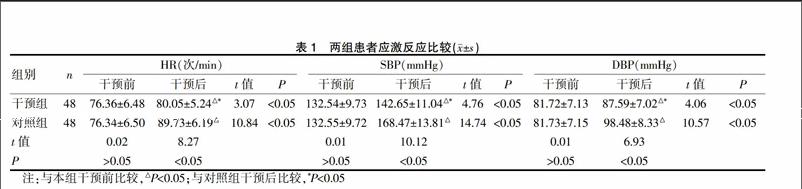
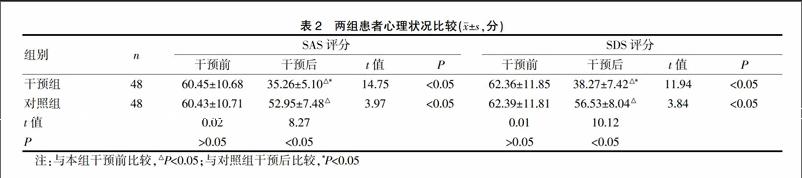
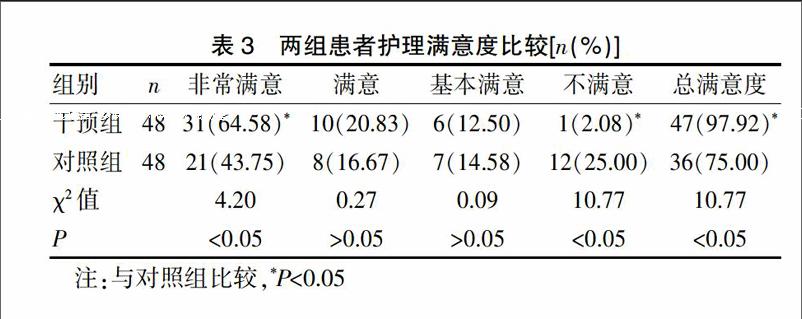
[摘要] 目的 探讨系统性护理干预在局部麻醉患者中的临床应用。 方法 选取2013年6~12月期间在我院进行局部麻醉手术的患者96例,采用随机数字表法将患者随机分为干预组和对照组。对照组患者采用一般常规护理干预,而干预组患者则在对照组基础上采用系统性护理干预,分别对两组的应激反应、心理状况、护理满意度进行比较分析。 结果 与对照组比较,干预组患者干预后的HR(80.05±5.24)次/min、SBP(142.65±11.04)mmHg、DBP(87.59±7.02)mmHg等应激反应指标均显著降低,SAS评分值(35.26±5.10)分、SDS评分值(38.27±7.42)分均明显降低,干预组患者对护理服务的非常满意率64.58%和总满意度97.92%均显著提升,而不满意率2.08%则显著降低,差异有统计学意义(P<0.05)。 结论 系统性护理干预能够有效缓解局部麻醉手术患者的应激反应,改善患者的心理健康状况,提高患者护理满意度。
[关键词] 局部麻醉;系统性护理干预;SAS;SDS
[中图分类号] R473 [文献标识码] B [文章编号] 1673-9701(2015)25-0122-03
Clinical application of systematic nursing intervention in patients with local anesthesia
SHEN Yi
Department of Anesthesiology, Liaoyang Central Hospital in Liaoning Province, Liaoyang 111000, China
[Abstract] Objective To investigate the clinical application of systematic nursing intervention in patients with local anesthesia. Methods Ninety-six patients who received local anesthesia surgery in our hospital from June to December 2013 were selected and randomly divided into the intervention group and the control group according to the random number table method. The control group was given ordinary conventional nursing intervention and the intervention group was given additional systemic nursing intervention program on the basis of the control group. The stress response, mental state, nursing satisfaction of the two groups were analyzed comparatively. Results After intervention, compared with the control group, the intervention group had significantly reduced stress response indicators, including HR(80.05±5.24 times/minute), SBP(142.65±11.04 mmHg) and DBP(87.59±7.02 mmHg), significantly reduced SAS score(35.26±5.10 points) and SDS score (38.27±7.42 points), significantly increased high satisfaction rate(64.58%) and total satisfaction rate(97.92%), and significantly reduced dissatisfaction rate(2.08%), with statistically significant differences(P<0.05). Conclusion Systemic nursing intervention can effectively relieve the stress response of patients with local anesthesia, improve the patients mental health state and increase patient nursing satisfaction.
[Key words] Local anesthesia; Systemic nursing intervention; SAS; SDS
非全身麻醉患者在进行局部麻醉手术时,其往往会由于自身始终处于较为清醒的意识状态,造成患者心理承受能力的大幅度降低,以及相关应激反应的进一步增强[1, 2],甚至在某种程度上加重患者病情,干扰手术的顺利进行并影响整个手术的临床治疗效果[3,4]。本文就系统性护理干预在局部麻醉手术患者中的临床应用进行探讨,现将结果报道如下。
1 资料与方法
1.1 一般资料
选取2013年6~12月期间在我院进行局部麻醉手术的患者96例,所有患者均签署知情同意书,并自愿参与研究,严格排除心肺肝肾重症疾病患者、恶性肿瘤患者、精神类疾病及认知功能障碍患者。采用随机数字表法将入选患者随机分为干预组和对照组各48例,干预组患者中男25例,女23例,年龄20~65岁,平均(38.26±5.47)岁;……