侵染油茶的两种病原菌的鉴定及其生物学特性研究
2016-01-08史红安傅本重张志林李国元王立华
史红安+傅本重+张志林+李国元+王立华

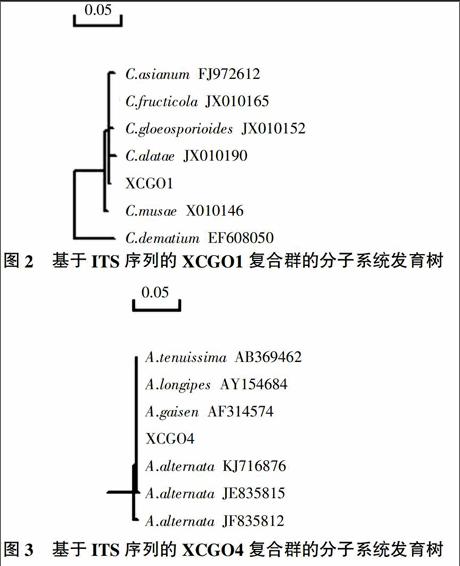
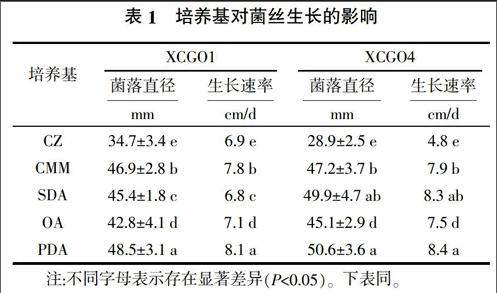
摘要:为了掌握湖北孝感本地油茶(Camellia oleifera)主要病害发生规律,采用常规组织分离法分离病原菌,依据病原菌的形态特征,结合其rDNA-ITS序列分析,对油茶病原菌进行分离和分子鉴定,并对其生物学特性进行了研究。结果表明,鉴定两种病原菌分别为胶孢炭疽菌(Colletotrichum gloeosporioides)和链格孢(Alternaria alternata);炭疽病菌菌株在PDA培养基中生长最快,最适碳源和氮源分别为淀粉、硫酸铵,pH 6.0为宜,最适生长温度为25 ℃,致死温度为52 ℃;链格孢菌株最适培养基为PDA培养基,以淀粉为碳源、硝酸铵为氮源为宜,pH 8.0时菌丝生长最快,最适温度为25 ℃,致死温度为54 ℃。
关键词:油茶(Camellia oleifera);病原菌;胶孢炭疽菌(Colletotrichum gloeosporioides);链格孢(Alternaria alternata);生物学特性
中图分类号:S432.4+4 文献标识码:A 文章编号:0439-8114(2015)23-5908-04
DOI:10.14088/j.cnki.issn0439-8114.2015.23.028
The Study of Two Camellia Pathogens Isolation,
Identification and Biological Characteristics
SHI Hong-an1,2,FU Ben-zhong1,ZHANG Zhi-lin1,LI Guo-yuan1,WANG Li-hua1
(1.Hubei Key Laboratory of Quality Control of Characteristic Fruits and Vegetables,Hubei Engineering University, Xiaogan 432000,
Hubei, China;2. College of life science, Hubei University,Wuhan 430062,China)
Abstract: The two Camellia pathogens were isolated, identified, and the primary biological characteristics were determined. By using routine isolation method from tissue, following morphological characteristics, combining with the result of the rDNA-ITS sequence analysis, the two pathogens were identified as Colletotrichum gloeosporioides and Alternaria alternata,respectively.The test showed the pathogen C. gloeosporioides grew best in PDA media,starch as carbon source,ammonium sulfate as nitrogen source,pH 6.0, the optimum temperature was 25 ℃ and the lethal temperature was 52 ℃;For A. alternata,which grew best in CMM, starch as the carbon source,ammonium nitrate as nitrogen source,pH 8.0,the optimum temperature was 25 ℃, and the lethal temperature was 54 ℃.
Key words: Camellia oleifera; pathogen; Colletotrichum gloeosporioides; Alternaria alternata; characteristics
油茶(Camellia oleifera)属山茶科(Theaceae)山茶属(Camellia),是中国特有的一种高级油料作物,主要生长于中国南方亚热带地区高山及丘陵地带,是重要的木本油料树种之一[1]。油茶炭疽病(Colletotrichum gloeosporioides Penz.)是油茶的主要病害之一,该病在中国各油茶产区普遍发生,油茶的地上各部位均可受害,主要引起落果、落蕾、枝梢枯死、枝干溃疡、甚至整株死亡[2]。病落果率通常在20%左右,有时高达40%以上。近年来,湖北油茶种植规模不断扩大,相应的病害逐步引起重视。尤其是苗圃的病害发生严重,苗木调运也能引起病害传播,因此,对苗圃的病原菌检测显得尤为重要。目前对油茶炭疽病的防治只有通过种植抗性品种和化学防治来控制。本试验对引起湖北孝感本地油茶炭疽病的病原菌进行了鉴定,并对病原菌的生物学特性进行初步研究,为防治该病害提供理论依据。……