良性阵发性位置性眩晕手法复位联合药物治疗120例临床分析
2015-08-29盛习华
盛习华
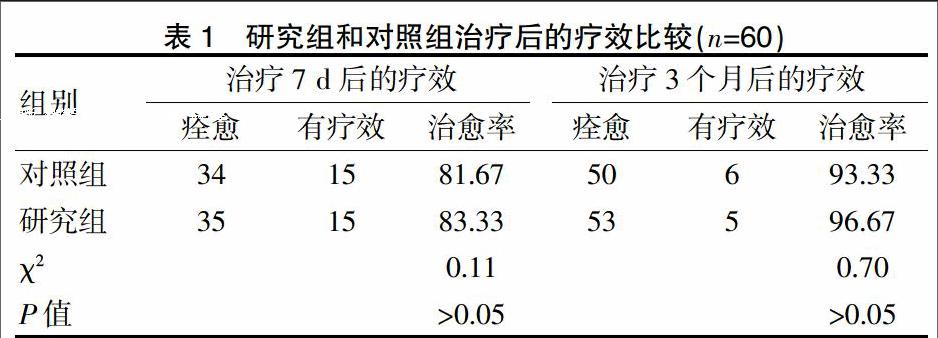
[摘要] 目的 探讨研究手法复位联合药物治疗良性阵发性位置性眩晕的临床治疗效果。 方法随机抽取 2013年1月—2014年12月该院收治120例良性阵发性位置性眩晕患者,将他们随机分成研究组和对照组,每组60例,研究组使用手法复位联合药物治疗,对照组使用手法复位治疗。使用统计学软件SPSS20.0对数据进行分析,比较两组患者治疗的疗效。结果 与对照组的治疗效果比较,研究组治愈率和总有疗效率相差不大,差异无统计学意义(P>0.05)。结论 手法复位联合药物治疗和单纯使用手法复位治疗良性阵发性位置性眩晕的疗效相差无几,特殊良性阵发性位置性眩晕患者的临床治疗应首选手法复位联合药物治疗。
[关键词] 良性阵发性位置眩晕;手法复位;药物治疗;半规管
[中图分类号] R764 [文献标识码] A [文章编号] 1674-0742(2015)04(c)-0065-02
[Abstract] Objective To investigate the therapeutic effect of manipulative reduction combined with drug therapy on benign paroxysmal positional vertigo. Methods 120 cases of benign paroxysmal positional vertigo patients from January 2013 to December 2014 were treated . They were divided into study group and control group, each group had 60 patients. The patients in study group were treated by manipulative reduction combined with drug therapy while the control group were just therapied with manipulative reduction. We used SPSS20.0 of statistical software to analyze the dates, compare the efficacy of the two different methods of treatment. Results Compared with the treatment of control group , cure rate and the total efficacy rate of study group had little difference, the differences between the two groups were not statistically significant(P>0.05). Conclusion The therapeutic effect of manipulative reduction with or without anti-vertigo drugs on benign paroxysmal positional vertigo does not differ much from each other, it should be the first choice for those special patient as a clinical treatment.
[Key words] Benign Paroxysmal Positional Vertigo; Manipulative Reduction; Drug Therapy; Semicircular canal
良性阵发性位置性眩晕是由于头部的运动或者身体姿势的改变而诱发的短暂性眩晕。目前其发病机制尚未完全阐明,较为流行的是Epley于1980年提出的半规管耳石症,认为耳石从椭圆囊中脱落后进入半规管,当头改变位置时,耳石便在半规管带动内淋巴一起移动,引起该半规管壶腹部位的毛细胞位置及放电频率的改变,最终导致良性阵发性位置性眩晕[1]。临床上治疗良性阵发性位置性眩晕的主要方法是各种耳石复位疗法[2],该研究随机选取该院2013年1月—2014年12月间良性阵发性位置性眩晕患者120例为研究对象,采用手法复位联合药物治疗的办法取得了不错的疗效,具体研究报告如下。
