丙泊酚复合不同镇痛药辅助腰硬联合麻醉用于经皮肾镜取石术的效果
2015-08-14施丽娟刘志平罗慧君朱珊珊沈逸飞徐珊
施丽娟 刘志平 罗慧君 朱珊珊 沈逸飞 徐珊
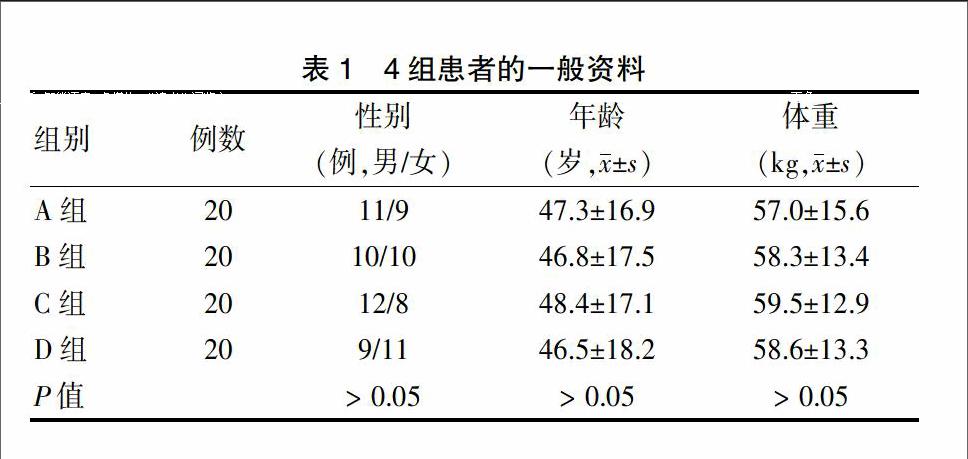
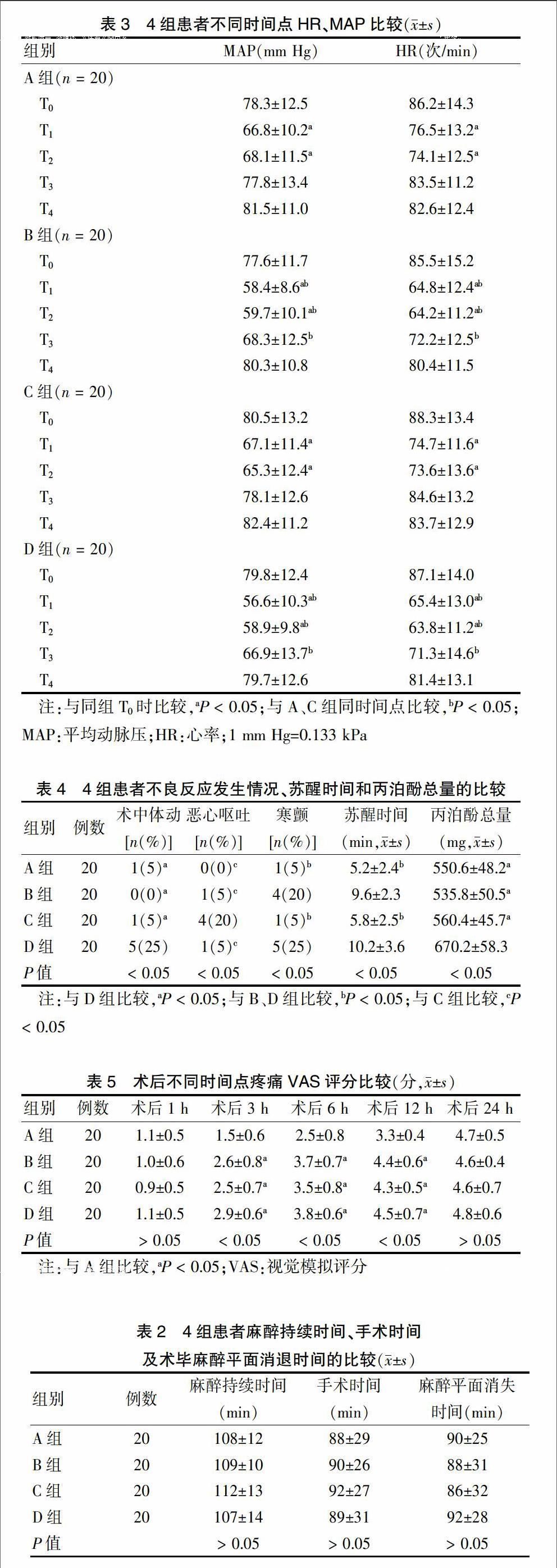
[摘要] 目的 观察丙泊酚复合不同镇痛药辅助腰硬联合麻醉用于经皮肾镜碎石术中的效果。 方法 选择2013年8月~2015年1月广州新海医院择期经皮肾镜取石术患者80例,所有手术均在腰硬联合阻滞辅助静脉麻醉下进行,根据静脉麻醉药丙泊酚复合镇痛药的不同,随机均分为4组:帕瑞昔布钠组(A组),芬太尼组(B组),曲马多组(C组)和生理盐水组(D组),每组各20例。记录4组患者静脉给药前(T0)、静脉给药后2 min(T1)、切皮时(T2)、手术开始后30 min(T3)、术毕时(T4)的心率(HR)、平均动脉压(MAP);记录4组患者术毕苏醒时间,丙泊酚的总用量,术中体动,术后恶心、呕吐、寒战、呼吸抑制等不良反应的发生率;记录麻醉持续时间、手术时间及术毕麻醉平面消退时间;记录术毕1、3、6、12、24 h的疼痛视觉模拟评分(VAS评分)。 结果 A、C组患者血流动力学较B、D组相对稳定;4组患者T1、T2时HR、MAP均较T0时有所下降(P < 0.05);B、D组在T1、T2、T3时HR、MAP明显低于A、C组(P < 0.05)。A、B、C组术中体动发生率、丙泊酚的总量明显低于D组,差异有统计学意义(P < 0.05)。与B、D组比较,A、C组术毕苏醒时间明显缩短(P < 0.05),术后寒战发生率明显降低(P < 0.05);C组术后恶心、呕吐的发生率明显高于A、B、D组(P < 0.05)。4组患者麻醉持续时间、手术时间及术毕麻醉平面消退时间比较,差异无统计学意义(P > 0.05)。A组术毕3、6、12 h的疼痛VAS评分明显低于B、C、D组,差异有统计学意义(P < 0.05)。 结论 丙泊酚复合不同镇痛药辅助腰硬联合麻醉用于经皮肾镜碎石术均安全有效,同时不影响术后麻醉阻滞平面的消退,但丙泊酚复合帕瑞昔布钠对血流动力学影响更小,麻醉更加平稳,苏醒时间短,不良反应少,术后疼痛轻,更适用于腰硬联合麻醉下经皮肾镜取石术中的辅助镇静镇痛。
[关键词] 丙泊酚;镇痛药;腰硬联合麻醉;经皮肾镜取石术
[中图分类号] R614 [文献标识码] A [文章编号] 1673-7210(2015)06(a)-0133-05
Effect of Propofol combined with different analgesics assisting comlined spinal-epidural anesthesia on percutaneous nephrolithotomy surgery
SHI Lijuan LIU Zhiping LUO Huijun ZHU Shanshan SHEN Yifei XU Shan
Department of Anesthesiology, Guangzhou Xinhai Hospital, Guangdong Province, Guangzhou 510300, China
[Abstract] Objective To observe the effection of Propofol combined with different analgesics assisting combined spinal-epidural anesthesia (CSEA) on percutaneous nephrolithotomy surgery. Methods From August 2013 to January 2015, in Guangzhou Xinhai Hospital, 80 patients scheduled for percutaneous nephrolithotomy surgery and all performed CSEA assisted intravenous anesthesia were selected, according to different analgesics combined with the intravenous anesthetic Propofol, they were divided into four groups: Parecoxib Sodium group (group A), Fentanyl group (group B), Tramadol group (group C) and normal saline group (group D), with 20 cases in each group. The HR, MAP were recorded at different time points: before intravenous induction (T0), 2 min after intravenous induction (T1), skin incision (T2),30 min after operation (T3) and at the end of the surgery (T4). Surgery recovery time, the Propofol total dose and occurrence rate of intraoperative body movement, postoperative nausea, vomiting, chills and respiratory depression were recorded; the duration of anesthesia, operation time and postoperative anesthesia plane regression time were recorded, the VAS score was recorded at 1, 3, 6, 12, 24 h after surgery. Results Compared with groups B and D, the hemodynamic of patients in groups A and C were relatively stable. At T1 and T2,the HR and the MAP in four groups were lower than those at T0 (P < 0.05); at T1, T2 and T3, HR and MAP in groups B and D were significantly lower than those in groups A and C (P < 0.05). The body intraoperative movement and the Propofol total dose in groups A, B and C were significantly lower than those in group D, the differences were statistically significant (P < 0.05). Compared with groups B and D, the surgery recovery time were significantly less than those in groups A and C (P < 0.05), and the postoperative chills occured rates were significantly less than those in groups A and C (P < 0.05); the occured rates of postoperative nausea and vomiting in group C were significantly more than those in groups A, B and D, the differences were statistically significant (P < 0.05). The anesthesia duration, operation time and postoperative anesthesia plane regression time of four groups were compared, the differences were not statistically significant (P > 0.05). After the surgery 3, 6, 12 h, VSA scores in group A were lower than those in group B, C and D, the differvences were statistically significant (P < 0.05). Conclusion It is safe effective for Propofol combined with different analgesics assisting CSEA on percutaneous nephrolithotomy surgery, and it did not affect the postoperative anesthesia plane regression, but Propofol combined with Parecoxib Sodium has less hemodynamic changes, more stable anesthesia, less recovery time, side effects and postoperative pain, it is more suitable for sedation and analgesia assisting CSEA on percutaneous nephrolithotomy surgery.
[Key words] Propofol; Analgesics; Combined spinal-epidura anesthesia; Percutaneous nephrolithotomy surgery
随着微创腔镜技术的发展,泌尿系结石从传统的开放手术治疗转向输尿管肾镜治疗,经皮肾镜取石术是治疗肾多发性结石的首选方法[1],其具有创伤小、手术时间短、术后恢复快等优点,国内多在椎管内麻醉下进行[2]。腰硬联合麻醉操作简单、起效快、麻醉效果好,但患者术中处于清醒状态,紧张、焦虑,再加上经皮肾镜取石术体位特殊患者难以耐受,因此如何更好地消除患者术中紧张、不适以及减轻术后疼痛,平稳、舒适渡过围术期需要麻醉医生进一步研究。……
