不同剂量右美托咪定对甲状腺手术全麻围拔管期的影响
2015-08-14李嵩山刘志恒黄绍农徐明禹赵昭
李嵩山 刘志恒 黄绍农 徐明禹 赵昭
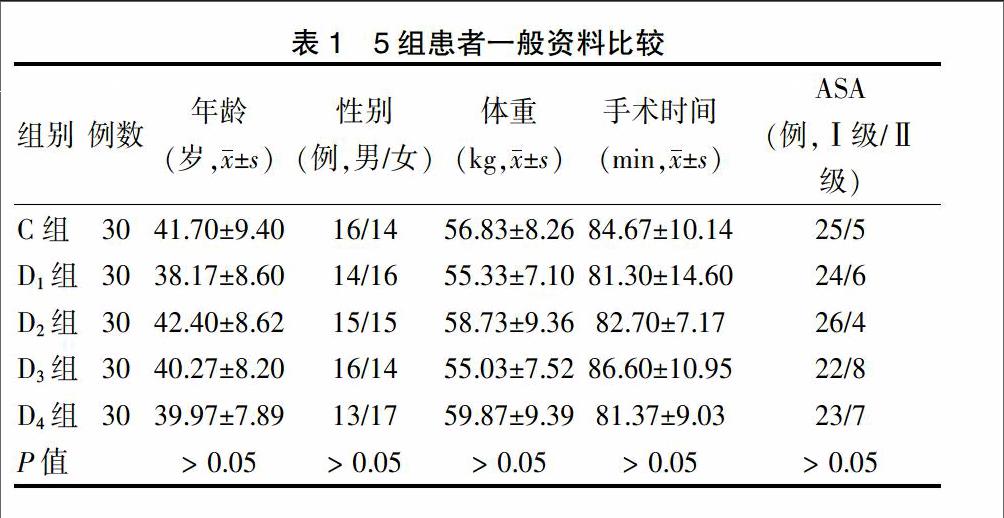
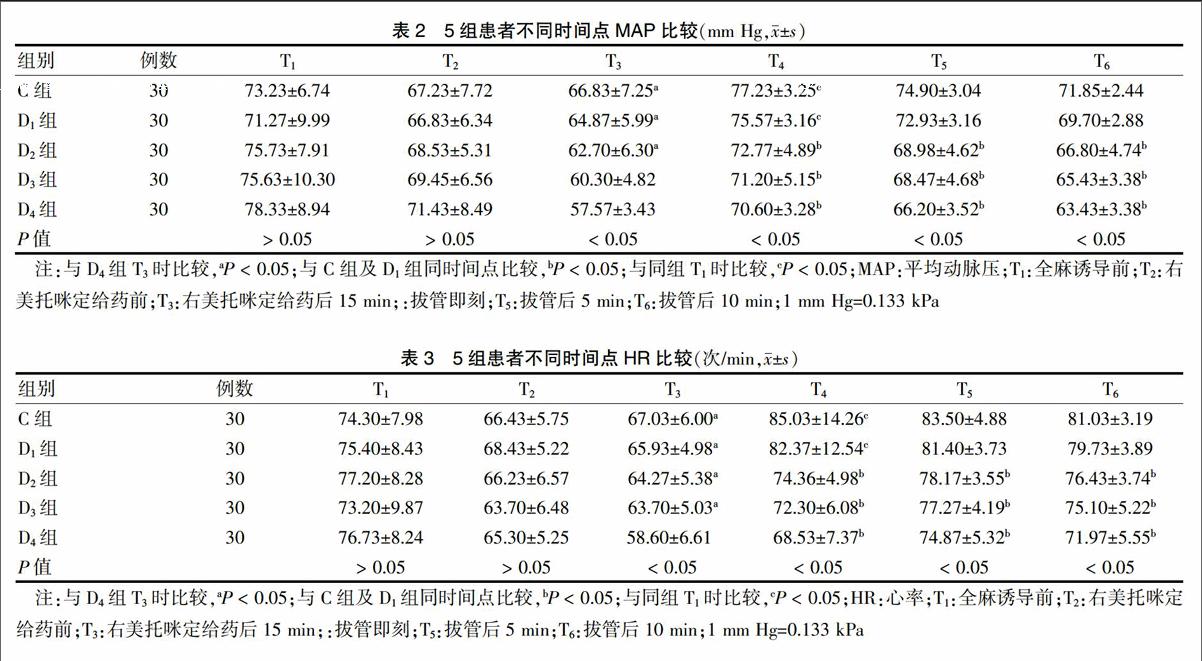

[摘要] 目的 观察不同剂量右美托咪定(DEX)对甲状腺手术全麻围拔管期的影响。 方法 选择2012年6月~2014年5月于深圳市第二人民医院接受甲状腺手术患者150例,按随机数字表法分为5组:对照组(C组),DEX1组(D1组),DEX2组(D2组),DEX3组(D3组)和DEX4组(D4组),每组各30例。在手术结束前30 min C组给予20 mL生理盐水,D1、D2、D3和D4组分别给予DEX 0.3、0.5、0.7、1.0 μg/kg,10 min输注完毕。观察并记录各组患者全麻诱导前(T1)、DEX给药前(T2)、DEX给药后15 min(T3)、拔管即刻(T4)、拔管后5 min(T5)、拔管后10 min(T6)的平均动脉压(MAP)和心率(HR);记录各组患者术毕至睁眼、自主呼吸恢复及拔管时间;拔管后10 min Ramsay镇静评分及围拔管期不良反应发生率。 结果 5组患者T1及T2时MAP及HR比较,差异无统计学意义(P > 0.05);D4组T3时MAP较C组及D1~2组降低(P < 0.05),D4组T3时HR较C组及D1~3组降低(P < 0.05);D2~4组T4~6时MAP及HR较C组及D1组降低(P < 0.05),D1组T4~6时间点MAP及HR与C组比较,差异无统计学意义(P > 0.05);C组及D1组T4时MAP及HR较T1时升高(P< 0.05)。术毕至睁眼、自主呼吸恢复及拔管时D4组较C组及D1~3组明显延长(P < 0.05),D1~2组与C组比较差异无统计学意义(P > 0.05),D3组与D1~2组与C组比较差异有统计学意义(P < 0.05),但无临床意义;Ramsay评分为5~6分的患者D4组较C组及D1~3组增多(P < 0.05),C组Ramsay评分为1分的患者较D2~3组增多(P < 0.05)。D2~4组围拔管期呛咳发生率低于C组和D1组(P < 0.05),D2~4组间比较差异无统计学意义(P > 0.05),C组和D1组比较差异无统计学意义(P > 0.05);围拔管期心血管不良反应心动过缓或低血压发生率D4组较C组和D1~3组增多(P < 0.05),C组围拔管期心动过速或高血压发生率较D2~4组增多(P < 0.05)。 结论 甲状腺全麻手术患者术毕前30 min给予DEX 0.5、0.7 μg/kg可使围拔管期血流动力学更加平稳,且不影响患者苏醒,不良反应发生较少。
[关键词] 右美托咪定;围拔管期;甲状腺切除术
[中图分类号] R614 [文献标识码] A [文章编号] 1673-7210(2015)06(a)-0128-05
Effects of different doses of Dexmedetomidine on general amesthesia thyroidectomy during tracheal extubation period
LI Songshan LIU Zhiheng HUANG Shaonong XU Mingyu ZHAO Zhao
Department of Anesthesiology, the Second People's Hospital of Shenzhen City, Guangdong Province, Shenzhen 518039, China
[Abstract] Objective To investigate the effects of different doses of Dexmedetomidine on general anesthesia thyroidectomy during tracheal extubation period. Methods From June 2012 to May 2014, in the Second People's Hospital of Shenxhen City, 150 patients undergoing thyroidectomy were randomly divided into 5 groups, with 30 cases in each group: control group (group C) and different doses of Dexmedetomidine groups (group D1-4). Normal saline (20 mL) and Dexmedetomidine 0.3, 0.5, 0.7, 1.0 μg/kg were infused over 10 min in groups C and D1-4 at 30 min before the end of the operation. The heart rate (HR), mean arterial pressure (MAP) were recorded at the time of before induction of anesthesia (T1), before Dexmedetomidine infused (T2), 15 min after Dexmedetomidine infused (T3), the time of tracheal extubation (T4), 5 min after tracheal extubation( T5), 10 min after tracheal extubation (T6). Time of eyes opened, breathing recovery and extubation after surgery were recorded; Ramsay sedative score at the time of 10 min after surgery and adverse reactions during extubation period were also recorded. Results There were no significant differences of MAP and HR at T1 and T2 among five groups (P > 0.05); MAP in group D4 decreased at T3 compared with group C and group D1-2 (P < 0.05). HR in group D4 decreased at T3 compared with group C and group D1-3 (P < 0.05); MAP and HR in group D2-4 decreased at T4-6 compared with group C and D1 (P < 0.05); there were no significant differences of MAP and HR at T4-6 between group D1 and group C (P > 0.05); MAP and HR at T4 were higher than those at T1 in group C and group D1 (P < 0.05). The time of eyes opened, breathing recovery and extubation after surgery in group D4 were increased than those in group C and group D1-3 (P < 0.05), no significant difference between group D1-2 and group C (P > 0.05), the differences between group D3 and group C and group D1-2 were statistical significance (P < 0.05), but those were not clinical significance; patients whose Ramsay sedative score was 5-6 in group D4 were more than those in group C and group D1-3 (P < 0.05), patients whose Ramsay sedative score was 1 in group C were more than those in group D2-3 (P < 0.05). The incidence rate of bucking in group C and group D1 was significantly higher than those in group D2-4 (P < 0.05), there was no significant difference between group D1 and group C (P > 0.05), and there were no significant differences between group D2-4 (P > 0.05); the incidence rate of bradycardia or hypotension were higher in group D4 than those in group D1-3 and group C (P < 0.05), the incidence rate of tachycardia or hypertension were higher those in group C and group D2-4 (P < 0.05). Conclusion 0.5 or 0.7 μg/kg Dexmedetomidine intravenously infused before the end of the operation can make haemodynamics of patients undergoing thyroidectomy during tracheal extubation period stable, and reduce the occurrence of adverse effect.
[Key words] Dexmedetomidine; Tracheal extubation; Thyroidectomy
甲状腺手术全麻围拔管期间,由于各种刺激引起患者交感神经兴奋导致血流动力学剧烈波动和呛咳,可能造成切口内出血压迫气管,发生严重的并发症。因此为保证患者安全,维持甲状腺手术患者全麻围拔管期平稳尤为重要,既往通常在拔管前给予芬太尼或舒芬太尼等阿片类药物,但有发生术后呼吸抑制的可能性[1-2]。右美托咪定(DEX)是高选择性α2肾上腺素受体激动剂,可有效抑制全麻气管插管期间心血管反应,维持血流动力学平稳[3],但不同剂量对甲状腺手术全麻围拔管期有何影响,目前研究较少。本研究拟……
