青梅腌制过程中的风味物质变化
2015-05-30林耀盛刘学铭李升锋池建伟陈智毅杨春英唐秋实
林耀盛 刘学铭 李升锋 池建伟 陈智毅 杨春英 唐秋实
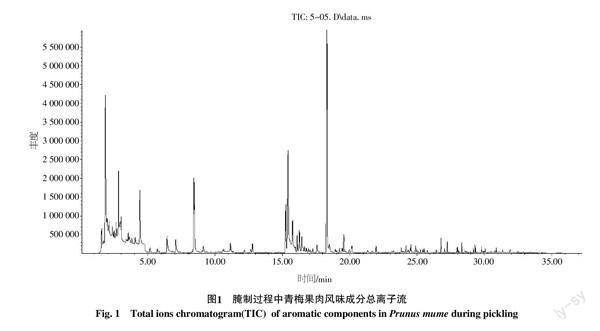
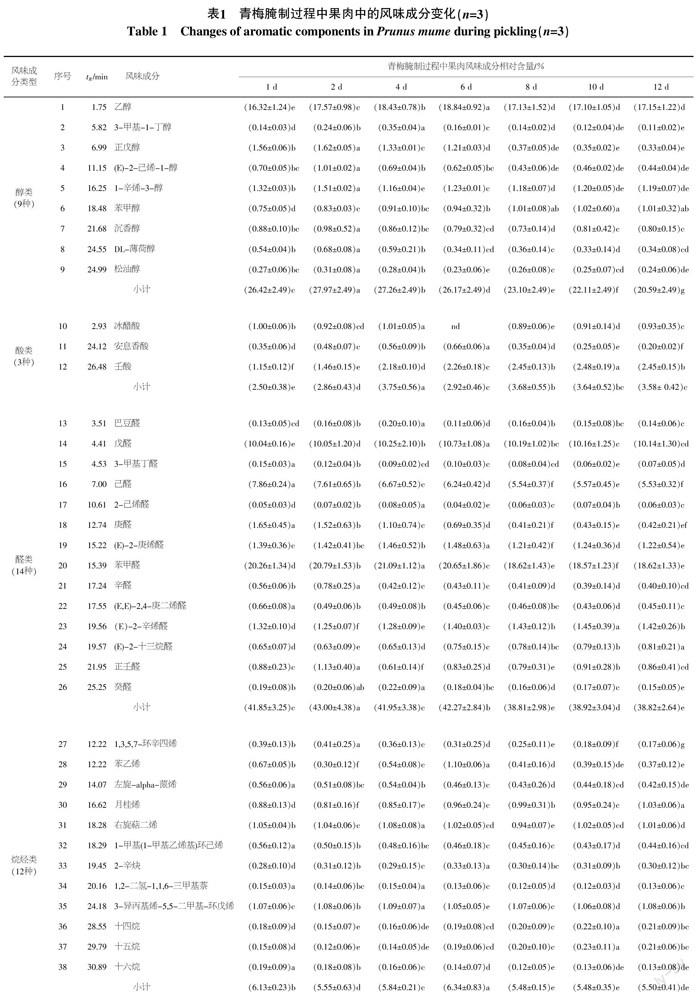
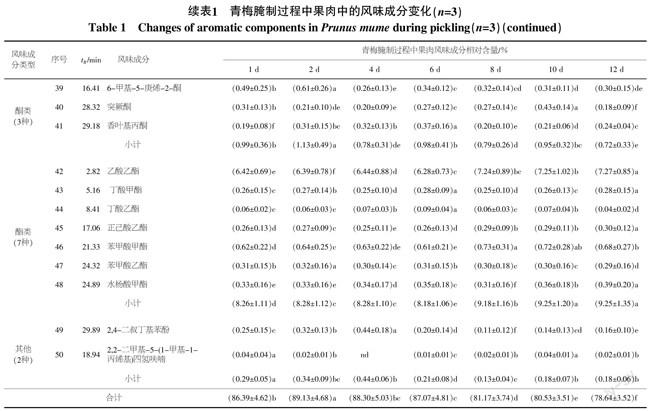
摘 要 以腌制青梅果肉为样品,采用顶空固相微萃取-气相色谱-质谱联用技术(HS-SPME-GC-MS)对青梅腌制过程中的风味成分分析鉴定,并进行统计分析。结果表明:其中,醛类物质14种、醇类9种、酯类7种、酸类3种、酮类3种、烷烃类12种和其他杂环类2种(占总挥发性的84.52%),共检测出50种挥发性成分。在腌制过程中,醛类和烷烃类与腌制时间显著负相关(p<0.01),醇类风味物质含量与腌制时间呈弱负相关(p<0.05),酯类物质含量与腌制时间显著正相关(p<0.01)。典型风味成分苯甲醛含量高达19.80%,腌制第2天,果肉中风味成分含量高且丰富,当腌制第8天时,风味成分变化趋于稳定。
关键词 青梅;腌渍;风味成分;气相色谱-质谱联用
中图分类号 TS255.43 文献标识码 A
Changes of Volatile Flavor Compounds of
Prunus mume During Pickling
LIN Yaosheng1,2,3, LIU Xueming1,2,3 *, LI Shengfeng1,2,3, CHI Jianwei1,2,3,
CHEN Zhiyi1,2,3, YANG Chunying1,2,3, TANG Qiushi1,2,3
1 Sericulture & Agri-Food Research Institute of Guangdong Academy of Agricultural Sciences, Guangzhou, Guangdong 510610, China
2 Key Laboratory of Functional Foods, Ministry of Agriculture, Guangzhou, Guangdong 510610, China
3 Guangdong Key Laboratory of Agricultural Products Processing, Guangzhou, Guangdong 510610, China
Abstract Changes of aromatic components in Prunus mume were determined by analyzing the flavor substance contents using headspace solid phase microextraction gas chromatography-mass spectrometry(HS-SPME/GC-MS). The results showed that a total of 50 volatile components were identified from the SPME of P. mume during pickling, including 14 aldehyde, 9 alcohols, 7 ester, 3 acids, 9 ketones, and 12 hydrocarbons and 2 heterocycles(accounting for 84.52% of the total volatile). In the process of curing, the relative contents of aldehyde and alkane flavor substances were significantly negatively correlated with curing time(p<0.01). Alcohol flavor substance content showed weakly negative correlation with curing time(p<0.05). The relative contents of ester flavor substances were significantly positively correlated with curing time(p<0.01). Benzene formaldehyde was the typical aroma component, the content with most abundant flavor species was as high as 19.80% in the second day, and the content tended to be stable in the eighth day.
Key words Prunus mume; Pickling; Aroma components; GC-MS
doi 10.3969/j.issn.1000-2561.2015.08.028
青梅(Prunus mume)又称为酸梅、果梅,为蔷薇科杏属乔木的果实,是我国传统的药食两用果品[1]。多数水果以甜取胜,唯独青梅以酸著称,不宜直接鲜食,多用于加工。在我国的传统医药中,青梅多用于加工成乌梅,作为收涩药使用,具有敛肺、涩肠、生津、安蛔等功效,用于肺虚久咳、久痢滑肠、虚热消渴、蛔厥呕吐腹痛(胆道蛔虫症)等病症。现代研究结果表明,青梅及其加工制品乌梅具有抗氧化[2],降血脂、降血糖[3],减肥[4],抑菌[5],抗病毒、抗炎[6],抗肿瘤、缓解精神压力[7]等功能,在功能食品加工中有重要应用。
由于青梅鲜果不能直接食用,而作为中药材使用需要量有限,尽管近几年青梅加工产品日渐多元化,开发出青梅果汁、发酵青梅酒、青梅酱等产品,但传统的腌制仍然是青梅最重要的原料保存和加工方式。青梅的腌制加工是将新鲜青梅与固体食盐分层堆积于腌制池,利用食盐的高渗作用对青梅进行加工的方法,通常腌制时间4~12个月。……
