Traditional Toy Design: A South African Perspective
2012-06-08KeneilweMunyaiMugendiRithaaCapePeninsulaUniversityofTechnology季立萍
文 /Keneilwe Munyai Mugendi K. M’Rithaa(Cape Peninsula University of Technology) 译 / 贾 佳 季立萍
Introduction
The origin of toys dates back to prehistoric times and they are believed to have been first used in the 14th century (Muhammad,2008). Toys in South Africa play the role of connecting the child’s ability to psychologically take advantage of new opportunities, to create,to imagine, discovering to identify, to develop skills, to explore relationships, and most importantly to learn and stimulate creativity.In the South African context toys are aligned to the socio-cultural and material conditions as well as to the fact that they are cheap to produce and use sustainable techniques.
The majority of children in South Africa have used natural found objects like sand, water,sticks, clay, straws, seeds, bottle tops, wire,and tins, to construct traditional dolls, model houses, cars, and animals, often without guidance from parents or teachers. The creation of toys is usually a spontaneous process which takes place at an individual level or amongst peers. Some toys appeal to boys and girls alike; like musical instruments, and board games, ball games, jumping games. There is also gender specif i c toys, girls often play with toys that imitate family life, looking after smaller children, cooking and all the other activities that they see being done at home.Boys are interested in physical activities linked to handiness technology, speed and movement(Massal, 2001).
While the self made toys and traditional dolls have slowly started receding in visibility and prominence, other toys such as wire cars, dolls,and recycled tin toys still exist in the rural communities and townships. The children choose their own materials suitable for the types of toys they want to make. In this article we discuss the process of traditional toy making, material manipulation, and availability of resources, sustainability of the product and materials as well as the role of local knowledge.The knowledge held by people in a particular geographical area enables them to get the most out of their natural environment (Mascarenhas,2005:5). The knowledge and skills is then passed down from earlier generations, but new generations adapt and build on to the body of knowledge in constant changing circumstances and environmental conditions.
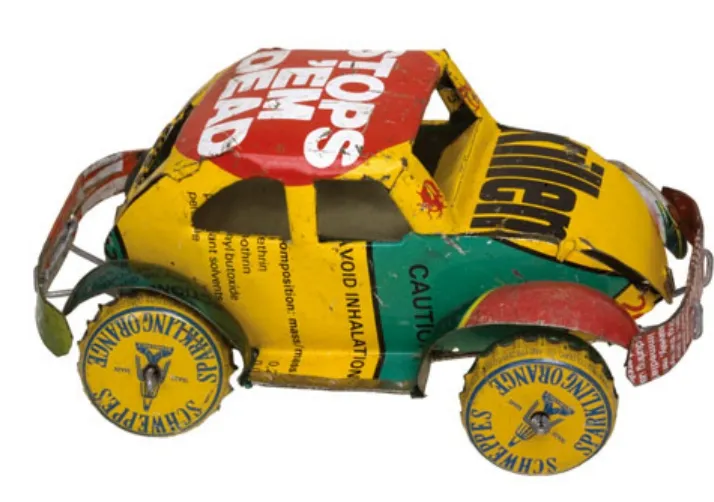
图1 南非本土玩具
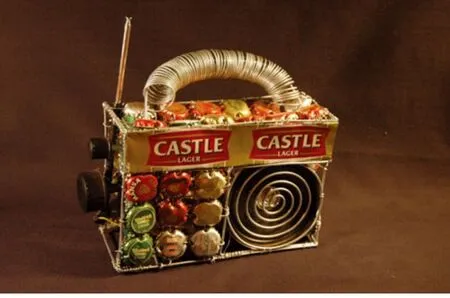
图2 南非本土玩具
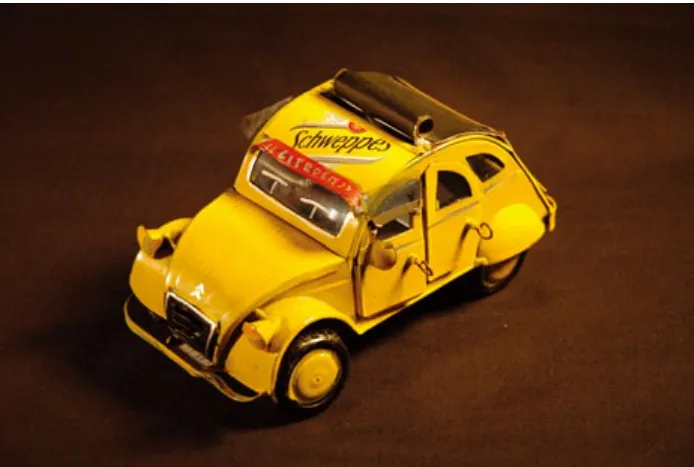
图3 南非本土玩具
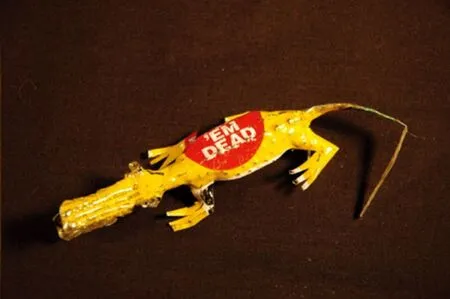
图4 南非本土玩具
South African Indigenous toys
According to Nkobodi and Mosimege(2009:381) “indigenous games and indigenous knowledge systems (IKS) deal with knowledge of local origin which is known largely by specif i c cultural groups”. IKS encourage making of toys that ref l ect African and South African everyday life and culture using what is locally available.The development of children involves physical and cognitive development which includes creativity, discovery, language skills, symbolic thought, problem solving skills, and the ability to focus and control which are all inf l uenced by the playing and creating experiences (Therrell,2002). One of the problem-solving skills is that of crafting solution to economic challenges,where parents do not have money to buy imported toys children and parents to a certain extent use available resources to create familiar objects such as f i gurines which are moulded out of clay, wire cars, fabric dolls that meet the children’s gaming needs (Smith & Cotze, 2010).The next section will focus on the games and play things created to meet the needs of the children varying from very simple to relatively complicated.
Marabaraba is one of the oldest games played in across Africa. It is a thinking game where two player strategise. The tools needed to play the game are simple enough that a board can easily be scratched on stone, sand or wood and coins,pebbles or bottle tops can be used as pieces .Each player has twelve stones, the aim is for one person to try and get three stones in a row the opponent role is to try and prevent this from happening (Syman & Van Niekerk, 1996: 44).
Manipulation of materials
IKS production process is based on the use of locally available resources, the use of the found object and the ability to manipulate materials to come up with safe playing objects. Recycled drink cans are cut up and meticulously assembled, wire models of cars that show creativity and replicas of the original cars,while some are evocative creations based on fantasy (Massal, 2001:2). The traditional process considers the ergonomics to make the toys more comfortable for use stones are used for bending.The construction process includes paying attention to the movement and functionality of the toy. The toys are made of natural found objects because, that is a process that is also applicable to other aspects of life within the IKS context. Scrap metal, rod for handles, connected via discarded telephone wire or cod to create the form of the object, bottle tops and wire are also used for wheels all show the ability create movement.
The designs of the toys vary from basic and the through practice, they become more sophisticated. African toys mainly promote culture, collective use, and sense of community and local knowledge. Traditional toys are simple and provide opportunities for openended play which requires the children to use their imagination, create their own storyline and rules for the game. The toys and games that children invent promote spontaneous interaction amongst the children and reflect South African life and culture as seen through the eyes of the child. Community lifestyles and the ethnic composition of the population inf l uence the creativity and ultimately the kind of toys that are produced.
A sense of ownership and sharing of toys in African culture is linked to sustainability and inclusiveness. Traditional toys are safe, effi cient,and pleasurable to the user. The child creates a toy that is congenial and harmless to engage in recreation with and share with others. The relationship Creating own toys helps with emotional development and helps shape their play and is linked to feelings of happiness,feeling of power over their environment,emotional awareness, sensitivity to others,emotional strength and stability, spontaneity,humour, it also encourages social learning during the play interactions. between the toy and the child assumes an operational and social context (Donlon, 1999).
The materials are transformed into more decorative and dynamic parts of the toy.Attention is given to form, movement and functionality of the toy. The children collaborate or compete in the construction of toys. The children adapt the toys they have created to meet their needs by creating toys that are suitable for their body size, the environmental suitability. While cognitive ergonomics covers the children’s mental processes, reasoning they create toys that are aligned to the socio-cultural and material conditions (see Figures 5, 6 & 7).
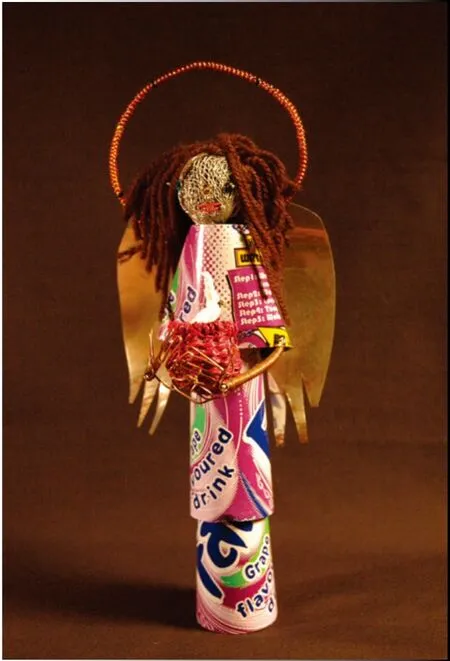
图5 南非本土玩具
Culture separates us from or unites us with other people. In this article, I have already argued that a design is proof of a way of life;culture therefore, in our design separates them from us. Design is the process of writing culture and is used as a means to write culture and African design refers to specific culturedesign interactions including the once that take place outside of Africa (Pido, 2001). However,there are some toys which are made by adults to support children’s imaginative, social as well as cognitive development these include stuf f ed toy, homemade dolls and other toys which are generally made from waste materials .
The designing of toys by adults particularly for children under the age of 5years old is done to address the well-being of the child (Therrell,2002). Design of toys intertwines with culture and identity in simple yet complicated ways.Since designers are constantly trying to and often do create new concepts and designs, they are responsible for changes in culture (Pido,2001). The dolls are usually made out of old recycled textiles, and usually resemble familiar dressing styles in the community. The cloth dolls are made for girls from the age of 2 years old.
There is cognitive and af f ective advantages to creating toys that are relevant to the children’s culture. Children learn by doing, and learn to be problem solvers (Vithal, 1992). However,since culture is not static toy design has also evolved to be industrially manufactured using traditional materials.
IKS as an inclusive knowledge that covers technologies and practices that have been and are still used by indigenous and local people for survival and adaptation in a variety of environments. The knowledge is not static but evolves and changes as it develops. It also influences and is also influenced by external circumstances and interaction with other knowledge systems (Mosimege & Onwu, 2004:2).
South African toy design still has reference to old techniques. The process to a certain extent still employs the traditional methods, made by hand, utilises recycled and found object,which makes the process sustainable and environmentally friendly.
In conclusion there is no doubt that the creative use of IKS with respect to available materials,assembling techniques and the functionality of designs has inf l uence many contemporary designers. Contemporary design is dependent on traditional knowledge. There is a link between sustainable design and IKS. However,it must also be acknowledged that due to the impact of globalisation in general, and the ubiquitous cheap imports in particular there is a real threat that home grown and self-made toys may become obsolete in the near future.
There is an urgent need for socially conscious designers in collaboration with artisans and custodians of indigenous knowledge to join hands in re-interpreting toys that are rich in socio-cultural and ecological value. Subsequent re-interpretation will breathe a new lease of life into an important and deeply enriching aspect of African lives and livelihoods.To this end, this paper highlights the signif i cant contribution of indigenous traditional knowledge to modern discourse on design, and the need to preserve the priceless heritage that authentic indigenous toys engender.
Donlon, J. (1999). Tradition and change in the wire toys of Southern Africa. Studies in popular culture. 22 (1).(np).Retrived from http://pcasacas.org/SiPC/22.1/donlon.htm
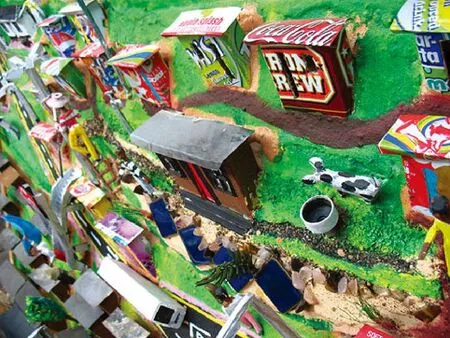
图6 南非本土玩具
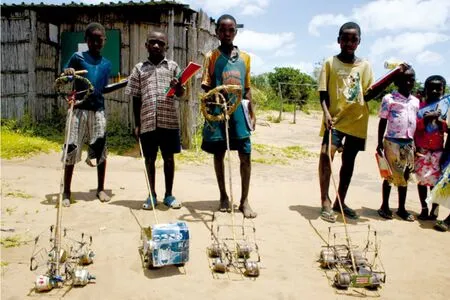
图7 南非孩童的自制玩具
Mascharenhas, A. (2004). Knowledge, Indigenous Knowledge, peace and development. Indilinga: African Journal of indigenous Knowledge Systems, 3: 1-15.
Mosimege MD & Onwu G (2004). Indigenous Knowledge Systems and Science Education.Journal of the Southern African Association for Research in Mathematics, Science and Technology Education, 8:1-12.
Muhammad, B.Y., 2008. Opinion: The need for culturally, socially adaptable toy for Africa. [accesed 26 March , 2012]http://www.tripolipost.com/articledetail.asp?c=5&i=1925
Nkopodi, N, & Mosimege, M. (2009). Incorporating the indigenous game of Marabara in the learning of mathematics. South African journal of education. Vol 29.No.3. Pretoria.ISSN 0256-0100
Pido, J.P.O., (2001, November). Design and the African cultural identity. Design for development conference.8 November 2001. Paper presented at the design for development conference. International Convention Centre in Durban. Retrieved from https://www.sabs.co.za/index.php?page=daci
Therrel, J.A. 2002. Age determination guidelines:Relating children’s age to toy characteristics and play behaviour. Washington D.C. US consumer product safety commission.
Retrieved from www.cpsc.gov/businfo/adg.pdf
Vithal, R. 1992. Use games in teaching mathematics.(Eds)in : Moodely, M. Njisane, R.A. & Presmeg, N.C.Mathematics education for in-service and pre-service teachers. Pietermaritzburg: Shuter & Shooter.
Massal, M. (2001). Children’s toys from Africa. Paris.EDISUD/UNESCO publications
引言
玩具的起源可以追溯到史前时代,但是直到14世纪人们才开始使用玩具(穆罕默德,2008)。在南非,玩具在孩子们的成长过程中发挥了重要作用,它鼓励孩子们去抓住新的机遇,去创造,去想象,去发现与识别,去提升技能,去探索关系,更为重要的是,鼓励他们去学习以及激发其创造力。在南非,玩具产业与社会文化和物质条件息息相关。与此同时,玩具生产成本低廉并且采用可持续性的生产技术。
通常在没有家长或老师的指导下,大多数南非儿童会利用像沙子、水、树枝、粘土、秸秆、种子、瓶盖、电线和易拉罐这样很容易找到的东西来制作传统玩具娃娃、房屋模型、汽车和动物。玩具的创造通常是个人或与同伴之间一个自发的过程。一些玩具,比如乐器、棋盘游戏、球类、跳跃游戏等,对男孩和女孩有着同样的吸引力。也有一些专门针对不同性别儿童而设计的玩具。女孩子们常常会玩模拟家庭生活、照顾小孩、做饭以及其他可以在家玩耍的游戏。男孩子们则对和技术、速度和运动相关的体育活动感兴趣(Massal,2001)。
虽然自制玩具和传统娃娃已经开始在市场上逐渐被淘汰,变得不再像以前那么重要,但是另外一些玩具,如玩偶,回收铁皮玩具等,仍然存在于农村社区和乡镇。对于自制玩具的材质,孩子们可以自行选择。……