盆底肌综合康复技术对盆底肌功能的影响
2024-05-21李兆香
李兆香
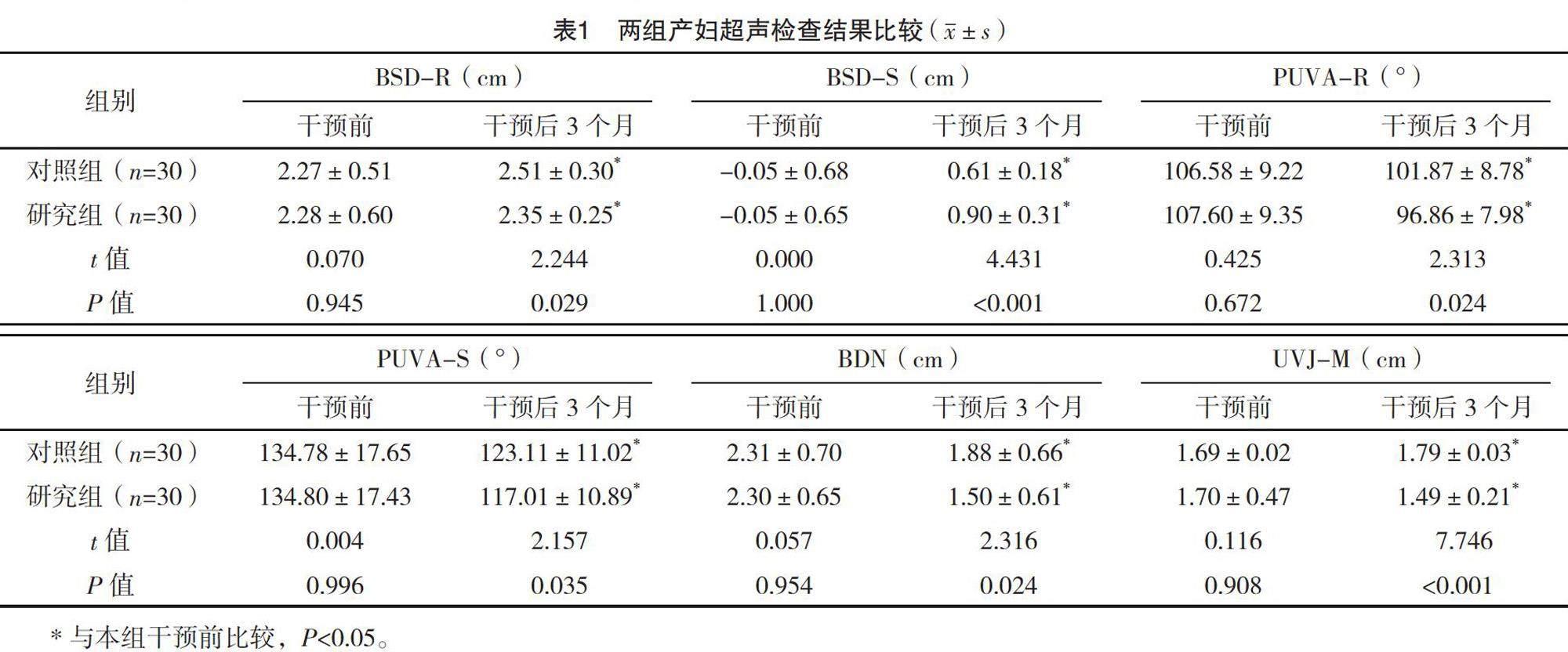
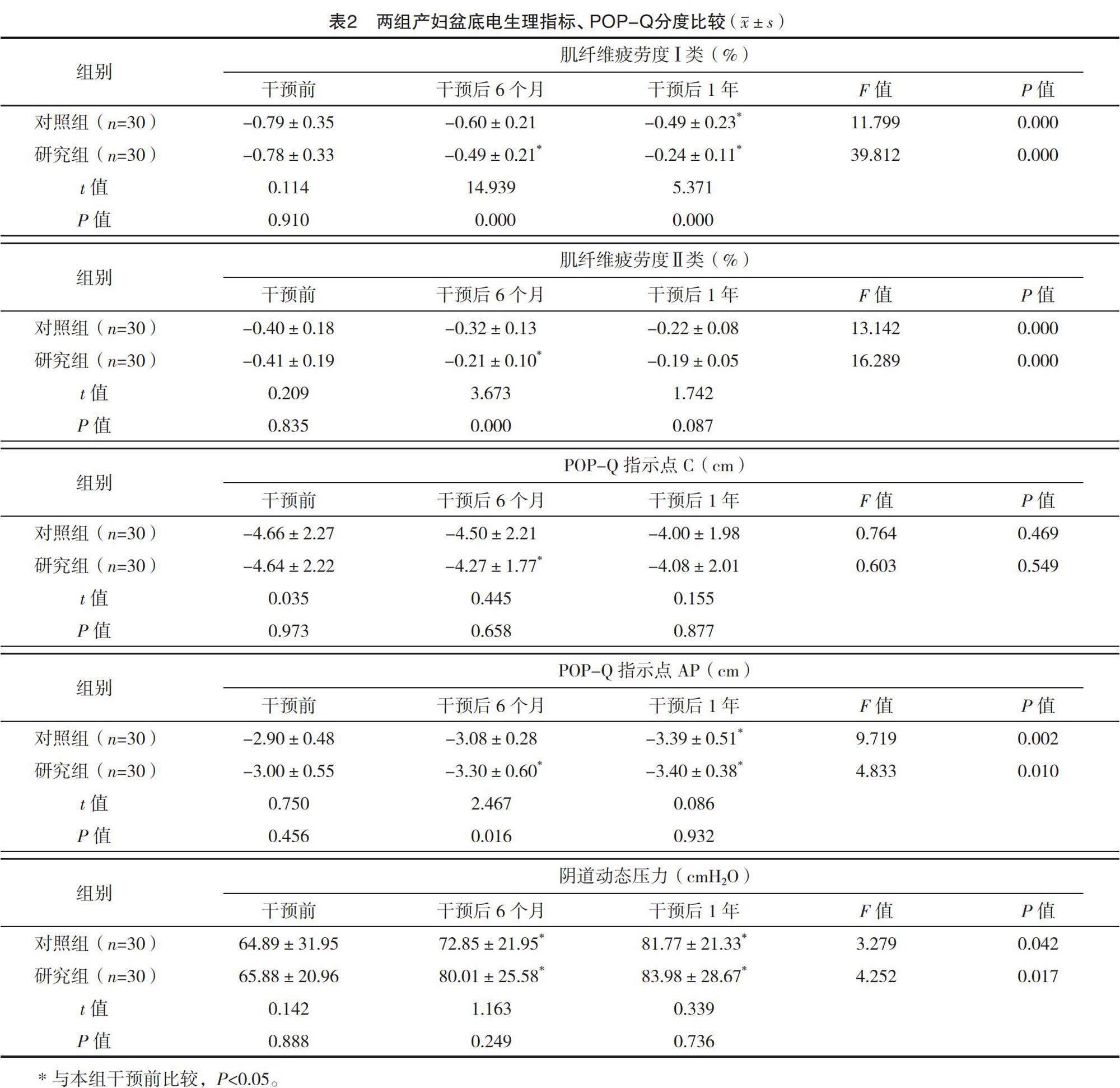
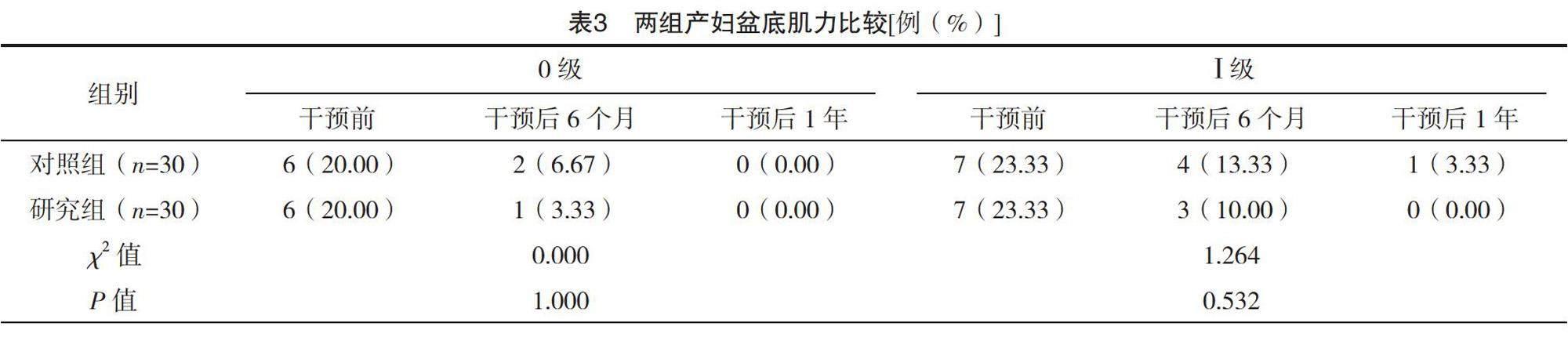
【摘要】 目的:探討盆底肌综合康复技术对盆底肌功能的影响。方法:按随机数字表法将2018年10月—2021年10月于赣州市南康区妇幼保健院分娩且产后42 d经复查确诊为盆底功能障碍性疾病的60例产妇分为对照组(30例)和研究组(30例)。对照组给予常规康复指导,研究组给予盆底肌综合康复技术,两组干预周期均为3个月。对比两组超声检查结果、盆底电生理指标、盆腔脏器脱垂(POP)-Q分度、阴道动态压力、盆底肌力、盆底肌功能障碍情况。结果:干预后3个月,研究组静息状态下膀胱颈至耻骨联合下缘的垂直间距(BSD-R)、压力状态下膀胱尿道后角(PUVA-S)、静息状态下膀胱尿道后角(PUVA-R)、膀胱颈下降值(BND)、尿道膀胱连接部移动距离(UVJ-M)均比对照组低,而压力状态下膀胱颈至耻骨联合下缘的垂直间距(BSD-S)则比对照组高(P<0.05)。干预后6个月研究组Ⅰ、Ⅱ类肌纤维疲劳度、POP-Q分度AP指示点比对照组更优(P<0.05);干预后6个月、1年,两组Ⅴ级盆底肌力占比均逐渐上升(P<0.05);干预前、干预后6个月、1年组间盆底肌力0级、Ⅰ级、Ⅱ级、Ⅲ级、Ⅳ级、Ⅴ级分级对比,差异均无统计学意义(P>0.05)。干预后3个月,研究组子宫垂落、阴道壁膨胀、尿失禁总发生率比对照组低,差异有统计学意义(P<0.05)。结论:对盆底功能障碍性疾病产妇进行盆底肌综合康复技术干预可有效缓解盆腔肌纤维疲劳度,提高盆底肌力,有助于产妇产后盆底功能的早日恢复,且具有较高的安全性。
【关键词】 盆底肌 综合康复技术 盆底肌功能
The Effect of Comprehensive Rehabilitation Techniques for Pelvic Floor Muscles on Pelvic Floor Muscle Function/LI Zhaoxiang. //Medical Innovation of China, 2024, 21(07): -114
[Abstract] Objective: To explore the impact of comprehensive rehabilitation techniques for pelvic floor muscle on pelvic floor muscle function. Method: According to the method of random number table, 60 parturients who gave birth in Nankang District Maternal and Child Health Hospital of Ganzhou from October 2018 to October 2021 and were diagnosed with pelvic floor dysfunction by reexamination 42 days after delivery were divided into control group (30 cases) and study group (30 cases). The control group was given routine rehabilitation guidance, and the study group was given comprehensive rehabilitation technology for pelvic floor muscle, the intervention period of both groups was 3 months. The results of ultrasound examination, pelvic floor electrophysiological indexes, pelvic organ prolapse (POP) -Q indexing, vaginal dynamic pressure, pelvic floor muscle strength, and pelvic floor muscle dysfunction were compared between the two groups. Result: After
3 months of intervention, bladder neck-symphyseal distance at resting state (BSD-R), posterior urethrovesical angle at stress state (PUVA-S), posterior urethrovesical angle at resting state (PUVA-R), bladder neck decline value (BND) and moving distance of urethrovesical junction (UVJ-M) in the study group were lower than those in the control group. the bladder neck-symphyseal distance at stress state (BSD-S) was higher than that in control group (P<0.05). The Ⅰ and Ⅱ muscle fiber fatigue, POP-Q index AP point after 6 months of intervention of the study group were better than those of the control group (P<0.05). After 6 months and 1 year of intervention, the proportion of grade Ⅴ pelvic floor muscle strength in the two groups were increased gradually (P<0.05); there were no significant differences in grade 0, grade Ⅰ, grade Ⅱ, grade Ⅲ, grade Ⅳ and grade V before and 6 months and 1 year after intervention (P>0.05). After 3 months of intervention, the total incidence of uterine prolapse, vaginal wall swelling and urinary incontinence in the study group was lower than that in the control group, the difference was statistically significant (P<0.05). Conclusion: Pelvic floor muscle comprehensive rehabilitation technique for parturients with pelvic floor dysfunction can effectively relieve pelvic muscle fiber fatigue, improve pelvic floor muscle strength, and contribute to early recovery of postpartum pelvic floor function, with higher safety.
[Key words] Pelvic floor muscle Comprehensive rehabilitation technology Pelvic floor muscle function
First-author's address: Maternity and Maternity Health Department, Nankang District Maternal and Child Health Hospital of Ganzhou, Ganzhou 341400, China
doi:10.3969/j.issn.1674-4985.2024.07.026
作为临床较为多见的一种疾病,盆底功能障碍多是由盆底结构受损、缺陷等引发,其临床表現有盆腔脏器脱垂、尿失禁等,对产妇的生活质量造成了严重的影响。有报道指出,顺产产妇在产后早期盆底功能障碍性疾病的发生率较高[1],且多数学者认为,产妇在产后进行早期康复训练可有效预防盆底功能障碍性疾病的发生[2-3]。因此,采取相应的康复措施对产妇进行干预具有至关重要的意义。常规康复指导应用于盆底功能障碍产妇的干预中由于缺乏针对性,其治疗效果并不理想[4]。……