正念减压疗法联合认知行为干预在行TACE治疗老年肝癌患者中的应用效果
2024-05-21叶妙桂
叶妙桂
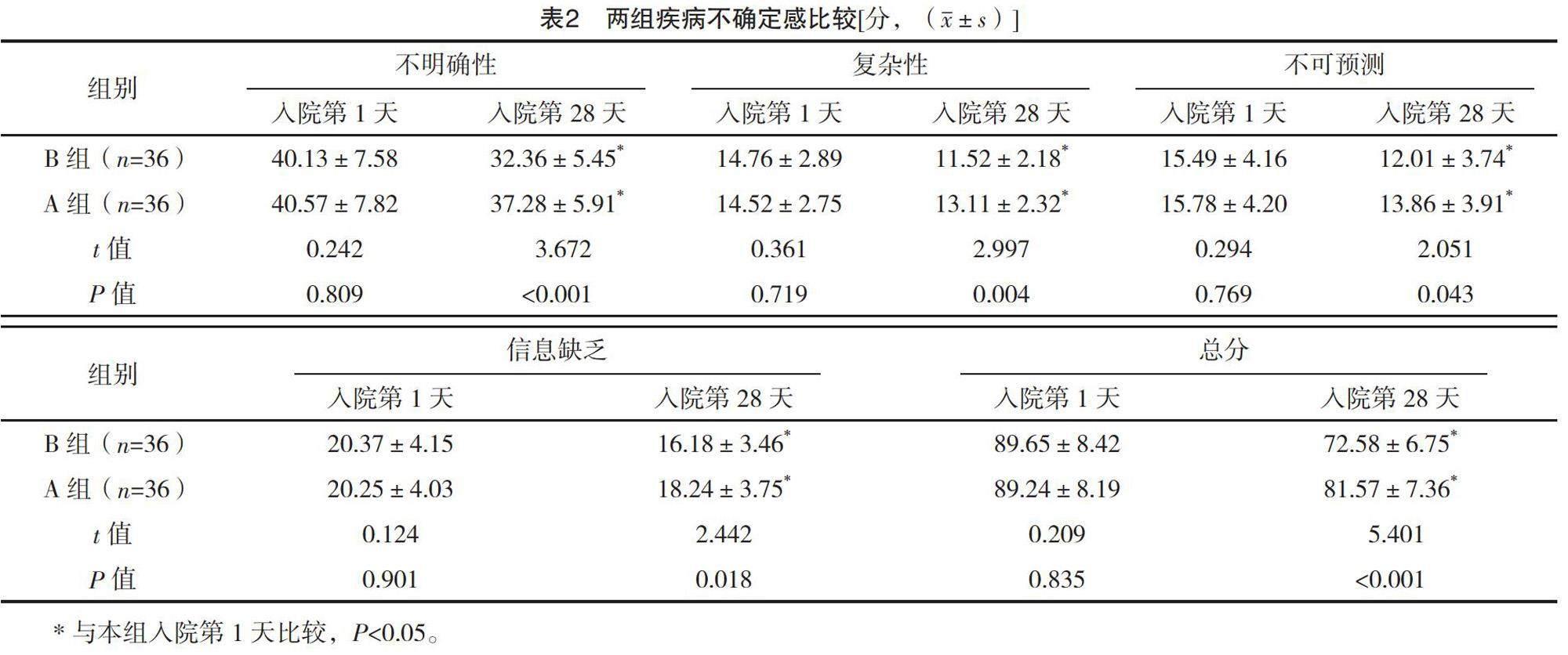
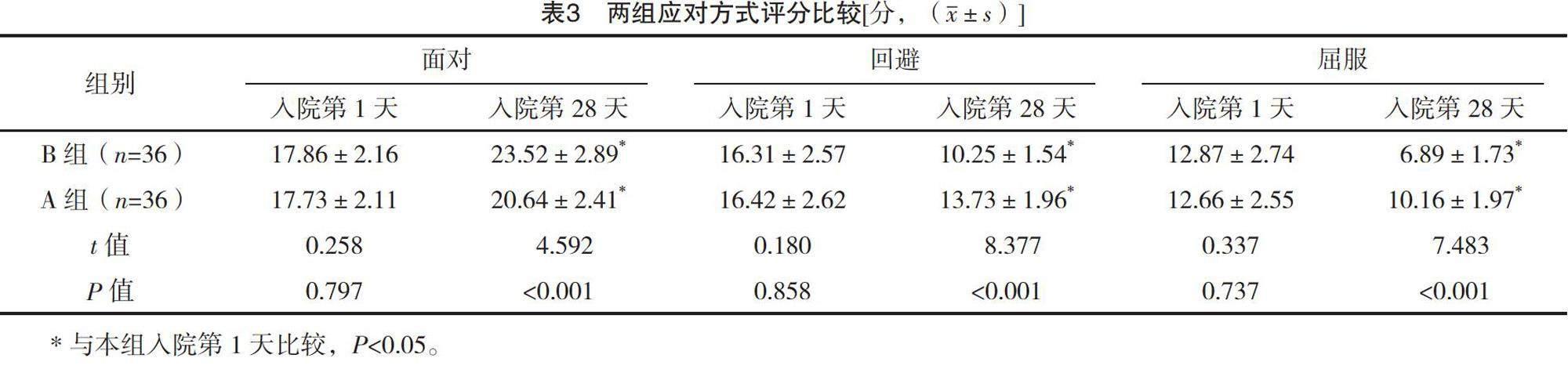
【摘要】 目的:探討对行经导管动脉化疗栓塞术(TACE)治疗老年肝癌患者实施正念减压疗法联合认知行为干预的应用效果。方法:选取2022年1月—2023年1月在厦门市第五医院介入治疗科介入导管室行TACE的老年肝癌患者72例,随机信封法分为A组,B组,各36例,A组给予常规护理,B组在A组基础上实施正念减压联合认知行为干预。比较两组疾病不确定感、应对方式(面对、回避、屈服评分)、护理总满意度。结果:入院第28天,两组疾病不确定感各维度评分及总分均低于入院第1天,且与A组疾病不确定感各维度评分及总分比较,B组均偏低(P<0.05)。入院第28天,B组面对评分高于A组,回避、屈服评分均低于A组(P<0.05)。入院第28天,B组护理总满意度高于A组(P<0.05)。结论:采用正念减压疗法联合认知行为干预在行TACE治疗老年肝癌患者中的应用效果显著。
【关键词】 正念减压疗法 认知行为干预 老年肝癌患者 经导管动脉化疗栓塞术 疾病不确定感 应对方式
Application Effect of Mindfulness-based Stress Reduction Therapy Combined with Cognitive Behavioral Intervention in TACE Treatment of Elderly Patients with Liver Cancer/YE Miaogui. //Medical Innovation of China, 2024, 21(07): 0-088
[Abstract] Objective: To explore the application effect of mindfulness-based stress reduction therapy combined with cognitive behavioral intervention in elderly patients with liver cancer treated with transcatheter arterial chemoembolization (TACE). Method: A total of 72 elderly patients with liver cancer who underwent TACE in Interventional Catheter Room of Interventional Therapy Department of Xiamen Fifth Hospital from January 2022 to January 2023 were selected, and divided into group A and Group B by random envelope method, with 36 cases in each group. Group A was given routine nursing, and group B received mindfulness-based stress reduction combined with cognitive behavioral intervention on the basis of group A. Disease uncertainty, coping style (assessed by facing, avoiding and yielding scores) and total nursing satisfaction were compared between the two groups. Result: On the 28th day of admission, the scores of all dimensions and total scores of disease uncertainty in both groups were lower than those on the 1st day of admission, and compared with the scores of all dimensions and total scores of disease uncertainty in group A, those in group B were lower (P<0.05). On the 28th day of admission, the face score of group B was higher than that of group A, and the avoidance and submission scores were lower than those of group A (P<0.05). On the 28th day of admission, total nursing satisfaction of group B was higher than that of group A (P<0.05). Conclusion: The application of mindfulness-based stress reduction therapy combined with cognitive behavior intervention in TACE for elderly hepatocellular carcinoma is remarkable.
[Key words] Mindfulness-based stress reduction therapy Cognitive behavior intervention Elderly patients with liver cancer Transcatheter arterial chemoembolization Disease uncertainty Coping style
First-author's address: Department of Interventional Therapy, Xiamen Fifth Hospital, Xiamen 361101, China
doi:10.3969/j.issn.1674-4985.2024.07.020
作为常见的恶性肿瘤之一,肝癌早期并无明显症状表现,随病情迁延,发展到晚期患者肝区位置可出现疼痛、乏力、腹胀等症状,对患者身心健康及社会发展造成了严重威胁[1-2]。目前,对于中晚期肝癌患者应用最多的介入治疗方式是经导管动脉化疗栓塞术(transcatheter arterial chemoembolization,TACE),其具有安全性高、见效快且创伤性小的特点,可有效延长肝癌患者的生存时间[3]。但往往由于老年肝癌患者对疾病及治疗方案相关知识了解甚少,加之其年龄越大顾虑越多,导致该群体患者易产生负面心理,不敢面对现实,进而引发其依从性下降、不配合治疗的现象出现,对TACE介入治疗的效果造成不利影响[4-5]。故如何改善老年肝癌患者负面情绪以增强其治疗信心是介入导管室护理人员关注的重点。……