颈动脉/椎动脉粥样硬化斑块患者应用TCD联合颈动脉超声诊断后循环缺血的效能及影像学特点
2024-05-21王晓春周佛养张玉朱晨霞李俊杰张娜金仲伟
王晓春 周佛养 张玉 朱晨霞 李俊杰 张娜 金仲伟


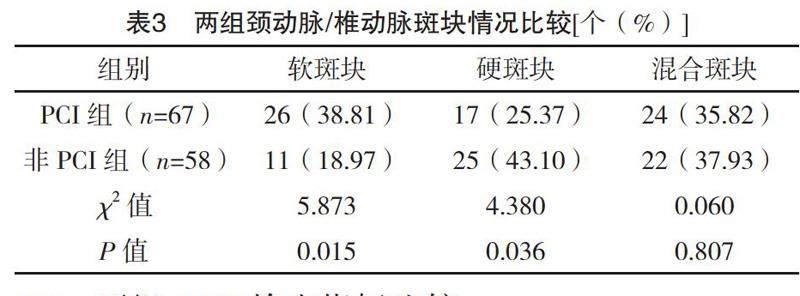
【摘要】 目的:探討分析经颅多普勒超声(TCD)联合颈动脉超声(CAU)诊断颈动脉/椎动脉粥样硬化斑块患者后循环缺血(PCI)的效能及影像学特点。方法:回顾性选取2021年1月—2023年10月安徽中医药大学第二附属医院收治的颈动脉/椎动脉粥样硬化斑块患者80例,将确诊PCI的42例患者纳入PCI组,将无PCI的38例患者纳入非PCI组。两组均行TCD与CAU检查。比较两组TCD检查指标[椎动脉(VA)、大脑后动脉(PCA)及基底动脉(BA)平均血流速度]、CAU检查指标[斑块情况、内-中膜厚度(IMT)、搏动指数(PI)、阻力指数(RI)],同时以CT血管造影(CTA)检查结果为“金标准”,比较TCD检查、CAU检查及二者联合诊断颈动脉/椎动脉粥样硬化斑块患者PCI的效能。结果:PCI组PCA、VA、BA平均血流速度均大于非PCI组,软斑块占比高于非PCI组,IMT、PI、RI均大于非PCI组,差异均有统计学意义(P<0.05);PCI组硬斑块占比明显低于非PCI组,差异有统计学意义(P<0.05);TCD检查诊断颈动脉/椎动脉粥样硬化斑块患者PCI的敏感度为76.19%(32/42),特异度为92.11%(35/38),Kappa值为0.677;CAU检查诊断颈动脉/椎动脉粥样硬化斑块患者PCI的敏感度为73.81%(31/42),特异度为89.47%(34/38),准确度为81.25%(65/80),Kappa值为0.627;TCD联合CAU检查诊断颈动脉/椎动脉粥样硬化斑块患者PCI的敏感度为97.62%(41/42),特异度为89.47%(34/38),准确度为93.75%(75/80),Kappa值为0.874;TCD联合CAU检查诊断颈动脉/椎动脉粥样硬化斑块患者PCI的敏感度、阴性预测值、准确度均高于各单项检查,差异均有统计学意义(P<0.05)。结论:颈动脉/椎动脉粥样硬化斑块PCI患者与非PCI患者相比,其血流动力学、斑块情况、血管循环阻力均存在显著差异,TCD联合CAU检查运用于颈动脉/椎动脉粥样硬化斑块患者中能有效观察其血流动力学改变,并且在诊断患者是否出现PCI中具有较高效能。
【关键词】 经颅多普勒超声 颈动脉超声 颈动脉/椎动脉粥样硬化 后循环缺血
Efficacy and Imaging Features of TCD Combined with Carotid Ultrasound in the Diagnosis of Posterior Circulation Ischemia in Patients with Carotid/Vertebral Atherosclerotic Plaque/WANG Xiaochun, ZHOU Foyang, ZHANG Yu, ZHU Chenxia, LI Junjie, ZHANG Na, JIN Zhongwei. //Medical Innovation of China, 2024, 21(08): -142
[Abstract] Objective: To explore and analyze the efficacy and imaging features of transcranial Dopple (TCD) combined with carotid ultrasound (CAU) in the diagnosis of posterior circulation ischemia (PCI) in patients with carotid/vertebral atherosclerotic plaque. Method: A total of 80 patients with carotid/vertebral atherosclerotic plaque admitted to the Second Affiliated Hospital of Anhui University of Chinese Medicine from January 2021 to October 2023 were retrospectively selected. 42 patients diagnosed with PCI were included in PCI group, and 38 patients without PCI were included in non-PCI group. Both groups were examined by TCD and CAU. TCD examination indexes [average blood flow velocity of vertebral artery (VA), posterior cerebral artery (PCA) and basilar artery (BA)], CAU examination indexes [plaque status, intima-media thickness (IMT), pulse index (PI) and resistance index (RI)] were compared between the two groups. At the same time, the results of CT angiography (CTA) taken as the "gold standard", the efficacy of TCD, CAU and their combination in diagnosing PCI in patients with carotid/vertebral atherosclerotic plaque were compared. Result: The average blood flow velocity of PCA, VA and BA in the PCI group were higher than those in the non-PCI group, the proportion of soft plaque was higher than that in the non-PCI group, and the IMT, PI and RI were higher than those in the non-PCI group, the differences were statistically significant (P<0.05). The proportion of hard plaque in PCI group was significantly lower than that in non-PCI group, the difference was statistically significant (P<0.05). The sensitivity of TCD examination in diagnosing PCI in patients with carotid/vertebral atherosclerotic plaque was 76.19% (32/42), the specificity was 92.11% (35/38), and the Kappa value was 0.677. The sensitivity of CAU examination in diagnosing PCI in patients with carotid/vertebral atherosclerotic plaque was 73.81% (31/42), the specificity was 89.47% (34/38), the accuracy was 81.25% (65/80), and the Kappa value was 0.627. The sensitivity of TCD combined with CAU examination in diagnosing PCI in patients with carotid/vertebral atherosclerotic plaque was 97.62% (41/42), the specificity was 89.47% (34/38), the accuracy was 93.75% (75/80), and the Kappa value was 0.874. The sensitivity, negative predictive value and accuracy of TCD combined with CAU in diagnosing PCI in patients with carotid/vertebral atherosclerotic plaque were higher than those of each single examination, the differences were statistically significant (P<0.05). Conclusion: There are significant differences in hemodynamics, plaque status and vascular cyclic resistance in carotid/vertebral atherosclerotic plaque patients with PCI compared with non-PCI patients. TCD combined with CAU can effectively observe hemodynamic changes in patients with carotid/vertebral atherosclerotic plaque, and has high efficiency in diagnosing whether patients have PCI.
[Key words] Transcranial Dopple Carotid ultrasound Carotid/vertebral atherosclerotic plaque Posterior circulation ischemia
First-author's address: Department of Ultrasound Medicine, the Second Affiliated Hospital of Anhui University of Chinese Medicine, Hefei 230000, China
doi:10.3969/j.issn.1674-4985.2024.08.031
目前心脑血管疾病已给我国居民生命健康带来严重威胁,同时也是导致居民死亡的最主要原因[1]。脑卒中是其中的主要类型,并且致死率与致残率均较高,而动脉粥样硬化则是导致该病的主要原因[2],因此动脉粥样硬化患者是罹患脑卒中的高危人群。20%~25%的脑卒中是由于后循环缺血(PCI)而导致的[3],且由于病情较为隐匿导致患者常不能及时获得准确诊断[4]。CT血管造影(CTA)由于能准确反映颅内动脉解剖结构与管腔狭窄情况,目前已成为诊断脑血管病变的有效手段[5],但该检查费用高昂,操作复杂,具有一定创伤性,同时还存在部分患者对造影剂过敏的情况,因此在推广上存在一定难度。……