腔内心电图联合超声引导经外周静脉置入中心静脉导管技术尖端定位的应用研究
2024-05-21黎洪群罗君梁芳刘燕翁恋恋
黎洪群 罗君 梁芳 刘燕 翁恋恋


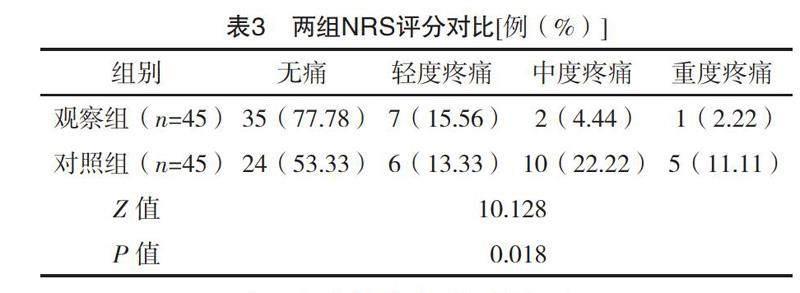
【摘要】 目的:探究腔内心电图联合超声引导经外周静脉置入中心静脉导管(PICC)技术尖端定位的应用。方法:临床研究对象选取2020年10月—2022年10月在九江市第一人民医院PICC门诊接受PICC置管的患者90例,按照随机数字表法将其分為观察组和对照组,每组45例。对照组采取腔内心电图定位下置管,观察组在对照组基础上联合进行超声引导PICC下置管。观察两组穿刺成功率、PICC尖端位置、数字评分法(NRS)评分、患者满意度及不良反应发生情况。结果:观察组一次性置管成功率(88.89%)显著高于对照组(68.89%),且总置管成功率(97.78%)相对于对照组(86.67%)更高(P<0.05);观察组PICC尖端定位到达最佳位置率(95.45%)相对于对照组(76.92%)更高(P<0.05)。观察组NRS评分优于对照组(P<0.05)。观察组总满意度(95.56%)相对于对照组(66.67%)更高(P<0.05)。观察组不良反应总发生率(4.44%)相对于对照组(20.00%)更低(P<0.05)。结论:针对接受PICC置管患者采取腔内心电图联合超声引导定位一方面有利于提高患者置管成功率,提高患者PICC尖端定位到达最佳位置率及降低患者疼痛程度;另一方面提高患者满意度,降低患者不良反应发生率。
【关键词】 腔内心电图 超声引导 外周静脉 中心静脉导管技术
Study on Application of Intracavitary Electrocardiogram Combined with Ultrasound-guided Peripherally Inserted Central Venous Catheter for Tip Positioning/LI Hongqun, LUO Jun, LIANG Fang, LIU Yan, WENG Lianlian. //Medical Innovation of China, 2024, 21(08): 0-093
[Abstract] Objective: To explore the application of intracavitary electrocardiogram combined with ultrasound-guided peripherally inserted central venous catheter (PICC) tip positioning. Method: The clinical research subjects selected 90 patients who received PICC catheterization at the PICC outpatient department of Jiujiang NO.1 People's Hospital from October 2020 to October 2022, were divided into observation group and control group according to the random number table method, with 45 patients in each group. The control group received catheterization guided by intracavitary electroencephalography, while the observation group received catheterization guided by ultrasound PICC in combination with the control group. The success rate of puncture, PICC tip positioning, numeric rating scale (NRS) score, patient satisfaction and the occurrence of adverse reactions in two groups were observed. Result: The success rate of single catheterization in the observation group (88.89%) was significantly higher than that in the control group (68.89%), and the total catheterization success rate (97.78%) was higher than that of the control group (86.67%) (P<0.05). Rate of PICC tip localization reaching the optimal position in the observation group (95.45%) was higher than that in the control group (76.92%) (P<0.05). The NRS score of the observation group was better than that of the control group (P<0.05). The overall satisfaction rate of the observation group (95.56%) was higher than that of the control group (66.67%) (P<0.05). The total incidence of adverse reactions in the observation group (4.44%) was lower than that in the control group (20.00%) (P<0.05). Conclusion: Adopting a combination of intracavitary electroencephalography and ultrasound-guided localization for patients undergoing PICC catheterization can improve the success rate of catheterization, increase the rate of achieving optimal PICC tip localization, and reduce patient pain; on the other hand, improving patient satisfaction and reducing the incidence of adverse reactions.
[Key words] Intracavitary electrocardiogram Ultrasound-guided Peripheral vein Central venous catheter technology
First-author's address: PICC Room, Jiujiang NO.1 People's Hospital, Jiujiang 332000, China
doi:10.3969/j.issn.1674-4985.2024.08.020
经外周静脉置入中心静脉导管(peripherally inserted central venous catheter,PICC)是从患者上臂贵要静脉进行穿刺,而导管直接到达上腔静脉,防止化疗药物与外周静脉发生直接接触,上腔静脉血流速度加快,从而迅速将化疗药物稀释,降低甚至避免药物引起血管刺激[1]。研究表明,PICC置管在临床上被普遍运用于肿瘤等患者化疗诊治中,有利于对患者采取长期静脉输液[2]。近年来,PICC置管技术已经广泛运用于危重症患者、肿瘤患者肠外营养及更多临床静脉化疗中[3]。研究表明,PICC可减少患者由于反复进行静脉穿刺造成身体疼痛,操作方式简洁[4]。但有临床研究表明,PICC技术关键在于定位,若定位不精准会造成一定不良反应[5],例如感染、导管异位、导管堵塞及静脉炎等。因此,针对PICC技术采取合理科学定位十分重要。……