延迟断脐与断脐方式选择对胎龄小于32周早产儿临床结局的影响
2024-05-21赵德荣
赵德荣
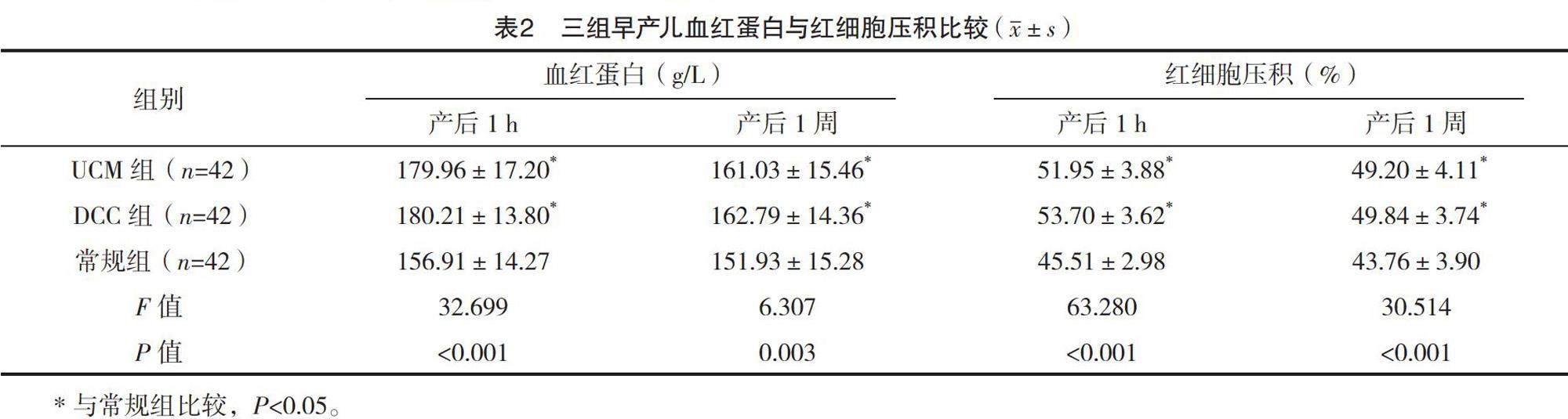
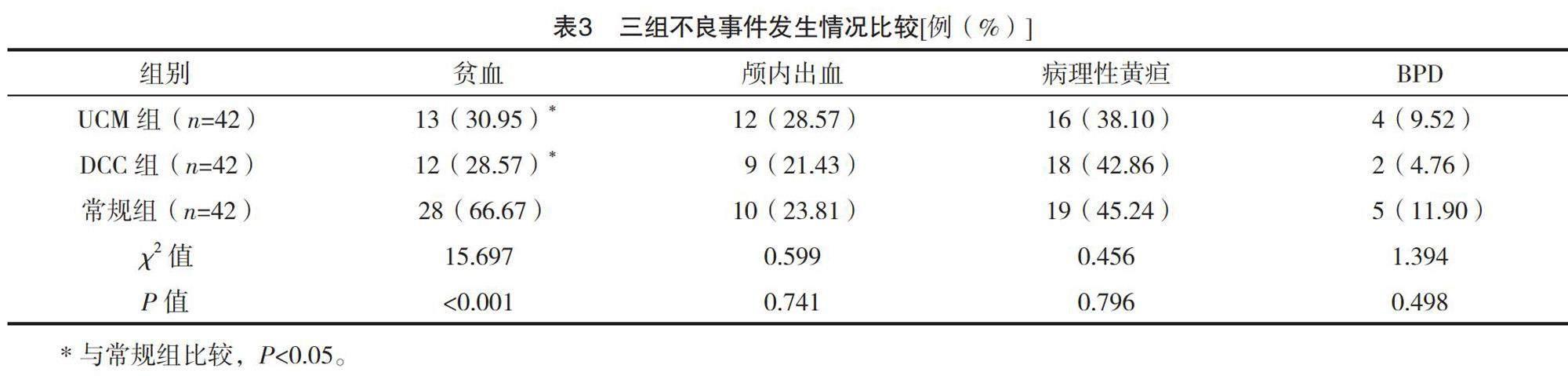
【摘要】 目的:探討延迟断脐与断脐方式选择对胎龄小于32周早产儿临床结局的影响。方法:选取2019年10月—2022年10月中国人民解放军总医院第七医学中心收治的126例早产儿,随机均分为延迟脐带结扎(deferred cord clamping,DCC)组、脐带挤压(umbilical cord milking,UCM)组、常规组,每组42例。比较三组早产儿产后血红蛋白与红细胞压积、不良事件发生率、平均输血量、光疗时间、产后胎盘残余血量、脐部残端脱落时间。结果:与常规组比较,UCM组、DCC组产后1 h、1周的血红蛋白、红细胞压积均明显更高(P<0.05),UCM组、DCC组产后1 h、1周的血红蛋白、红细胞压积差异均无统计学意义(P>0.05)。UCM组、DCC组贫血事件的发生率均显著低于常规组(P<0.05),三组颅内出血、病理性黄疸、支气管肺发育不良的发生率差异均无统计学意义(P>0.05)。三组输血量、光疗时间、产后胎盘残余血量、脐部残端脱落时间差异均有统计学意义(P<0.05)。结论:断脐方式对胎龄<32周早产儿的临床结局有重要影响,与常规断脐方式比较,采取延迟断脐或脐带挤压方式,有助于促进血液从胎盘到新生儿的转移,改善产后血红蛋白与红细胞压积,降低贫血风险,缩短脐部残端脱落时间。
【关键词】 早产儿 延迟断脐 脐带挤压 断脐方式 临床结局
Effect of Delayed Umbilical Cord and Choice of Umbilical Cord Weaning Mode on Clinical Outcome of Premature Infants with Gestational Age Less than 32 Weeks/ZHAO Derong. //Medical Innovation of China, 2024, 21(08): 0-088
[Abstract] Objective: To investigate the effect of delayed umbilical cord and the choice of umbilical cord weaning method on the clinical outcome of preterm infants less than 32 weeks of gestational age. Method: A total of 126 preterm infants admitted to the Seventh Medical Center of PLA General Hospital from October 2019 to October 2022 were selected and equally divided into deferred cord clamping (DCC) group, umbilical cord milking (UCM) group and conventional group, with 42 cases in each group. The postnatal haemoglobin and hematocrit, incidence of adverse events, mean blood transfusion, time to phototherapy, postnatal placental residual blood volume and time to detachment of umbilical stump were compared among the three groups of preterm infants. Result: Compared with the conventional group, haemoglobin and hematocrit were significantly higher in the UCM group and DCC group at 1 h and 1 week postpartum (P<0.05), there were no significant differences in hemoglobin and hematocrit in UCM group and DCC group at 1 h and 1 week postpartum (P>0.05). The incidences of anaemic events in the UCM group and DCC group were significantly lower than that in the conventional group (P<0.05), there were no significant differences in the incidences of intracranial hemorrhage, pathological jaundice and bronchopulmonary dysplasia among the three groups (P>0.05). There were significant differences in blood transfusion volume, phototherapy time, placental residual blood volume and umbilical stump shedding time among the three groups (P<0.05). Conclusion: The method of umbilical cord weaning has an important impact on the clinical outcome of preterm infants born at gestational age <32 weeks. Compared with the conventional method of umbilical cord weaning, adopting delayed umbilical cord weaning or umbilical cord milking helps to facilitate the transfer of blood from the placenta to the newborn, improve postnatal haemoglobin and hematocrit, reduce the risk of anaemia and shorten the time to detach the umbilical cord stump.
[Key words] Preterm infant Delayed umbilical cord Umbilical cord milking Mode of umbilical cord weaning Clinical outcome
First-author's address: Maternity Ward, the Seventh Medical Center of PLA General Hospital, Beijing 100700, China
doi:10.3969/j.issn.1674-4985.2024.08.019
胎龄与多种疾病的发病风险有密切关联,包括新生儿贫血、新生儿肺炎、支气管肺发育不良(BPD)等[1]。既往调查发现,胎龄不足32周的早产儿,出现宫外生长发育迟缓的风险更高[2]。另有研究指出,胎龄<32周的早产儿,肠内喂养的实际效果并不理想,喂养不耐受现象较常见[3]。随后,与胎龄<32周早产儿并发症风险防治与营养干预有关的课题研究逐渐受到重视。脐带管理是新生儿科面临的重要问题,娩出后立即断脐是既往产科共识,但随着相关理念的更新及胎盘输血理论的深入研究,胎盘管理的出发点发生明显改变,促进血液从胎盘到新生儿的转移,成为断脐方式选择的主要目标。对胎龄<32周的早产儿,胎盘中储存的循环血量相对较少,血流动力学稳定性较差,积极采取胎盘管理措施,促进胎盘输血,有重要意义。研究发现,与常规断脐方法比较,延迟脐带结扎(deferred cord clamping,DCC)可减少新生儿贫血、脐炎等问题的发生率,降低胎盘残余血量,改善新生儿血红蛋白水平[4]。但也有观点指出,部分早产儿娩出后需要立即复苏,采取DCC措施可能延误复苏,继而对早产儿临床结局产生不良影响。脐带挤压(umbilical cord milking,UCM)是介于常规断脐与DCC之间的一种断脐方式,根据储存循环血量及早产儿实际情况,分一次或多次完成挤压,促使脐带血向新生儿转移。从理论角度分析,DCC及UCM两种处理方法,在增加血容量、增强氧合等方面均有良好作用效果,但如何根据早产儿娩出后情况选择最佳脐带管理方案,以及UCM是否适宜用于各种类型早产儿,现阶段尚未形成共识。基于此,本研究围绕延迟断脐与断脐方式选择对胎龄小于32周早产儿临床结局的影响进行分析,以期为今后早产儿的脐带管理提供参考。
1 资料与方法
1.1 一般资料
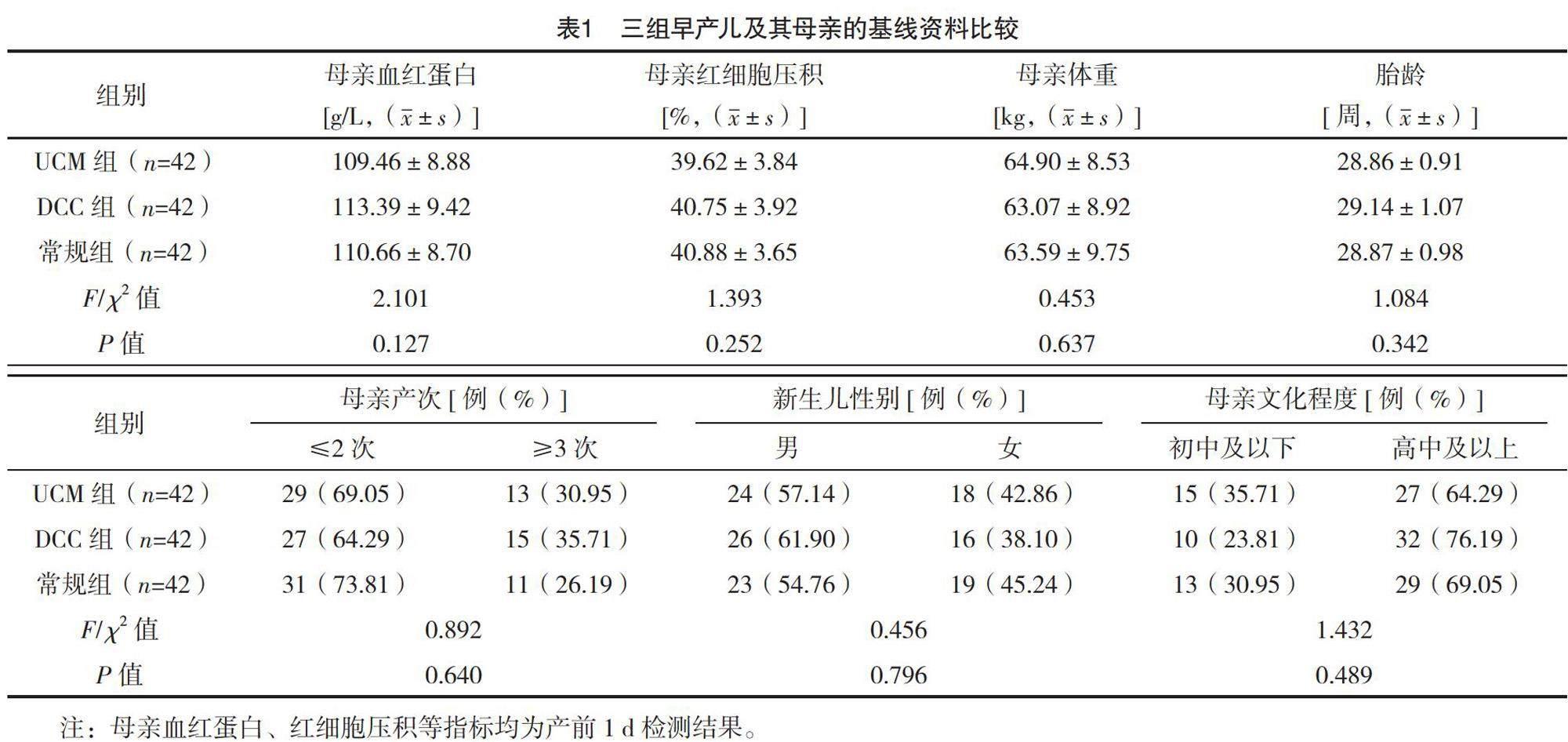
选取2019年10月—2022年10月中国人民解放军总医院第七医学中心收治的126例早产儿,纳入标准:(1)胎龄<32周;(2)经阴道分娩;(3)单胎妊娠。排除标准:(1)母亲存在高热、严重感染等问题;(2)有前置胎盘、前置血管出血等高危因素;(3)伴遗传代谢性疾病;(4)病理妊娠;(5)早产儿出生后1 min Apgar评分≤7分。根据母亲分娩顺序进行编号,由计算机生成一组随机数,并列于编号下方,对随机数进行排序(依从小到大次序),排序1~42对应编号为常规组(n=42),排序43~84对应编号为DCC组(n=42),排序85~126对应编号为UCM组(n=42)。本研究经本院医学伦理委员会批准,取得家属知情同意。
1.2 方法
1.2.1 脐带管理方法 所有纳入研究的早产儿母亲均有较完整的病历资料,胎儿娩出后经积极治疗,生命体征均稳定,三组早产儿对应脐带管理方式如下。
常规组:胎儿顺利娩出后,立刻对脐带、脐部周围皮肤进行常规消毒(5%聚维酮碘),选取距离脐部约1.0 cm处,使用钳夹夹断,立即进行结扎处理。DDC组:胎儿顺利娩出后,常规消毒并立刻开始计时,将其置于产妇两腿之间,并确保早产儿位置低于胎盘,高度差控制在10 cm左右,45 s后做结扎处理,期间由专人使用无菌毛巾轻柔擦拭皮肤,做好保暖工作。……