持续质量改进对老年支气管炎护理质量及家属满意度的影响分析
2022-06-20赵婷
赵婷
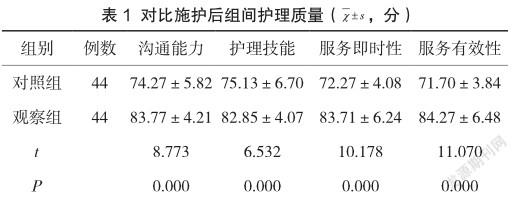
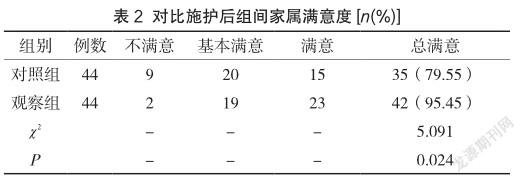
【摘要】目的:探讨在支气管炎老年患者治疗中辅以持续质量改进护理,对提升临床护理质量与家属满意度的施护价值。方法:试验对象选于2020年1月—2022年1月期间,在我院就医的支气管炎老年患者88例,以随机数字表法均分两组,在施治期间提供常规护理与持续质量改进,统计组间护理质量与家属满意度差异性。结果:观察组沟通能力、护理技能、服务即时性与服务有效性指标评分比对照组高(P<0.05) ;观察组家属总满意度比对照组高(P<0.05) 。结论:通过以持续质量改进模式施护,可有效提升临床护理质量的同时,还能增加患者家属对于医疗服务满意度,适宜临床展开研究与借鉴。
【关键词】支气管炎;老年患者;持续质量改进;施护质量;满意度
Effects of continuous quality improvement on nursing quality of elderly bronchitis and satisfaction of family members
ZHAO Ting
Yongzheng Town Health Center, Zhengning County, Gansu Province, Qingyang, Gansu 745302, China
【Abstract】Objective: To explore the nursing value of improving clinical nursing quality and family satisfaction in the treatment of elderly patients with bronchitis supplemented by continuous quality improvement nursing. Methods: The test subjects were selected from January 2020.1-February 2022.01, 88 elderly patients with bronchitis hospitalized in our hospital were divided into 2 groups by random number table method. Routine nursing and continuous quality improvement were provided during the treatment, and the difference of nursing quality and family satisfaction among the groups was counted. Results: The scores of communication ability, nursing skills, service immediacy and service effectiveness in the observation group were higher than those in the control group(P<0.05); The total satisfaction of the observation group was higher than that of the control group(P<0.05).Conclusion: The continuous quality improvement model can not only effectively improve the quality of clinical nursing, but also increase the satisfaction of patients family members for medical services, which is suitable for clinical research and reference.
【Key Words】Bronchitis; Elderly patients; Continuous quality improvement; Nursing quality; Satisfaction
支氣管炎作为临床常见疾病之一,好发于老年与幼儿群体中,主要是由于物理、化学刺激或者微生物感染等因素所致,临床症状以咳痰、咳嗽等为主,在治疗上临床大多以平喘、化痰、止咳等对症治疗为主,并积极提供有效治疗干预,可起到提升临床疗效及改善患者预后的作用[1-2]。本研究目的主要是为了探讨在施治期间提供持续质量改进模式施护的价值,现展开具体分析。
1 资料与方法
1.1病例资料
本组入选对象为88例患有支气管炎疾病的老年患者,组间以随机数字表法实施分组,对组内对象资料以回顾性分析法进行分析。对照组,年龄65~80岁,平均年龄(72.37±8.64)岁,男性24例,女性20例;观察组,年龄67~80岁,平均年龄(72.65±8.71)岁,男性22例,女性22例。综合分析两组资料数据(P>0.05),有可对比性。入组患者纳入要求:(1)经临床检查确诊;(2)遵循知情原则且同意参与;(3)临床症状为程度不同的咳嗽、咳痰等;(4)临床资料无缺失;(5)依从性不低;(6)无言语或精神障碍。排……
