胶孢炭疽菌侵染橡胶树叶片染色方法的建立及显微观察
2021-12-08龙明滕,梁晓宇,杜艳楠,邹丽君,张宇,王萌
龙明滕,梁晓宇,杜艳楠,邹丽君,张宇,王萌
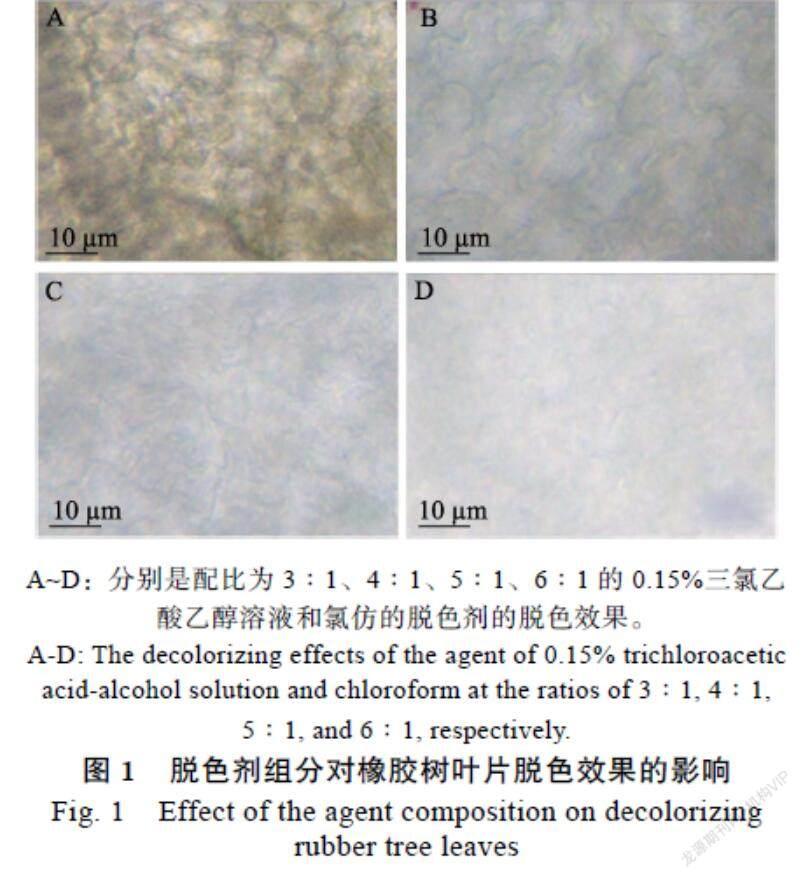
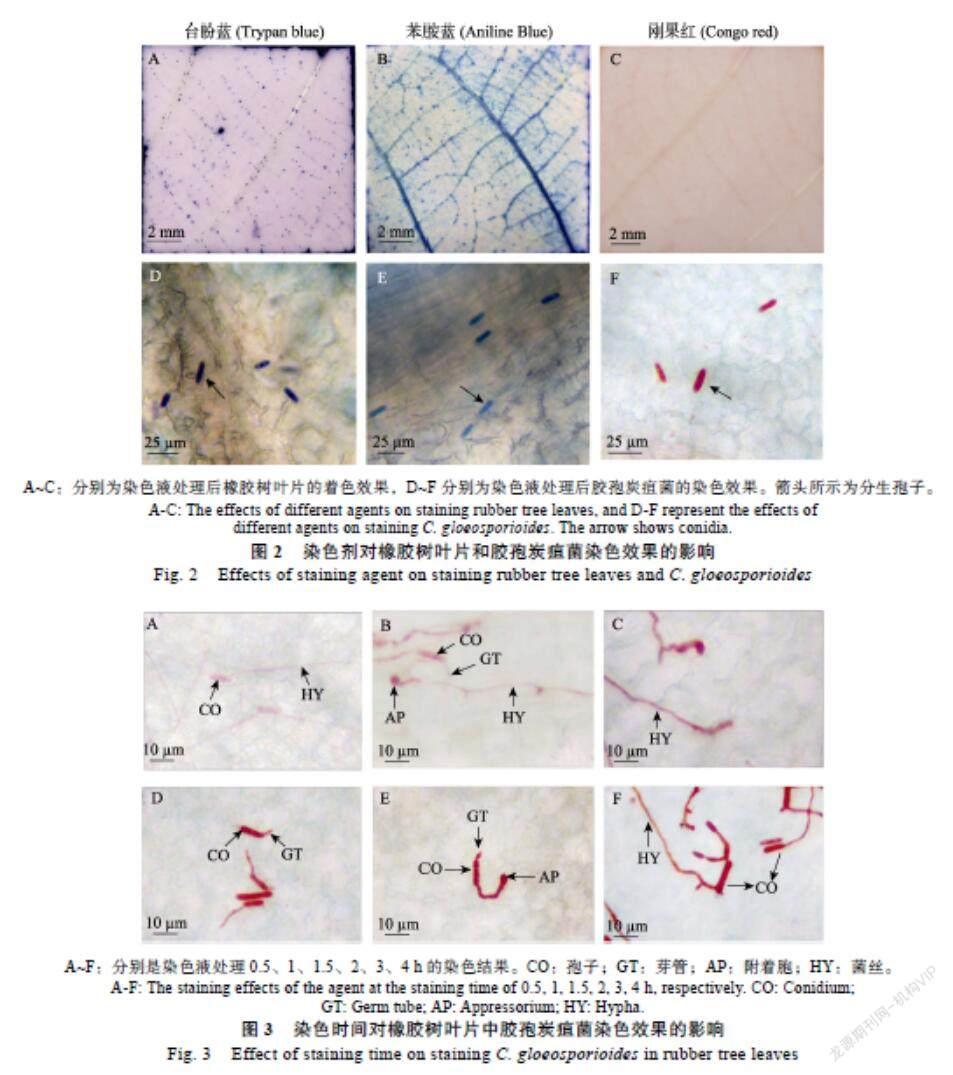
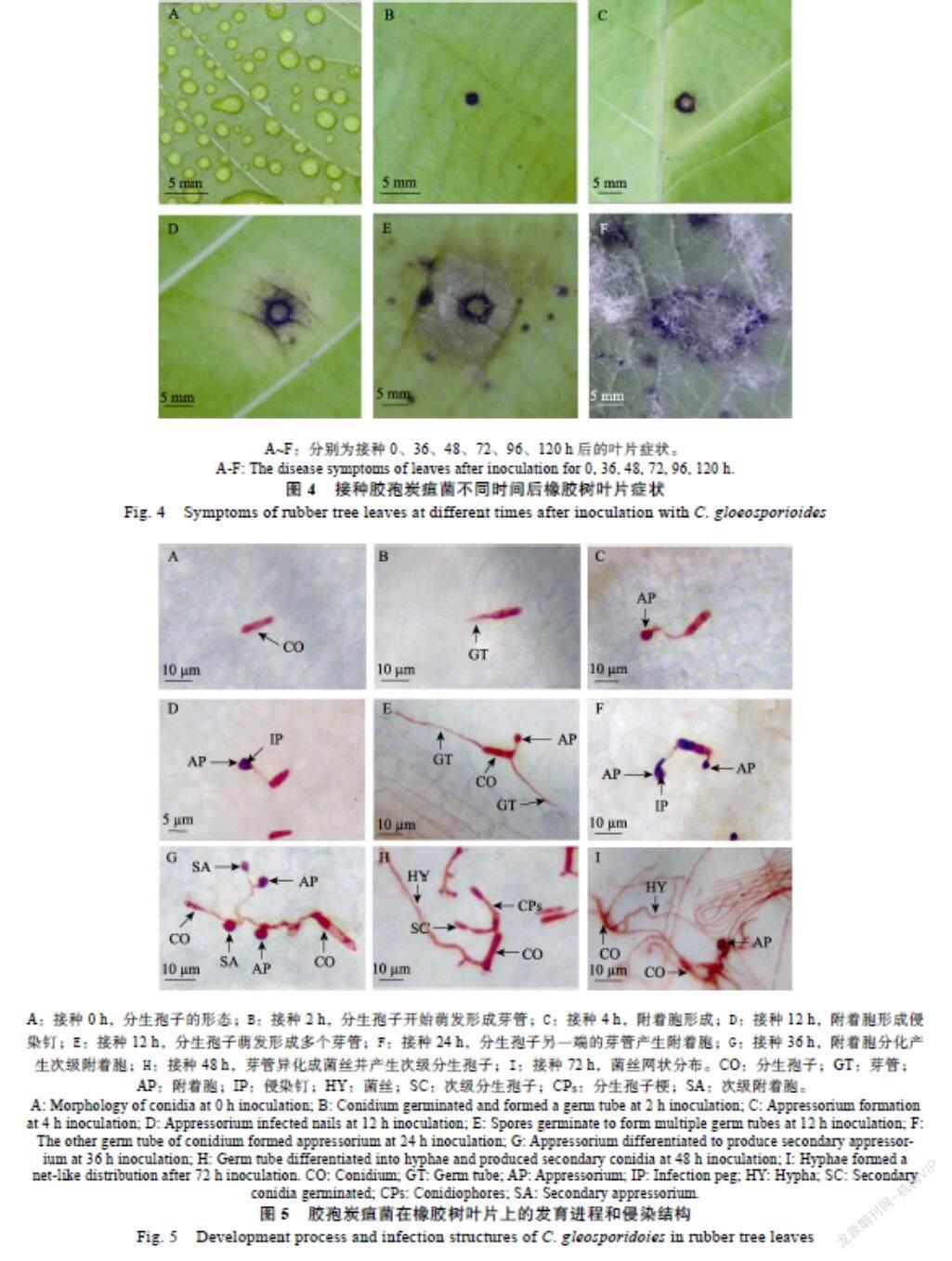
摘 要:本研究建立了一种橡胶树叶片中胶孢炭疽菌的染色方法,通过显微观察明确胶孢炭疽菌在橡胶树叶片中的侵染结构,为橡胶树炭疽病的预测预报提供理论依据。在脱色剂(0.15%三氯乙酸乙醇溶液∶氯仿=5∶1)处理12 h,1%刚果红染色剂抽滤染色3 h的条件下,能清晰观察到胶孢炭疽菌在橡胶树叶片上的发育进程和侵染结构。结果表明,在28 ℃、100%相对湿度培养条件下,接种橡胶树淡绿期叶片2~6 h为分生孢子萌发高峰期,12 h后分生孢子萌发率大于85%;8~12 h为附着胞形成高峰期,接种12 h约75%的芽管顶端产生附着胞,少数附着胞中央部位開始形成侵染钉;24 h为侵染钉形成高峰期,同时分生孢子萌发形成多个芽管;36 h时附着胞顶端再次萌发产生次级附着胞,从而进一步侵染周围细胞,叶片出现零星病斑;48 h时芽管不断分支异化成菌丝并产生次级分生孢子,叶片出现大量典型的炭疽病病斑;72 h后菌丝在叶片表面纵横扩展,随机分支,逐步形成网状分布。随着菌丝的扩展,叶片组织发生一系列的病理变化,侵染部位组织出现褐色坏死病斑。本研究建立了一种着色效果好,简便易行,经济有效的橡胶树叶片中胶孢炭疽菌的染色方法,进一步明确了胶孢炭疽菌的侵染结构。
关键词:橡胶树;炭疽病;胶孢炭疽菌;染色方法;侵染结构
中图分类号:S763.7 文献标识码:A
Establishment of Staining Method and Microscopic Observation of Rubber Tree Leaves Infected by Colletotrichum gloeosporioides
LONG Mingteng1, LIANG Xiaoyu1,2, DU Yannan1, ZOU Lijun1, ZHANG Yu1,2*, WANG Meng1,2*
1. School of Plant Protection, Hainan University, Haikou, Hainan 570228, China; 2. Key Laboratory of Green Prevention and Control of Tropical Plant Diseases and Pests, Ministry of Education, Haikou, Hainan 570228, China
Abstract: The infection structures of Colletotrichum gloeosporioides on rubber trees would be clarified through microscopic observation to provide scientific basis for the anthracnose prediction in rubber trees. After rubber trees leaves treated with decolorizing agent (0.15% trichloroacetic acid-ethanol solution∶chloroform, 5∶1) for 12 h and 1% Congo red staining agent for 3 h, the developmental process and infection structure of C. gloeosporioides infection were clearly observed. Under the inoculation condition of 28 ℃ and 100% humidity, the crest-time of conidial germination was within 2-6 h after inoculated in rubber tree leaves at the light green phase. More than 85% of conidia were germinated after 12 h inoculation. The crest-time of appressorium formation was within 8-12 h after inoculation. About 75% germ tubes generated appressoria and appressoria began forming infection pegs after 12 h inoculation. The crest-time of infection pegs formation was at 24 h inoculation, while several germ tubes formed at the other top of the germinal conidium. The appressorium germinated to produce secondary appressorium, which further infected surrounding cells and caused leaves sporadic lesions at 36 h inoculation. After 48 h inoculation, Germ tubes of abundant branched differentiated into hyphae, some of which produced secondary conidia on the top. A large number of typical anthracnose spots formed. The hyphae spread vertically and horizontally on the leaf surface and gradually formed a net-like distribution after 72 h inoculation. As the hyphae expanded, a series of pathological changes occurred in the leaf tissue. In this study, a method for staining C. gloeosporioides in rubber tree leaves with good staining effects, simplicity, and efficiency was established, which further clarified the infection structures of C. gloeosporioides.
Keywords: rubber tree; anthracnose; Colletotrichum gloeosporioides; staining method; infection structure
DOI: 10.3969/j.issn.1000-2561.2021.10.031
巴西橡胶树(Hevea brasiliensis)起源于亚马逊河流域,后成功引进我国,成为我国天然橡胶的唯一来源,是我国重要的战略资源[1-2]。……