生物炭与硝化抑制剂联合施用对热带菜地土壤硝化过程及N2O排放的影响
2021-12-08朱云飞,张琪,黄一伦,冷有锋,陈淼,范长华,李勤奋
朱云飞,张琪,黄一伦,冷有锋,陈淼,范长华,李勤奋

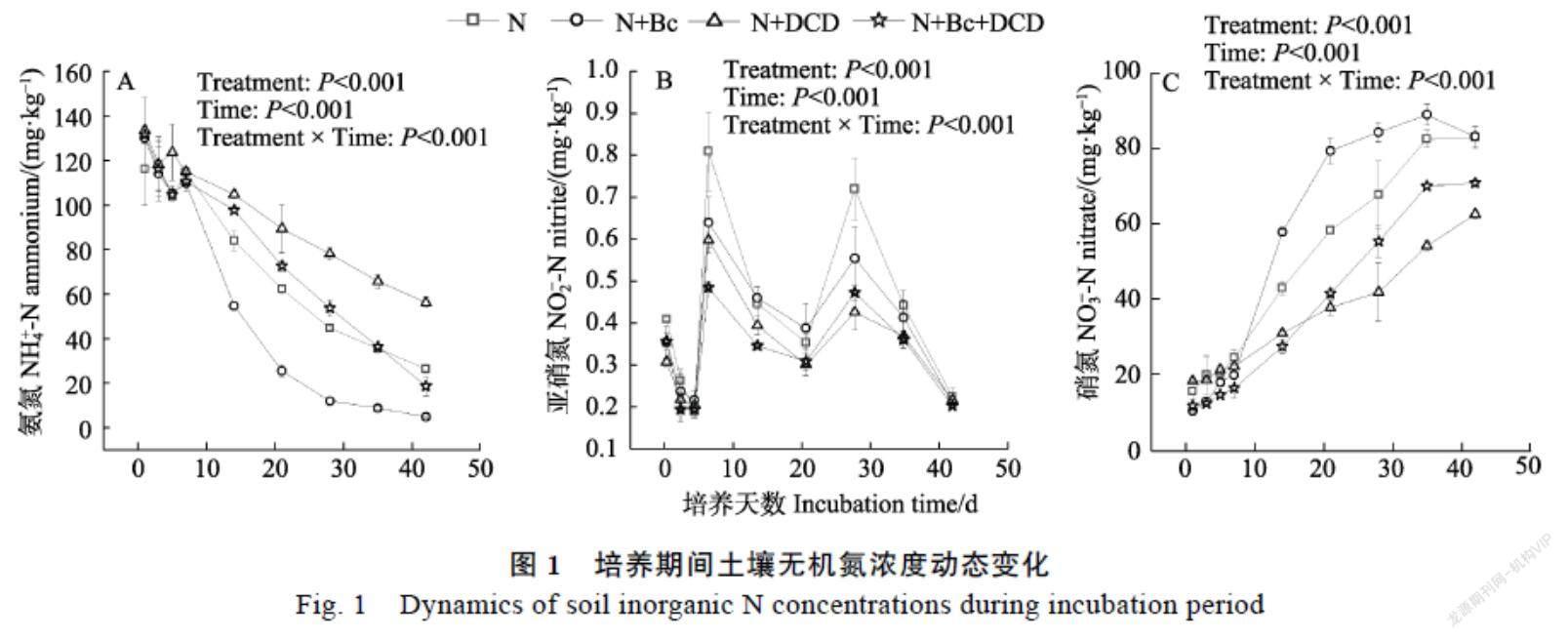

摘 要:本研究以热带菜地土壤为对象,通过室内培养试验探讨生物炭与硝化抑制剂联合施用下土壤无机氮含量和强度及N2O排放的變化规律,旨在明确施用生物炭和硝化抑制剂对热区土壤硝化过程的调控作用及对N2O的减排效应。本试验设置4个处理:单施氮肥(N),氮肥配施生物炭(N+Bc),氮肥配施硝化抑制剂(N+Ni)以及氮肥同时配施生物炭和硝化抑制剂(N+Bc+Ni)。结果表明:培养期间,生物炭施用下土壤NO3––N强度显著提高15.8%,表明添加生物炭能够显著促进土壤硝化过程;硝化抑制剂添加下土壤NH4+–N强度显著提高33.4%,表明硝化抑制剂的施用显著减缓硝化过程;此外,硝化抑制剂能够削弱由生物炭添加引起的激发硝化过程的效应,表明生物炭和硝化抑制剂对硝化过程影响存在交互效应。施用生物炭或硝化抑制剂都能降低NO2––N强度,其中硝化抑制剂作用更加显著;此外,生物炭或硝化抑制剂单独施用能够降低菜地土壤15.1%~68.3%的N2O排放量,二者联合施用在一定程度上能够发挥更强的减排作用。综合来看,生物炭与硝化抑制剂联合施用有望在热带菜地土壤中发挥固碳和减排的双重功效。
关键词:生物炭;硝化抑制剂;硝化作用;氧化亚氮;菜地土壤
中图分类号:S31 文献标识码:A
Effects of Co-application of Biochar and Nitrification Inhibitor on Soil Nitrification and N2O Emissions in Tropical Vegetable Soil
ZHU Yunfei1,4, ZHANG Qi1,5, HUANG Yilun1,5, LENG Youfeng1,4, CHEN Miao1,2,3,5, FAN Changhua1,2,3*, LI Qinfen1,2,3*
1. Institute of Environment and Plant Protection, Chinese Academy of Tropical Agricultural Sciences, Haikou, Hainan 571101, China; 2. Danzhou Scientific Observing and Experimental Station of Agro-Environment, Ministry of Agriculture and Rural Affairs, Danzhou, Hainan 571737, China; 3. Hainan Key Laboratory of Tropical Eco-Circular Agriculture, Haikou, Hainan 571101, China; 4. College of Eco-environment Engineering, Guizhou Nationality University, Guiyang, Guizhou 550025, China; 5. College of Ecology and Environment, Hainan University, Haikou, Hainan 570228, China
Abstract: To evaluate the effects of co-application of biochar and nitrification inhibitor on regulating soil nitrification and mitigating N2O emission, an incubation experiment was conducted to explore the dynamic variations of inorganic N concentration and the associated intensity and N2O emissions in tropical vegetable soil. Four treatments were established as N fertilizer alone (N), N fertilizer applied with biochar (N+Bc), N fertilizer applied with nitrification inhibitor (N+Ni), and N fertilizer applied with biochar and nitrification inhibitor (N+Bc+Ni). Results showed that biochar amendment accelerated the conversion of NH4+–N to NO3––N, while nitrification inhibitor significantly decreased this process, and the co-application of the both weakened the nitrification to some extent. Moreover, biochar amendment elevated the NO3––N intensity by 15.8%, while nitrification inhibitor amendment promoted NH4+–N intensity by 33.4%, and the significant interaction occurred between biochar and nitrification inhibitor on NH4+–N and NO3––N intensity. In addition, NO2––N intensity was decreased by biochar or nitrification inhibitor amendment, with the latter having more obvious effects. Furthermore, biochar and nitrification inhibitor amendment alone decreased N2O emission by 15.1%–68.3%, and further decline in N2O emission occurred in the co-application of the both. Therefore, the co-application of biochar and nitrification inhibitor would be a promising strategy for simultaneously sequencing carbon and mitigating N2O emission in tropical vegetable soil.
Keywords: Biochar; nitrification inhibitor; nitrification; nitrous oxide (N2O); vegetable soil
DOI: 10.3969/j.issn.1000-2561.2021.10.039
氧化亚氮(N2O)是一种强效温室气体,在100年尺度上,其增温潜势是二氧化碳(CO2)的298倍,能够参与平流层中臭氧反应,造成臭氧层的损耗[1]。农业是温室气体N2O的重要排放源。……