昆明市中老年2型糖尿病患者不同中医证型骨密度的临床研究
2021-12-08陈岳祺柳尧颜洁刘弘毅马迪
陈岳祺 柳尧 颜洁 刘弘毅 马迪

【摘要】 目的 分析昆明市中老年2型糖尿病患者不同中醫证型骨密度的临床特点。
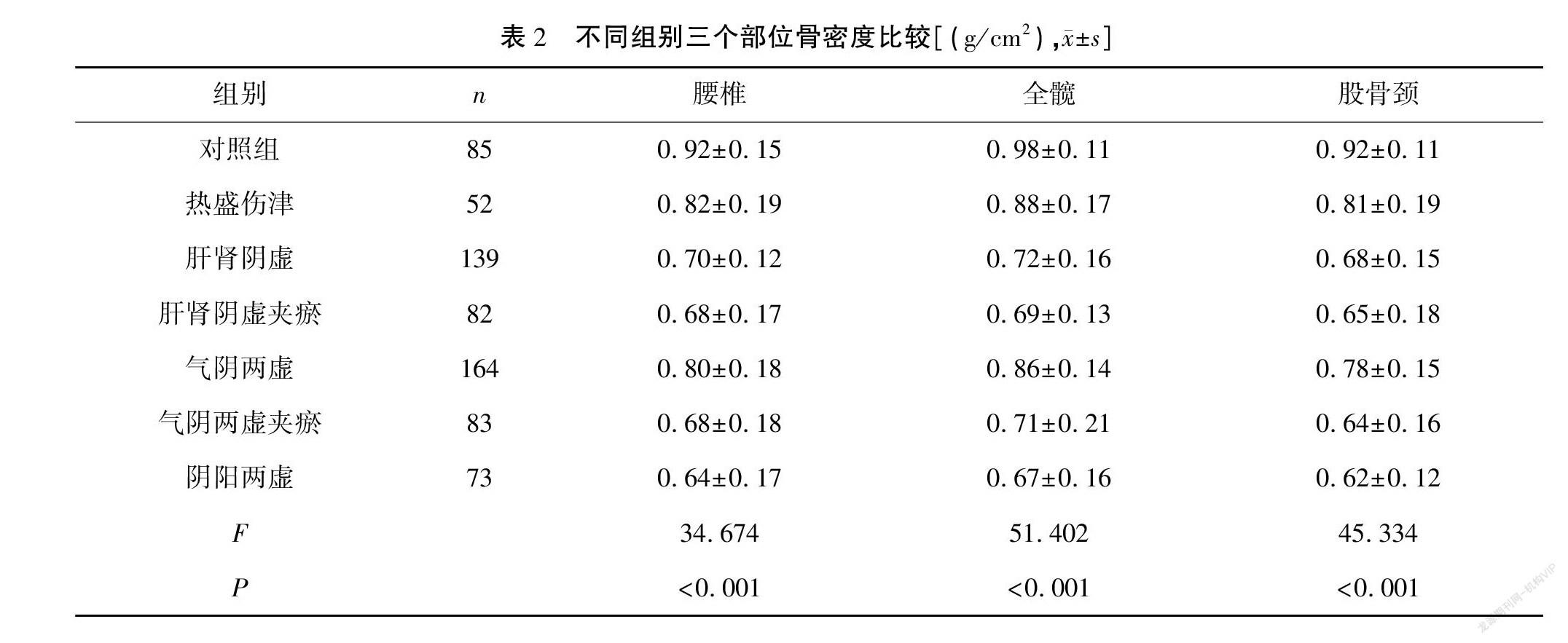
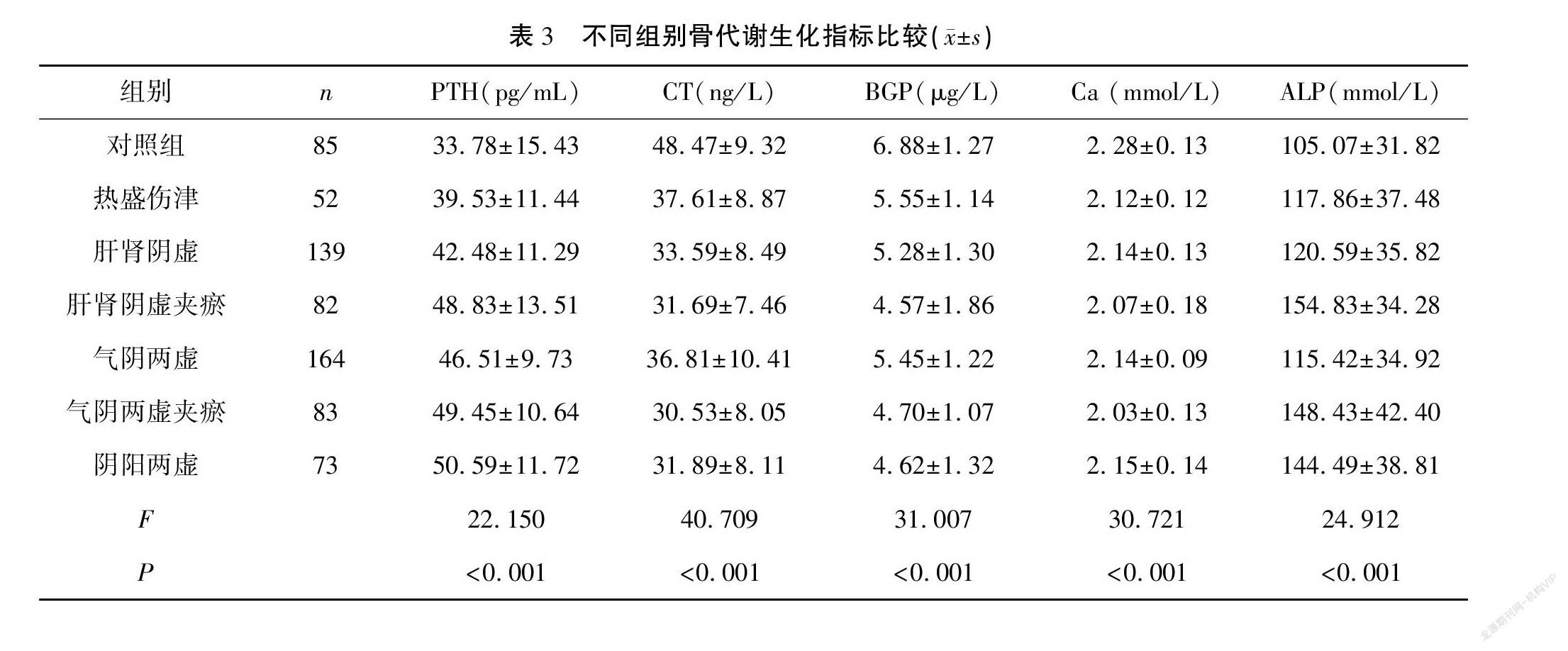
方法 选取2016年1月~2019年8月在云南省中医医院住院的593名2型糖尿病患者作为研究对象。根据辨证分型,将患者分为热盛伤津证、肝肾阴虚证、肝肾阴虚夹瘀证、气阴两虚证、气阴两虚夹瘀证、阴阳两虚证6个证候组,同时选择同期体检的健康中老年人85例作为对照组,比较7组血生化水平、骨密度和骨代谢生化指标,并对比骨质疏松和骨折发生率。
结果 糖尿病患者的血生化水平、骨密度和骨代谢生化指标较对照组均有不同程度异常,其中以阴阳两虚、肝肾阴虚夹瘀、气阴两虚夹瘀和肝肾阴虚组异常程度较大。骨质疏松、骨折发生的比例均为阴阳两虚组>肝肾阴虚夹瘀组>气阴两虚夹瘀组>肝肾阴虚组>气阴两虚组>热盛伤津组。
结论 肝肾阴虚、气阴两虚和阴阳两虚组分别为2型糖尿病的终末期,随着病程发展,患者骨质疏松及骨折的发生率逐渐增加,而合并肾虚及夹瘀的患者更容易发生骨质疏松及骨折。
【关键词】 中老年;2型糖尿病;骨密度;中医证型
中图分类号:R259 文献标志码:A DOI:10.3969/j.issn.1003-1383.2021.10.001
Clinical study on bone mineral density of different TCM syndromes in middle-aged and elderly patients with type 2 diabetes mellitus in Kunming
CHEN Yueqi, LIU Yao, YAN Jie, LIU Hongyi, MA Di▲
(Department of Endocrinology, Yunnan Provincial Hospital of Traditional Chinese Medicine—The First Affiliated Hospital of Yunnan University of Traditional Chinese Medicine, Kunming 650021, Yunnan, China)
【Abstract】 Objective To analyze the clinical characteristics of bone mineral density of different TCM syndromes in middle-aged and elderly patients with type 2 diabetes mellitus in Kunming.
Methods From January 2016 to August 2019, 593 patients with type 2 diabetes in Yunnan Provincial Hospital of Traditional Chinese Medicine were selected as research subjects. According to the syndrome differentiation, the patients were divided into the following 6 syndrome groups: consumption of fluid due to intense heat syndrome group, liver and kidney yin deficiency syndrome group, liver and kidney yin deficiency with blood stasis syndrome group, qi and yin deficiency syndrome group, qi and yin deficiency with blood stasis syndrome group, and yin and yang deficiency syndrome group. At the same time, 85 healthy middle-aged and elderly people who underwent physical examination during the same period were selected as the control group. And then, blood biochemical levels, bone densities, and bone metabolism biochemical indicators of the 7 groups were compared, and the incidence of osteoporosis and fractures was compared.
Results The blood biochemical levels, bone mineral densities and bone metabolic biochemical indexes of diabetic patients were abnormal to varying degrees while comparing with those of the control group. Among them, yin and yang deficiency syndrome group, liver and kidney yin deficiency with blood stasis syndrome group, qi and yin deficiency with blood stasis syndrome group, liver and kidney yin deficiency syndrome group had greater abnormal degree. The proportion of osteoporosis and fracture occurrence was all yin and yang deficiency syndrome group > liver and kidney yin deficiency with blood stasis syndrome group > qi and yin deficiency with blood stasis syndrome group > liver and kidney yin deficiency syndrome group > consumption of fluid due to intense heat syndrome group > qi and yin deficiency syndrome group.
Conclusion Liver and kidney yin deficiency syndrome group, qi and yin deficiency syndrome group, and yin and yang deficiency syndrome group are all at the end stage of type 2 diabetes mellitus. With the development of the disease course, the incidence of osteoporosis and fracture increases gradually, while patients with kidney deficiency and blood stasis are more likely to develop osteoporosis and fracture.
【Key words】 the middle-aged and elderly; type 2 diabetes mellitus; bone density; TCM syndromes
2型糖尿病(type 2 diabetes mellitus, T2DM)的患病率不断上升,生存率不断提高,易发生并发症和合并症[1],其中骨骼系统的并发症可以增加骨折的风险[2]。众所周知,骨密度(bone mineral density, BMD)在T1DM患者中普遍降低,这也导致了骨质疏松及骨折风险增加[3],而在T2DM患者中,骨密度是否降低仍存在争议。有动物实验研究报告示,高胰岛素血症可引起生长过程中横断骨的减少和成骨细胞生成的增加[4],而中老年患者机体糖脂代谢以及蛋白质代谢异常,使骨量流失[5~6],从而导致骨量和质量均下降。本研究主要是分析昆明……