从脾胃论治国医大师熊继柏膝痹经验方结合电针膝痹八穴治疗瘀血痹阻型老年性膝骨性关节炎的临床研究
2021-11-29蒋学余,钟青华,杨松,孟灵,杨子恂,王瑞安,林伟弟,王雅岚,杨亭伟,徐元培,熊继柏,常小荣
蒋学余,钟青华,杨松,孟灵,杨子恂,王瑞安,林伟弟,王雅岚,杨亭伟,徐元培,熊继柏,常小荣

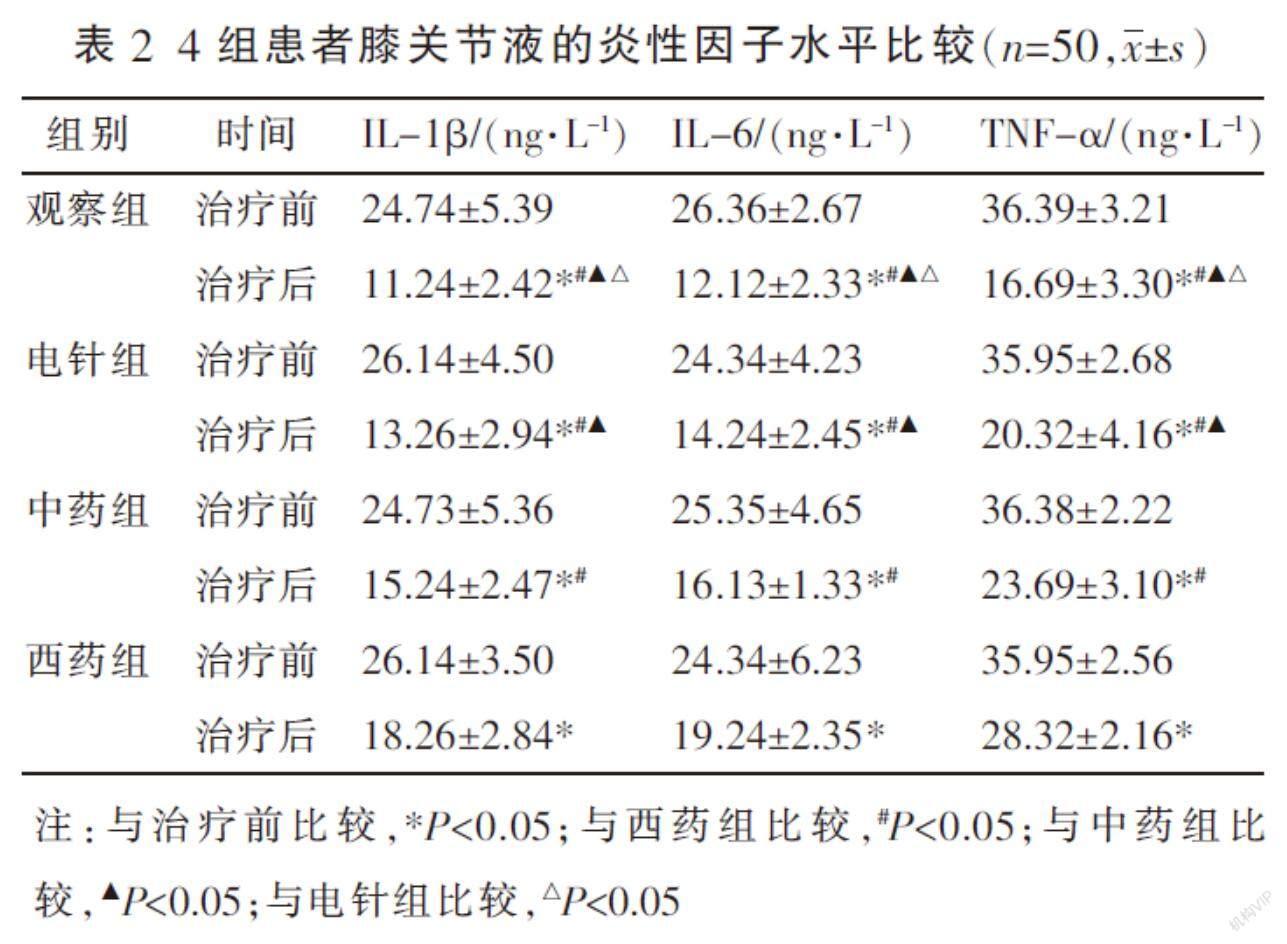
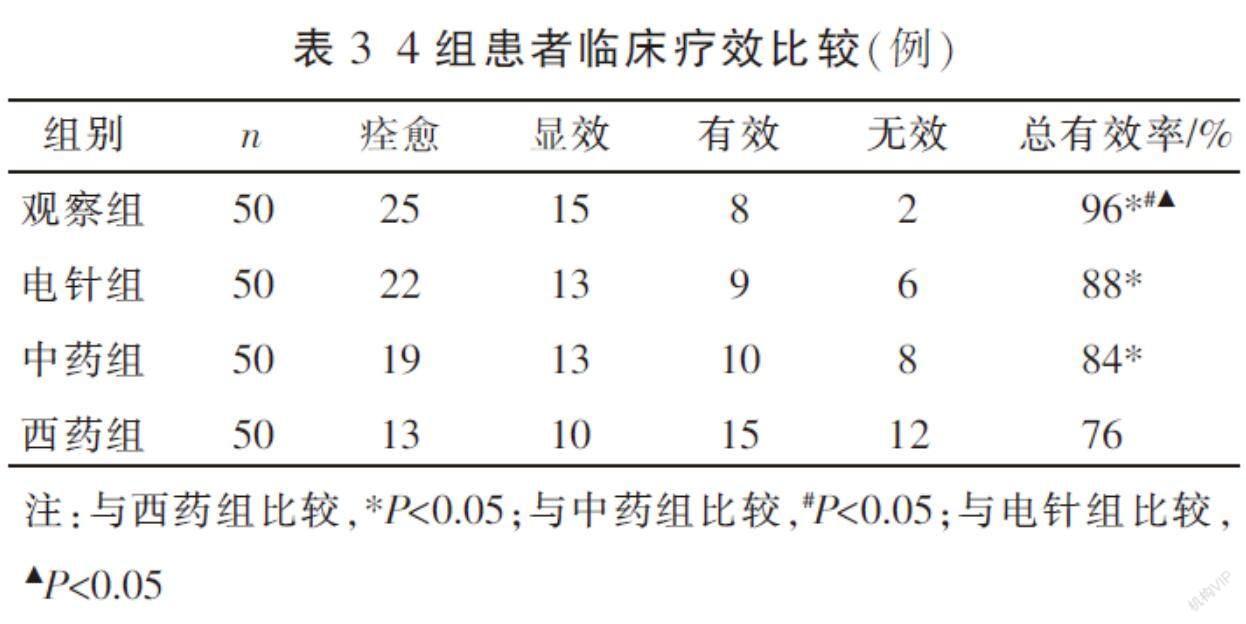
〔摘要〕 目的 研究从脾胃论治国医大师熊继柏膝痹经验方结合电针膝痹八穴治疗瘀血痹阻型膝关节骨性关节炎(knee osteoarthritis, KOA)的有效性及作用机制。方法 200例瘀血痹阻型KOA患者随机分为观察组(国医大师熊继柏膝痹经验方结合电针膝痹八穴)、电针组(电针膝痹八穴)、中药组(国医大师熊继柏膝痹经验方)及西药组(双氯酚酸钠肠溶片),每组50例。记录4组患者治疗前后的疼痛视觉模拟量表(visual analogue scale, VAS)评分、安大略西部麦克马斯特大学骨关节炎指数(Western Ontario and Mcmaster Universities osteoarthritis index, WOMAC)评分、骨髓水肿面积及关节液中炎性因子含量的变化并比较其疗效。结果 与治疗前比较,治疗后4组VAS评分、WOMAC评分均明显降低,核磁共振检测骨髓水肿面积减少,关节腔内白细胞介素1β(interleukin-1β, IL-1β)、白细胞介素6(interleukin-6, IL-6)、肿瘤坏死因子α(tumor necrosis factor-α, TNF-α)均减少(P<0.05);治療后观察组与其余三组比较,VAS评分、WOMAC评分均明显降低,骨髓水肿面积和IL-1β、IL-6、TNF-α含量均减少(P<0.05)。治疗后,观察组总有效率(96%)与电针组(88%)、中药组(84%)、西药组(76%)比较,差异有统计学意义(P<0.05)。结论 从脾胃论治国医大师熊继柏膝痹经验方结合电针膝痹八穴治疗瘀血痹阻型KOA,可有效改善患者疼痛、关节活动度,减少骨髓水肿面积,降低关节液中炎性因子水平。
〔关键词〕 膝关节骨性关节炎;瘀血痹阻型;脾胃论治;电针;骨髓水肿面积;炎性因子;国医大师;熊继柏
〔中图分类号〕R274 〔文献标志码〕B 〔文章编号〕doi:10.3969/j.issn.1674-070X.2021.11.022
Clinical Study of National TCM Master Xiong Jibos Knee Paralysis Experience Prescription Combined with Electroacupuncture of Knee Paralysis Eight Points in the Treatment of the Senile Knee Osteoarthritis with Blood-stasis Obstruction from the Spleen and Stomach
JIANG Xueyu1,2, ZHONG Qinghua2, YANG Song2, MENG Ling2, YANG Zixun2, WANG Ruian2, LIN Weidi2, WANG Yanan2, YANG Tingwei2, XU Yuanpei2, XIONG Jibo3, CHANG Xiaorong2*
(1. Yueyang Hospital Affilitated to Hunan University of Chinese Medicine, Yueyang, Hunan 414000, China; 2. School of Acupuncture-Moxibustion and Tui-na, Hunan University of Chinese Medicine, Changsha, Hunan 410208, China; 3. The First Affiliated Hospital of Hunan University of Chinese Medicine, Changsha, Hunan 410007, China)
〔Abstract〕 Objective To study the efficacy and mechanism of Xiong Jibo knee paralysis experience prescription combined with electroacupuncture of knee paralysis eight points in the treatment of knee osteoarthritis (KOA) with blood-stasis obstruction. Methods Two hundred patients with KOA of blood-stasis obstruction were randomly divided into observation group (Xiong Jibos knee paralysis experience prescription combined with electroacupuncture of knee paralysis eight points), electroacupuncture group (electroacupuncture of knee paralysis eight acupoints), traditional Chinese medicine group (Xiong Jibos knee paralysis experience prescription) and western medicine group (diclofenac sodium enteric-coated tablets), with 50 cases in each group. The visual analogue scale (VAS) score, Western Ontario and McMaster University osteoarthritis index (WOMAC) score, bone marrow edema area and the content of inflammatory factors in synovial fluid were recorded before and after treatment, and the curative effects were compared. Results Compared with those before treatment, VAS score, WOMAC score, bone marrow edema area detected by MRI, interleukin-1β (IL-1β), interleukin-6 (IL-6) and tumor necrosis factor-α (TNF-α) in the joint cavity of the four groups decreased significantly after treatment (P<0.05). After treatment, the VAS score, WOMAC score, bone marrow edema area and the content of IL-1β, IL-6 and TNF-α in the observation group were significantly lower than those in the other three groups (P<0.05). After treatment, the total effective rate of the observation group (96%) was compared with electroacupuncture group (88%), traditional Chinese medicine group (84%) and western medicine group (76%), and the difference was statistically significant (P<0.05). Conclusion National TCM master Xiong Jibos knee paralysis experience prescription combined with electroacupuncture of knee paralysis eight points in the treatment of the senile KOA with blood-stasis obstruction from the spleen and stomach can effectively improve the pain and range of motion of the patients, reduce the area of bone marrow edema and reduce the level of inflammatory factors in articular fluid.
〔Keywords〕 knee osteoarthritis; blood-stasis obstruction; treatment based on the spleen and stomach theory; electroacupuncture; area of bone marrow edema; inflammatory factor; national TCM master; Xiong Jibo
膝关节骨性关节炎(knee osteoarthritis, KOA)主要表现为关节软骨退行性病变,主要由慢性积累性磨损引起,已成为高龄老年人腿痛的常见病因之一[1]。KOA是一种慢性关节疾病,其病理特点为膝关节软骨反应性增生、软骨形成骨刺以及膝关节软骨的变性[2]。相关流行病学研究[3]表明,本病好发于50岁以上人群,女性患病率明显高于男性的患病率,KOA在中国的发病率约为18%。KOA患者与健康人群相比较,消耗经济较多,并且其生活质量明显较差。……
