乘用车排气净化器热疲劳分析方法
2021-11-28陈正国杨小东褚霞齐冬亮张辉
陈正国 杨小东 褚霞 齐冬亮 张辉
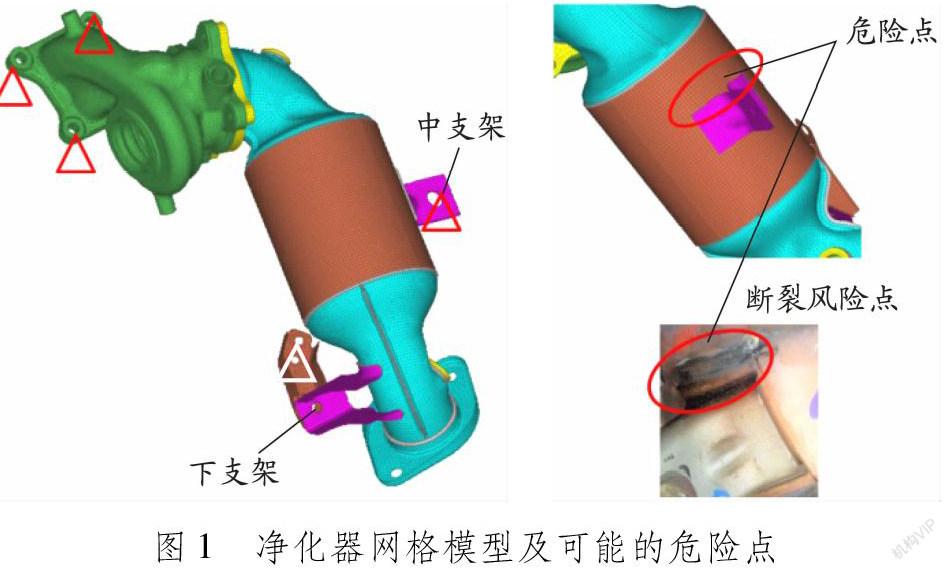
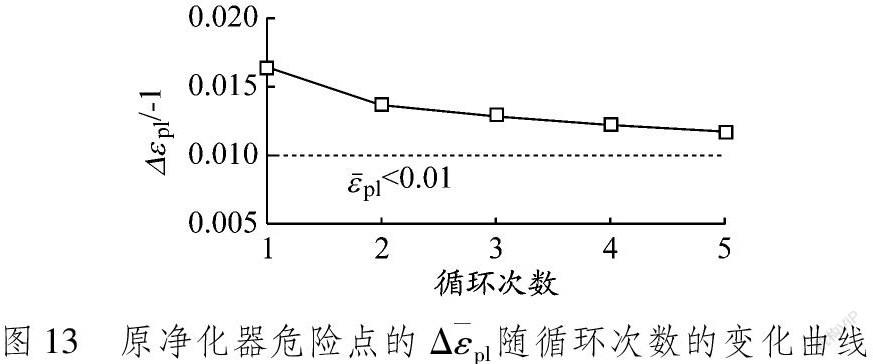
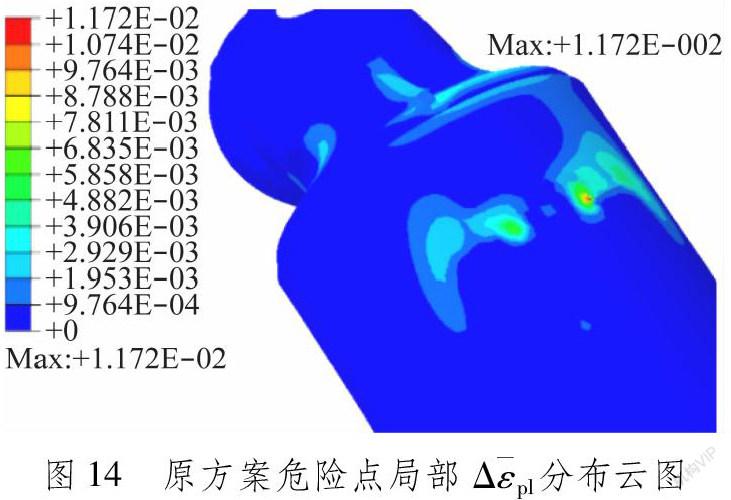
摘要:为探究温度循环载荷下排气净化器的热疲劳性能,结合传热分析和静力学分析,采用有限元软件HyperMesh和Abaqus,对某型乘用车排气净化器进行深入研究,考虑高温效应和材料硬化效应的影响,选择等效塑性应变幅值作为评价热疲劳的关键指标,分析得到危险点等效塑性应变幅值为0.011 7,不满足热疲劳耐久要求。对原排气净化器的下支架进行翻边处理,得到的新排气净化器的等效塑性应变幅值最高为0.008 7,满足热疲劳耐久要求。
关键词:排气净化器;熱疲劳;传热;有限元
中图分类号:TP391.99;U464.134.4
文献标志码:B
文章编号:1006-0871(2021)03-0044-05
DOI:10.13340/j.cae.2021.03.008
Abstract:To study the thermal fatigue performance of exhaust converter under temperature cyclic load, an depth study on an vehicle exhaust converter is carried out combined with heat transfer analysis and static analysis by finite element software HyperMesh and Abaqus. Considering the high temperature effect and material hardening effect, the thermal fatigue is evaluated taking the equivalent plastic strain amplitude as the key index. It shows that the equivalent plastic strain amplitude at the dangerous point is 0.011 7, which does not meet the requirements of thermal fatigue durability. The lower support of the original exhaust converter is flanged, and the maximum equivalent plastic strain amplitude of the new exhaust converter is 0.008 7, which meets the requirements of thermal fatigue durability.
Key words:exhaust converter;thermal fatigue;heat transfer;finite element
0 引 言
汽车排气净化器承受高温载荷和剧烈振动,其结构可靠性一直是重要研究领域[1-7]。YOSHIMASA等[3]基于标准试样,对排气歧管的热疲劳性能进行初步分析;CHINOUILH等[4]通过实验测试和有限元分析研究排气歧管的热疲劳性能。国内学者董劲等[8]采用2个加热-冷却循环加载进行热机疲劳分析,并采用第2个循环的等效应变增量评估排气歧管的热疲劳性能;李相旺等[9]采用热应力值表征增压发动机排气热端的热疲劳性能;张涵宇等[10]进一步利用Manson-Coffin理论预测高镍铸铁排气歧管的热疲劳寿命。
本文借签已有研究成果,同时考虑高温因素和材料循环硬化的影响,采用5个加热-冷却循环进行热机疲劳分析,采用等效塑性应变幅值评价排气净化器的热疲劳性能,对原净化器结构进行分析和优化,使其满足热疲劳耐久指标要求。
1 关……