基于Logistic回归惩罚函数的遗传位点分析
2021-11-20庄虹莉


DOI:10.16644/j.cnki.cn33-1094/tp.2021.11.003
摘 要: 探讨将基于惩罚函数的变量选择方法应用到遗传位点分析。以2016年9月16日的全国研究生数学建模竞赛B题的数据为例,首先对每个位点的碱基对(A、T、C、G)编码方式数值化处理,最后用数值化后的数据进行建模,并将单变量选择Logistic SCAD、组变量选择Logistic Group SCAD模型和双层变量选择Logistic cMCP模型定位到与遗传性疾病显著相关的遗传位点,分别与出题者提供的标准答案进行对比,结果显示双层变量选择Logistic cMCP模型能够准确的定位到与遗传性疾病显著相关的遗传位点。因此将其运用到具有遗传性疾病和性状的遗传位点分析是值得研究的。
关键词: Logistic回归; 惩罚函数; cMCP; 遗传位点
中图分类号:O 文献标识码:A 文章编号:1006-8228(2021)11-09-03
Genetic locus analysis based on penalty function in Logistic regression
Zhuang Hongli
(JINSHAN College of Fujian Agriculture and Forestry University, Fuzhou, Fujian 350002, China)
Abstract: Discuss the application of the penalty function based variable selection method in genetic locus analysis. Taking the data of question B of the National Graduate Mathematical Modeling Competition on September 16, 2016 as an example, the base pair (A, T, C, G) coding method of each site is numerically processed, and modeling with final numerically processed data, the univariate selection Logistic SCAD, the group variable selection Logistic Group SCAD model, and the two-layer variable selection Logistic cMCP model are located to genetic sites that are significantly related to genetic diseases, and compare with the standard answers provided by the questioner. The results show that the two-layer variable selection Logistic cMCP model can accurately locate genetic sites that are significantly related to genetic diseases. Therefore, applying it to the analysis of genetic locus with genetic diseases and traits is worth studying.
Key words: Logistic regression; penalty function; cMCP; genetic locus
0 引言
人體中携带的DNA是人的遗传密码的载体。DNA由分别带有A,T,C,G四种碱基的脱氧核苷酸链接组成的双螺旋长链分子,基因则是DNA长链中有遗传效应的一些片段,在这些片段中有一些特定位置的单个核苷酸经常发生变异引起DNA的多态性,我们称之为位点[1]。通过大量研究表明,人体的许多表现型性状差异以及对药物或者是否患病等都可能与某些位点相关联或多个位点的基因相关联。常用的统计方法多要求样本量要远大于变量数,而在基因数据中解释变量的维数往往远大于样本量即“大[p]小[n]”数据,导致传统的统计方法不再适用。
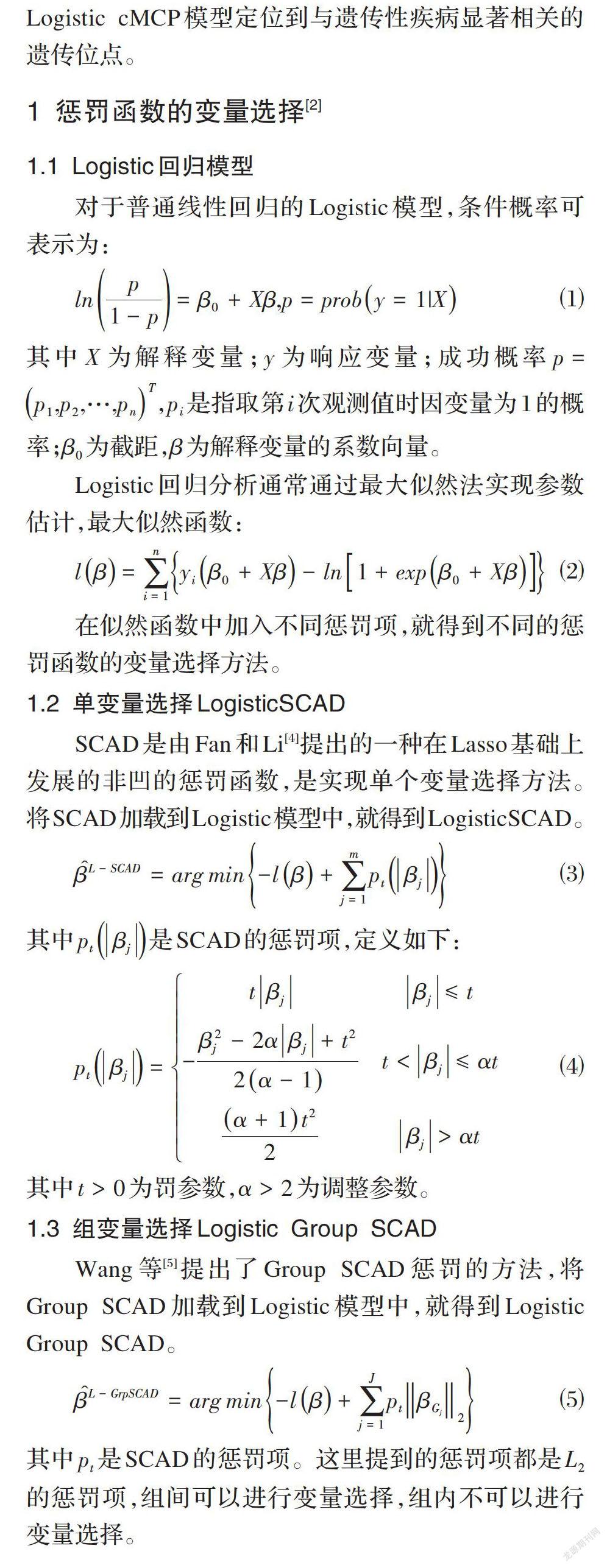
基于惩罚函数的变量选择是在线性回归模型的参数估计中,在原有的最小二乘或极大似然函数的基础上加入惩罚函数项得到新的惩罚目标函数[2],从而实现变量选择和参数估计。……