抗高血压药物基因检测在脑出血高血压患者中的应用效果
2021-11-14于涛龚海东鉴玉波袁婧朱琳梁欢王闰纪国敏李海红马丽秋
于涛 龚海东 鉴玉波 袁婧 朱琳 梁欢 王闰 纪国敏 李海红 马丽秋


[關键词] 高血压;基因多态性;药效学;脑出血
[中图分类号] R743.34 [文献标识码] A [文章编号] 1673-9701(2021)23-0005-05
Application effect of gene testing of antihypertensive drugs in hypertensive patients with cerebral hemorrhage
YU Tao1 GONG Haidong1 JIAN Yubo1 YUAN Jing1 ZHU Lin1 LIANG Huan1 WANG Run1 JI Guomin1 LI Haihong2 MA Liqiu1
1.Department of Neurosurgery, Hongqi Hospital Affiliated to Mudanjiang Medical University, Mudanjiang 157011, China; 2.Department of Gitical Care Medicine, Hongqi Hospital Affiliated to Mudanjiang Medical University, Mudanjiang 157011, China
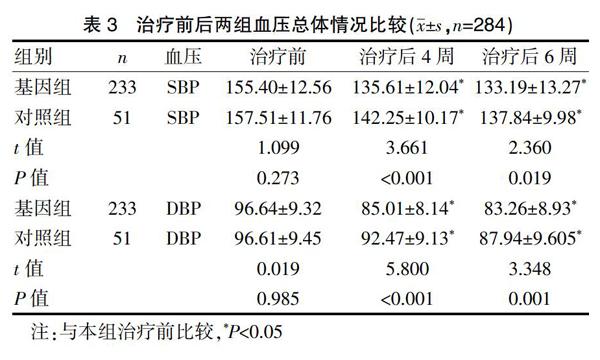
[Abstract] Objective To analyze the polymorphisms of anti-hypertensive-related genes in hypertensive patients with cerebral hemorrhage and distribution characteristics in the population and explore the clinical effect of anti-hypertensive gene testing on rational drug intervention in hypertensive patients with cerebral hemorrhage. Methods A total of 284 stroke patients who had a history of hypertension or were diagnosed with hypertension at the time of discharge and were hospitalized in the Department of Neurosurgery of Hongqi Hospital of Mudanjiang Medical University from January 2018 to September 2020 were selected. They were divided into the gene group (n=233) and the control group (n=51), according to whether they were given anti-hypertensive gene testing. The gene group were given corresponding anti-hypertensive drugs were given to patients according to different test results, and the control group were given conventional anti-hypertensive treatment. The effect on reducing blood pressure was compared between the two groups. Results Among the 233 hypertensive patients with cerebral hemorrhage who underwent anti-hypertensive genetic testing, the mutation rate of CYP2D6(*10) was 49.4%, ADRB1 (1165G-C) was 77.3%, CYP2C9(*3) was 2.8%, AGTR1 (1166A-C) was 4.5%, ACE (I/D) was 37.6%, NPPA (2238T-C) was 0.9%, and CYP3A5(*3) was 75.5%. At 4 and 6 weeks after treatment, the systolic and diastolic blood pressures of the gene group were significantly lower than those of the control group, with statistically significant differences (P<0.05). At 6 weeks after treatment, the total effective rate of reducing blood pressure of the gene group was 89.7%, which was higher than that of 72.5% in the control group , with statistically significant difference(P<0.05). Conclusion The gene polymorphism has obvious individual differences in hypertensive patients with cerebral hemorrhage. The rational adjustment of medication based on anti-hypertensive gene testing has significance in reducing blood pressure in hypertensive patients.
[Key words] Hypertension; Gene polymorphism; Pharmacodynamics; Cerebral hemorrhage
脑出血主要包括原发性脑出血及继发性脑出血,高血压及腦血管畸形是原发性脑出血的主要原因[1-2]。作为脑出血的重要危险因素之一,原发性高血压是世界第一位的致死因素,尤其是在发展中国家,是一种由遗传和环境因素共同作用的疾病,发病机制尚未完全明确[3]。从根本上阻止自发性脑出血发生的关键问题是控制血压,但是,相同的降压药物对血压的控制效果也因人而异,这可能与不同患者之间编码基因的遗传差异所诱导的药代动力学变化有关。基因多样性参与高血压的形成,且肾素-血管紧张素系统(Renin-angiotensin system, RAS)、交感植物性神经系统、肾脏功能、电解质平衡等高血压的病理过程也受遗传因素影响。随着基因组技术的发展,高血压基因组学及药物基因组学研究的深入,本研究拟通过检测5大类降压药物及7组基因位点并进行统计分析,探讨抗高血压基因检测在临床中的应用价值,现报道如下。
1 资料与方法
1.1 一般资料
在患者及家属知情同意的前提下,选择2018年1月至2020年9月于牡丹江医学院附属红旗医院神经外科住院治疗的脑出血患者,且有高血压病史或出院时诊断高血压病者作为研究对象。参考《中国高血压防治指南2018年修订版》高血压诊断标准作为实验对象的纳入标准[4],即入院起连……
