黄淮稻区早熟水稻品种(品系)穗颈瘟抗性分析
2021-11-14邢运高刘艳迟铭陈庭木孙志广徐波杨波李景芳李健方兆伟卢百关王宝祥徐大勇
邢运高 刘艳 迟铭 陈庭木 孙志广 徐波 杨波 李景芳 李健 方兆伟 卢百关 王宝祥 徐大勇

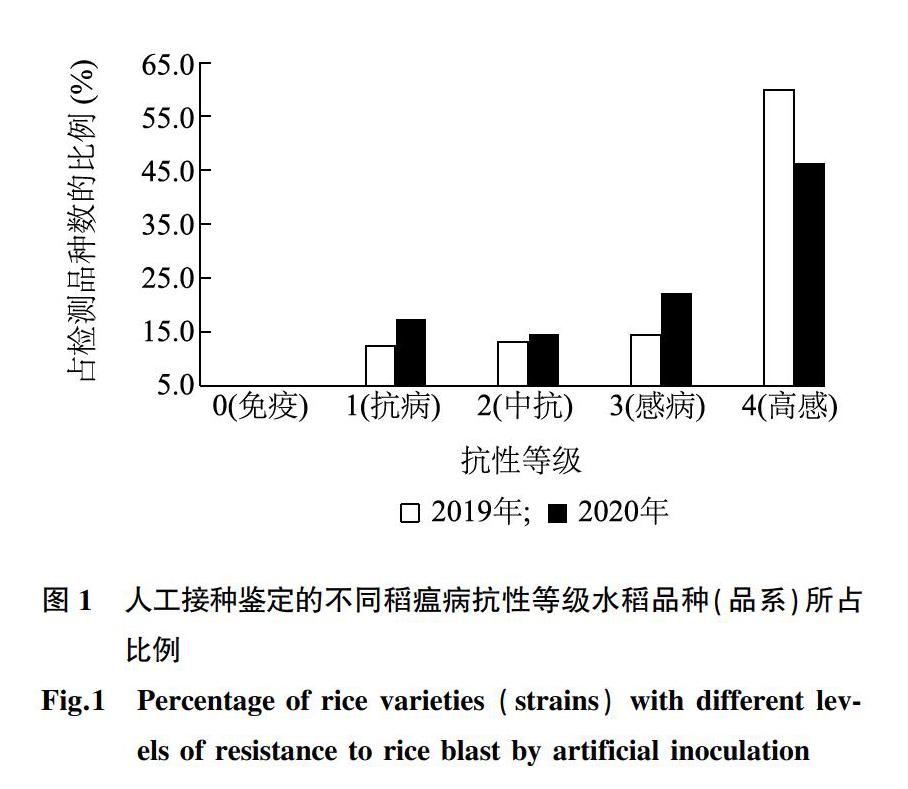
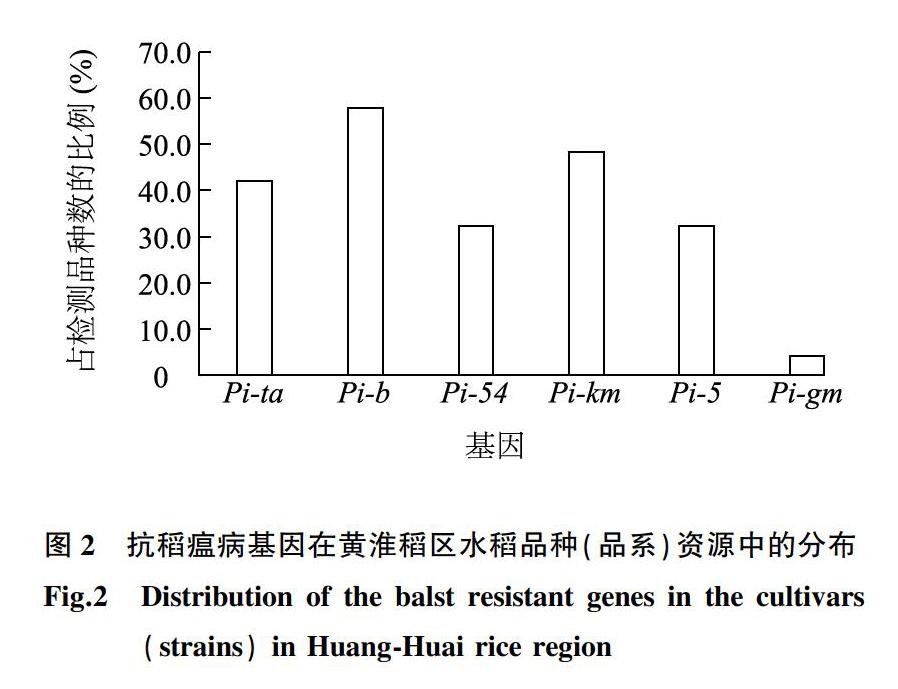
摘要: 為明确黄淮稻区早熟水稻品种(品系)的稻瘟病抗性,对145份黄淮稻区早熟水稻品种(品系)进行连续2年的接种鉴定,并利用 Pi-ta 、 Pi-b 、 Pi-km 、 Pi-54 、 Pi-5 和 Pi-gm 6个抗病基因的分子标记进行抗稻瘟基因型检测。抗性基因在检测品种(品系)中的分布结果表明,抗性基因 Pi-b 分布比例最高,检出率为57.9%,其次是抗性基因 Pi-km、Pi-ta、Pi-54 和 Pi-5 ,检出率分别为51.0%、42.1%、32.4%及32.4%,抗性基因 Pi-gm 分布比例最低,仅有4.1%。2019-2020年连续2年的人工接种鉴定结果显示,74.5%和68.3%的品种(品系)表现为感病,说明黄淮稻区早熟品种(品系)的稻瘟病抗性较差,抗病材料较少。携带抗性基因 Pi-ta 、 Pi-b 、 Pi-km 、 Pi-54 、 Pi-5 和 Pi-gm 的品种(品系),2019年抗性比例分别为42.6%、21.4%、27.7%、34.3%、27.7%和100.0%,2020年抗性比例分别为49.2%、26.2%、25.5%、32.9%、34.0%和100.0%。6个基因中, Pi-gm 抗性比例最高,达到100.0%, Pi-ta 次之,抗性比例达45.9%,而 Pi-b 最差,抗性比例仅为23.8%。黄淮稻区早熟水稻品种(品系)抗稻瘟病能力较差,需要通过聚合多个抗性基因来提高抗性,特别需要加强 Pi gm 等新的抗稻瘟病基因的应用。
关键词: 水稻; 早熟品种(品系); 稻瘟病; 抗性基因
中图分类号: S435.111.4 +1 文献标识码: A 文章编号: 1000-4440(2021)05-1089-11
Resistance analysis of early-maturing rice varieties (strains) to neck blast in Huang-Huai rice region
XING Yun-gao, LIU Yan, CHI Ming, CHEN Ting-mu, SUN Zhi-guang, XU Bo, YANG Bo, LI Jing-fang, LI Jian, FANG Zhao-wei, LU Bai-guan, WANG Bao-xiang, XU Da-yong
(Lianyungang Academy of Agricultural Sciences/Jiangsu Collaborative Innovation Center for Modern Crop Production, Lianyungang 222006, China)
Abstract: To clarify the resistance of early-maturing rice varieties (strains) to rice blast in Huang-Huai rice region, 145 early-maturing rice varieties (strains) in Huang-Huai rice region were identified through artificial inoculation in two consecutive years. The rice blast resistant genotypes were analyzed by molecular markers of six resistance genes such as Pi-ta 、Pi-b、Pi-km、Pi-54、Pi-5 and Pi-gm . Among the tested varieties (strains), resistance gene Pi-b had the highest distribution proportion, with a detection rate of 57.9%, followed by resistance genes Pi-km , Pi-ta , Pi-54 and Pi-5 , their detection rates were 51.0%, 42.1%, 32.4% and 32.4% respectively, and resistance gene Pi-gm had the lowest distribution proportion, which was only 4.1%. The identification results of artificial inoculation in two consecutive years from 2019 to 2020 showed that, 74.5% and 68.3% of the varieties (strains) were sensitive to rice blast in 2019 and 2020, respectively. It was indicated that the resistance of early-maturing varieties (strains) in Huang-Huai rice region was poor and the resistant materials were few. The resistance proportions of the varieties (strains) carrying resistance genes Pi-ta、Pi-b、Pi-km、Pi-54、Pi-5 and Pi-gm were 42.6%, 21.4%, 27.7%, 34.3%, 27.7% and 100.0% respectively in 2019, and were 49.2%, 26.2%, 25.5%, 32.9%, 34.0% and 100.0% in 2020. Among the six genes, Pi-gm had the highest resistance proportion, which reached 100.0%, followed by Pi-ta , with resistance proportion of 45.9%. Pi-b had the lowest resistance proportion, with a resistance proportion of only 23.8%. The resistance of the early-maturing rice varieties (strains) to rice blast in Huang-Huai rice region is poor, and is necessary to aggregate multiple resistance genes to improve the resistance of rice varieties (strains), especially to strengthen the application of new blast resistance genes.
Key words: rice; early-maturing varieties (strains); rice blast; resistant gene
黄淮稻区水稻面积约 1.60× 10 6 hm 2 ,占南方粳稻面积的一半左右,是中国重要的粳稻产区 [1] 。稻瘟病一直是危害水稻生產的重要病害,严重威胁中国的水稻生产安全。黄淮稻区地处中国南北过渡带,年际间气候不稳定,特别在粳稻抽穗灌浆期间经常遭遇连续的低温、阴雨等不良天气。适温高湿的环境利于稻瘟病,特别是穗颈瘟的暴发,严重影响水稻的生产安全。……
