烘干方式对银耳营养品质的影响
2021-11-12姚清华林虬陈美珍黄敏敏颜孙安
姚清华 林虬 陈美珍 黄敏敏 颜孙安
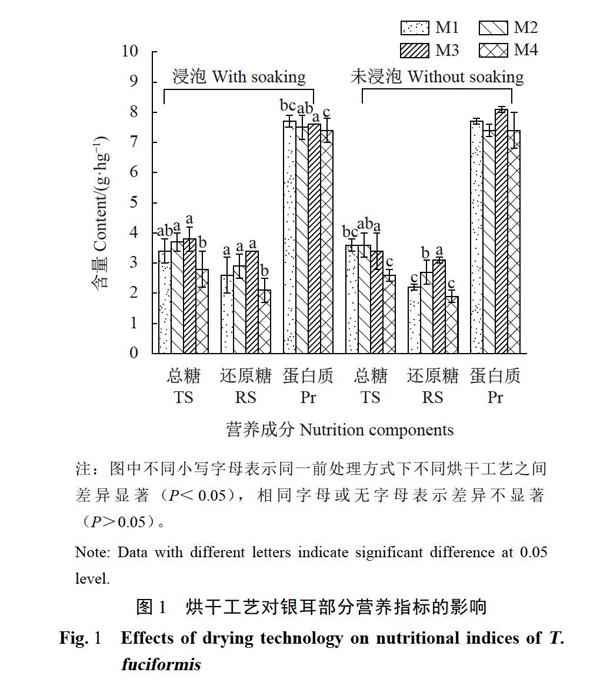
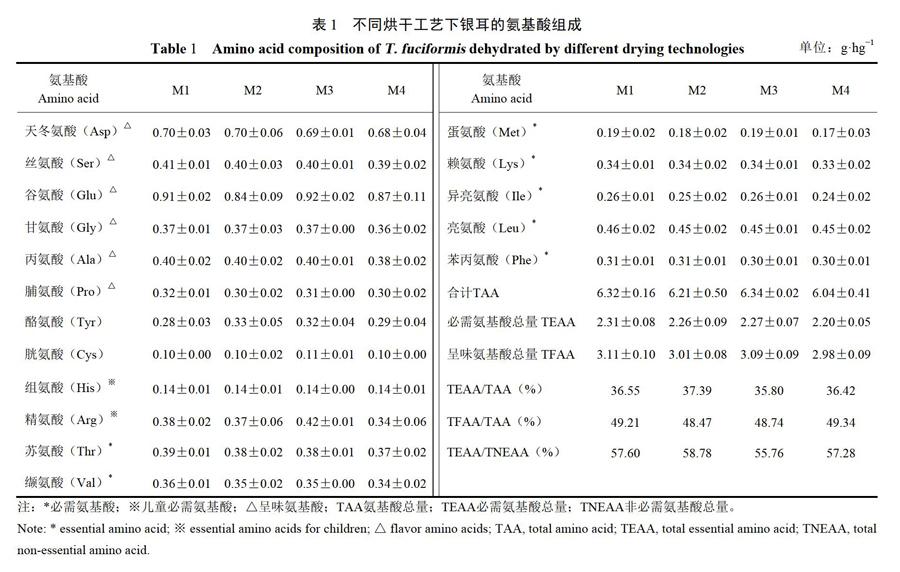
摘要:【目的】研究烘干方式對银耳营养的影响,为完善银耳烘干工艺、提高银耳品质提供理论依据。【方法】以蛋白质、糖类含量和氨基酸营养品质为评价指标,应用统计学和FAO/WHO建议的氨基酸评估模式,比较银耳实际生产中常见的以废菌棒为燃料工厂化烘干(MI)、以废菌棒木屑为燃料工厂化烘T(M2)、以废菌棒燃料小灶烘干 (M3)、电热干厂化烘干(M4)等4种烘干工艺对银耳营养的影响。【结果】烘干前的浸泡工序对银耳蛋白质、糖类、氨基酸营养和二氧化硫含量无显著性影响(P> 0.05)但M2. M3烘干条件下的银耳总糖、还原糖含量显著高于M4(P< 0.05)。4种烘干方式制备的银耳干品单一氨基酸含量及总量均无显著性差异(P>0 05),组成特征相似。小同烘干组银耳氨基酸营养平衡性略有差异,氨基酸比值系数分从高到低依次为M1( 80.52)>M4( 79.55) >M3( 79.15) >M2( 77.80),说明银耳是一种氨基酸营养比较均衡的食物。赖氨酸为银耳干制品的第一限制性氨基酸。【结论】烘T前的清洗、浸泡小会导致银耳营养变化,现行烘干工艺制备的银耳干品并无二氧化硫残留,以废菌棒木屑为燃料的工厂化烘干方式及以废菌棒燃料的小灶烘干方式下银耳营养损失较少。
关键词:银耳;干燥;营养品质;氨基酸;二氧化硫
中图分类号:TS 225.36
文献标志码:A
文章编号:1008-03 84( 2021) 07-0861-06
Effects of Drying Technology on Nutrition of Tremella fuciformis
YAO Qinghua 1.2.3, LIN Qiu 1.2.3, CHENMeizhen 1.2.3. HUANGMinmin 1.2.3, YAN Sunan 1.2.3
(1 Fujian Key Laboratory of Agro-products Quality and Safety, Fuzhou, Fujian 350003. China;2.Institute of Quality Standardsand Testing Technologyfor Agro-products, Fujian Academy ofAgriczdtural Sciences, Fuzhou, Fujian 350003, China;3.Labora tory of Quality and Safeo isk Assessment for Agro-products,Ministry of
Agriculture and Rural Affairs, Fuzhou, Fujian 350003. China)
Abstract: 【Objective】 Effect of drying technology on the nutritional quality of Tremella fuciformis Berk was studied【Method】 The national standards on the nutritional quality of edible fungi, such as contents of total sugar, reducing sugar,protein, and amino acids. were the indices used to evaluate 4 drying technologies in producing the dehydrated product. TheFAO/WHO indexing system was applied to gage the protein nutrition. Dehvdration of T fuciformis employed either spentculture substrate for fuel in a factory oven (M1), spent culture substrate and wood chips for fuel in a factory oven (M2), spentculture substrate for fuel in a workshop oven (M3). or an industrial electric oven (M4). 【Results】Water-soaking of the fungiprior to dehydration showed no significant effect on the contents of protein, sugar, amino acids. and sulfur dioxide in the driedproduct (P> 0.05). However. the various drying methods resulted in quality differentiations among them. The contents of totalsugar and reducing sugar in the dried,fuciformis prepared under M2 and M3 were significantly higher than those under M4(P<0.05). The amino acid contents of the products made by different technologies did not differ significantly (P> 0.05). Thenutritional grading based on amino acids ranked the dried mushrooms from those made by Ml at a score of 80.52. to M4 0f79.55. M3 0f 79. 15, and M2 0f 77.80. A11 dried fungi products had a well-balance nutritional composition with lysine being thetop restricted amino acid. 【 Conclusion】 The total sugar and amino acids in the dehydrated T. fuciformis were not affected bythe pre-soaking but significantly by the drying process. Either drying by using spent culture substrate and wood chips for fuelin a factory oven (M2) or by using spent culture substrate for fuel in a workshop oven (M3) retained the nutrients moreeffectively than other methods. Incidentally. there was no sulfur dioxide residue detected in the dried T. fuciformis produced bythe process currently practiced by the industry.
Key words: Tremella fuciformis Berk; drying; nutrition property; amino acid: sulfur dioxide
0 引言
【研究意义】银耳(Tremellafuciformis Berk),是银耳科、银耳属的一种食药兼用真菌,又名雪耳、银耳子、白木耳[1]。银耳主要栽培于我国和部分亚洲地区,因具有抗肿瘤、抗氧化、增强机体免疫力等多种保健功效深受消费者青睐[2-4]。由于银耳鲜样含水量高且营养丰富,不利于贮藏保鲜,大部分的银耳是以脱水干制品的形式销售[4],因此,研究银耳干制工艺对银耳产业的发展具有积极的意义。【前人研究……
