耳鸣患者与睡眠质量相关性的临床分析及治疗探讨
2021-11-03连纯利刘元献杨龙刘霞胡镇何强亮
连纯利 刘元献 杨龙 刘霞 胡镇 何强亮

[关键词] 耳鸣;睡眠治疗;耳鸣治疗;耳鸣睡眠
[中图分类号] R764.45 [文献标识码] B [文章编号] 1673-9701(2021)17-0073-05
Discussion on clinical analysis and treatment of the correlation between tinnitus and sleep quality
LIAN Chunli LIU Yuanxian YANG Long LIU Xia HU Zhen HE Qiangliang
Department of Otorhinolaryngology, Shenzhen Traditional Chinese Medicine Hospital, Shenzhen 518000, China
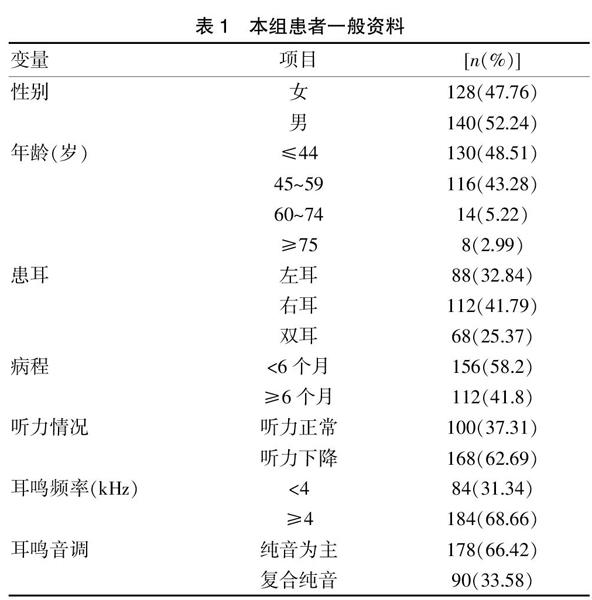
[Abstract] Objective To analyze clinically the correlation between tinnitus patients and sleep to provide effective treatment for tinnitus. Methods A total of 268 patients with tinnitus admitted to Shenzhen Hospital of Traditional Chinese Medicine from August 2018 to January 2020 were evaluated by general survey, tinnitus disability scale THI and Pittsburgh sleep quality index.Meanwhile,pure tone audiology, tinnitus pitch and frequency matching were also performed. Results The patients with tinnitus were 47.76% for female and 52.24% for male, including 48.51% under 44 years old,43.28% between 45 and 59 years old, 5.22% between 60 and 74 years old and 2.99% over 75 years old. Tinnitus patients with hearing loss accounted for 62.69%; tinnitus mainly with pure tone accounted for 66.42%; tinnitus frequency mainly with high frequency accounted for 68.66%. The THI scores of patients with sleep disorders were significantly higher than those with normal sleep;a significant positive correlation between tinnitus disability scale (THI) and Pittsburgh sleep quality index (PSQI) was observed (r=0.291, P<0.001). Conclusion The more serious the tinnitus,the worse the sleep quality, and the two affect each other.The multiple comprehensive treatment should be adopted based on the improvement of sleep quality, which is beneficial to relieve tinnitus.
[Key words] Tinnitus; Sleep treatment; Tinnitus treatment; Tinnitus sleep
耳鳴是在耳鼻喉头颈外科常见的一种症状,是指外界没有相应声源或电刺激存在,患者耳内或颅内有声音的主观感觉[1]。目前耳鸣的发病机制尚未明确, 多认为疾病主要因传导途中神经纤维异常点活动、边缘神经系统紊乱、自主神经系统紊乱等机制有关[2]。耳鸣发病率约10.0%~20.0%[3]。成人耳鸣患者中超过一半有睡眠障碍[4]。耳鸣患者容易出现睡眠障碍,其伴随的焦虑、抑郁情绪是影响睡眠质量的重要因素[5]。由于耳鸣病因不明,治疗疗效存在不确定性,临床治疗难度较大,病情反复。因此,本研究以问卷形式调查耳鸣患者严重程度与睡眠质量的相关性,从患者睡眠质量角度探讨耳鸣的治疗方法,为耳鸣的临床诊疗提供更多思路,现报道如下。
1 资料与方法
1.1 一般资料
选取2018年8月至2020年1月在深圳市中医院就诊的268例耳鸣患者为研究对象,年龄18~75岁,平均(42.21±12.70)岁。其中男140例,平均年龄(43.65±10.59)岁,女128例,平均年龄(41.07±14.24)岁。
纳入标准:①符合《欧洲多学科耳鸣指南:诊断、评估和治疗》[6]对耳鸣的诊断标准,本临床研究已通过我院医学伦理学委员会批准,临床研究开始前患者均知情同意并签署同意书。②常规耳鼻咽喉科检查外耳道、鼓膜、鼻咽部未见异常及占位性病变。③中枢神经系统检测无阳性体征。④声导抗检查双耳鼓室A型图。⑤中耳、内耳、头颅CT、MRA等检查排除先天异常、血管病变、占位性病变等客观性耳鸣,无耳部感染及手术史。……