亚临界技术处理后的牡蛎壳吸附重金属的性能评价
2021-10-28康永松
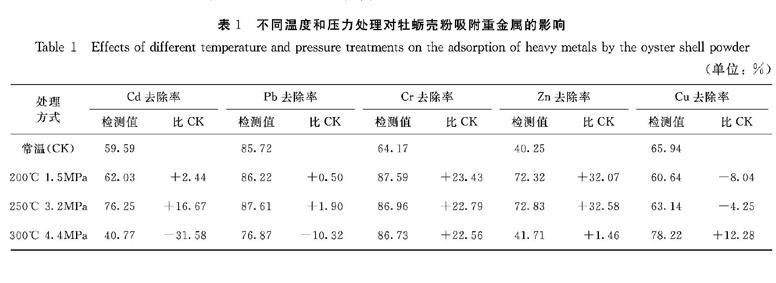
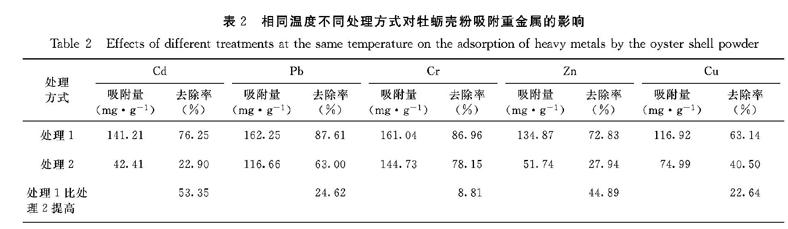
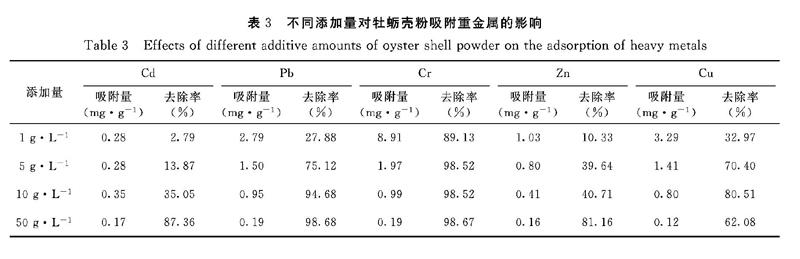
摘 要:通过研究亚临界技术处理后牡蛎壳对重金属吸附性能的影响,探究牡蛎壳制备土壤修复剂的可行性。牡蛎壳经过亚临界水解处理后对重金属离子具有较强的吸附性能,通过设置不同温度和压力处理、相同温度不同处理、牡蛎壳粉不同添加量,不同重金属初始浓度等试验开展研究,利用电感耦合等离子体发射光谱仪进行元素分析检测,结果表明:牡蛎壳粉对重金属Cd、Pb、Cr、Zn、Cu的吸附性能符合准二级动力学方程和Langmuir 等温模型。利用亚临界制备的牡蛎壳粉去除Cd最佳添加量为5~10 g·L1,去除 Pb、Cr、Zn、Cu的最佳添加量为1~5 g·L1;牡蛎壳粉末对重金属Cd、Pb、Cr、Zn、Cu的去除率最高可达到95.99%、98.68%、98.67%、93.22%和80.51%。
关键词:牡蛎壳;亚临界技术;重金属;吸附性能
中图分类号:X 703 文献标志码:A 文章编号:0253-2301(2021)08-0078-05
DOI: 10.13651/j.cnki.fjnykj.2021.08.013
Evaluation on the Adsorption of Heavy Metals by Oyster Shell Treated with Subcritical Technology
KNAG Yong-song
(Xiamen Kanghao Ecological Agriculture Co., Ltd., Xiamen, Fujian 361100, China)
Abstract: In order to explore the feasibility of preparing the repairing additive of soil from oyster shells, the effects of oyster shells treated with the subcritical technology on the adsorption of heavy metal were studied. The oyster shells had strong adsorption for the heavy metal ions after the treatment of subcritical hydrolysis. The experiments were carried out by setting different temperature and pressure treatments, different treatments at the same temperature, different additive amounts of oyster shell powder, and different initial concentrations of heavy metals. And then the analysis and detection on the elements were conducted by using the inductively coupled plasma atomic emission spectrometer (ICP-AES). The results showed that the adsorption of the oyster shell powder for the heavy metals such as Cd, Pb, Cr, Zn and Cu was in accordance with the quasi-second-order kinetic equation and Langmuir isothermal model. The optimal additive amount of oyster shell powder to remove Cd which prepared by subcritical technology was 5-10 g·L1, and the optimal additive amount of oyster shell powder to remove Pb, Cr, Zn and Cu was 1-5 g·L1. The removal rates of Cd, Pb, Cr, Zn and Cu by the oyster shell powder could reach 95.99%, 98.68%, 98.67%, 93.22% and 80.51%, respectively.Key words: Oyster shell; Subcritical technology; Heavy metals; Adsorption
根據2014年环境保护部和国土资源部发布的全国土壤污染调查公报显示[1],全国土壤总的占位超标率为16.1%,污染类型以无机型重金属污染为主,占全部超标点位的82.8%,有机型次之,复合型污染比重较小。2017年开始陆续制定发布一系列土壤污染防治与风险管控技术规范;2018年6月发布农用地土壤污染风险管控标准、建设用地土壤污染风险管控标准;2019年1月《土壤污染防治法》正式实施。
牡蛎壳由于具有特殊的层级堆叠的物理构造,再加上其含有的各种有机质及无机质成分,使其能像一般的吸附剂那样吸附重金属离子,其主要成分95%的碳酸钙和少量的壳质素[2]。Song等[3]对贝壳分级结构进行观察,研究发现棱柱结构由大小几十微米的变截面棱柱晶组成,砖泥结构中砖的尺寸为几微米,且布有大量的抑菌纳米结构颗粒,贝壳珍珠层无机文石片平行于贝壳表面排列,形成致密的层状微结构,微量的有机胶原蛋白在文石片之间发挥了黏结作用[4]。……