不同年龄段儿童免疫性血小板减少症的临床特点分析
2021-10-20王峰娜斯曼·尼加提段丽倪瓒
王峰 娜斯曼·尼加提 段丽 倪瓒

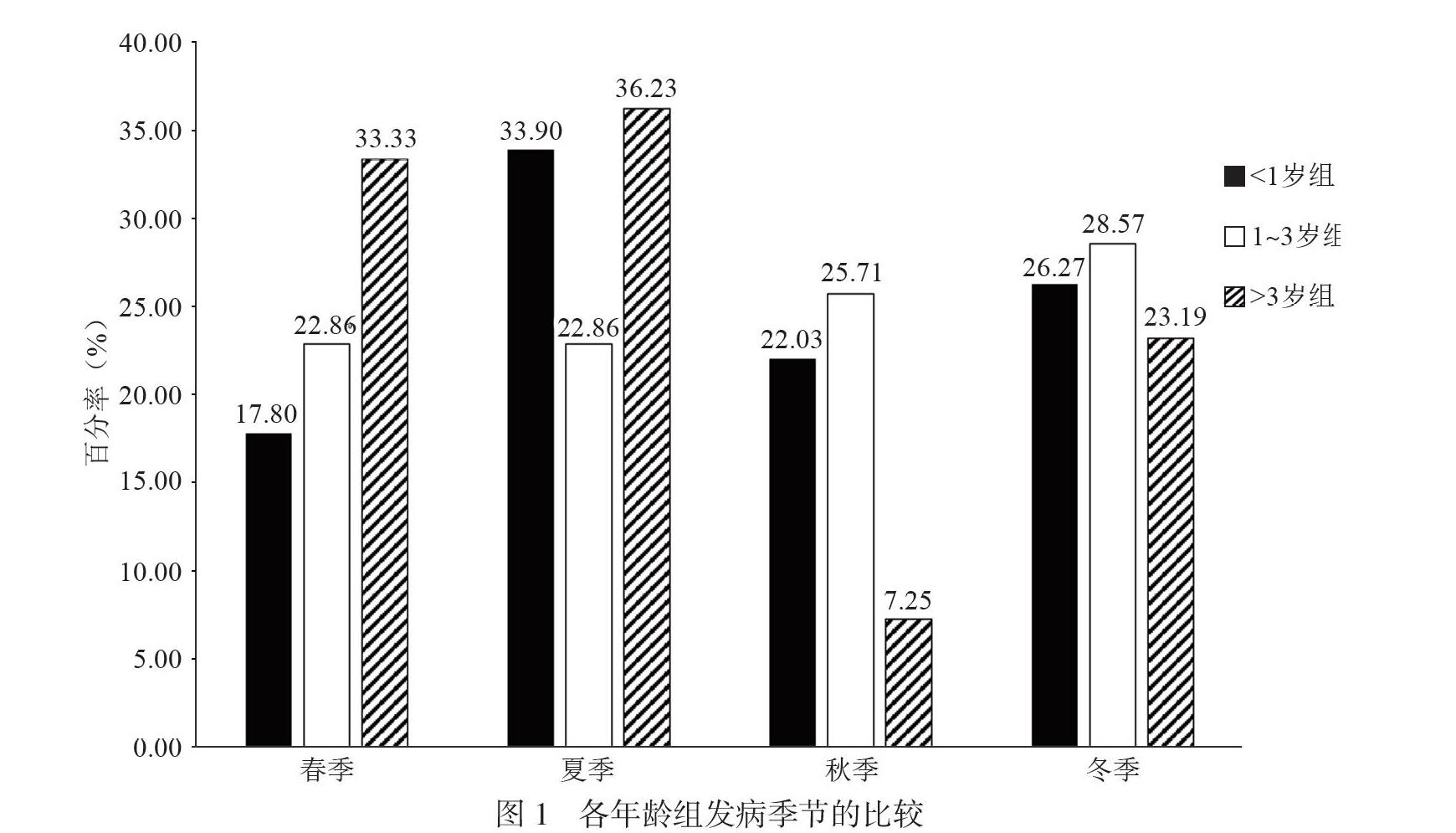

【摘要】目的 探討儿童原发性免疫性血小板减少症(ITP) 与年龄相关的临床特点。 方法 回顾性分析257例ITP患儿的临床资料,对< 1岁组、1 ~ 3岁组和> 3岁组的性别、发病季节、发病诱因、出血情况、初诊时血小板参数、治疗方法、疗效及预后情况进行统计学分析。 结果 ①257例患儿中< 1岁118例(45.9%),1 ~ 3岁70例(27.2%),> 3岁69例(26.9%)。< 1岁组男女比例3.06∶1,但随着年龄增长,男性百分率相对降低,女性百分率相对增高,< 1岁组与其他2组性别构成比比较差异有统计学意义(P均< 0.05/3)。②儿童ITP在各季节均可发病,但夏冬季相对较多,秋季最低,< 1岁组和> 3岁组发病有明显的季节性,而1 ~ 3岁组各季节持平。> 3岁组与其他2组发病季节比较差异有统计学意义(P均< 0.05/3)。③患儿中52.9%有前驱感染史,以呼吸道感染为主,11.3%有疫苗接种史,< 1岁组发病诱因中疫苗接种史高于其他2组(P均< 0.05/3)。< 1岁组与其他2组发病诱因比较差异有统计学意义(P均< 0.05/3)。④临床表现以皮肤黏膜出血为主,< 1岁组尤甚,> 3岁组鼻出血比例较高,3组间出血情况比较差异均有统计学意义(P均< 0.05/3)。⑤初诊时均有血小板计数(PLT)、血小板比容(PCT)降低,平均血小板体积(MPV)、血小板体积分布宽度(PDW)升高,< 1岁组前两者明显下降,> 3岁组后两者明显升高(P均< 0.05/3)。⑥在治疗方式中,< 1岁组静脉注射Ig(IVIG)使用比例高于其他2组,而> 3岁组IVIG联用激素的比例更高(P均< 0.05/3)。经初始同种治疗,< 1岁组完全反应率高于其他年龄组,尤其是初始治疗3 d后更显著(P均< 0.05/3)。⑦慢性ITP发病率随年龄增大而增多,< 1岁组慢性病例比例最低(P均< 0.05/3)。结论 < 1岁ITP患儿百分率最高,且男性高于女性。ITP夏冬季多发,秋季最少。ITP患儿临床表现以皮肤黏膜出血为主。大多数患儿有发病诱因,< 1岁患儿以疫苗接种最常见。< 1岁患儿的初始血小板参数PLT与PCT明显下降,> 3岁患儿的MPV与PDW明显升高。< 1岁患儿初始治疗3 d后完全反应率最高,转为慢性ITP的比例最低。
【关键词】免疫性血小板减少症;儿童;临床特点;年龄
Clinical characteristics of immune thrombocytopenia in children of different ages Wang Feng, Nasiman.Nijiati, Duan Li, Ni Zan. Department of Pediatric Rheumatology, Zhuhai Center for Maternal and Child Health Care, Zhuhai 519000, China
Corresponding author, Nasiman.Nijiati, E-mail: nsm1023@163.com
【Abstract】Objective To investigate the age-related clinical features of childhood primary immune thrombocytopenia (ITP). Methods Clinical data of 257 children with ITP admitted to Zhuhai Center for Maternal and Child Health Care from 2013 to 2019 were retrospectively analyzed. The gender, onset season, onset inducement, bleeding situation, platelet parameters at first diagnosis, treatment method, efficacy and prognosis were statistically analyzed among the < 1, 1-3 and >3 year-old groups. Results Among 257 children, 118 cases (45.9%) were aged < 1 year, 70 cases (27.2%) aged 1-3 years and 69 cases (26.9%) aged >3 years. The male-to-female ratio in the < 1 year-old group was 3.06∶1. The prevalence of ITP in boys was decreased, whereas that of girls was increased over aging. The male-to-female ratio significantly differed between the < 1 year-old group and the other two groups (both P < 0.05/3). ITP could occur in children in all seasons, which was more frequent in summer and winter, and the lowest in autumn. The seasonal onset of ITP in the < 1 and > 3 year-old groups was pronounced, whereas the incidence of ITP was almost the same throughout the year in the 1-3 year-old group. There was a significant difference in the onset season between the > 3 year-old group and the other two groups (both P < 0.05/3). Among 257 children, 52.92% of them had a history of pre-infection, primarily respiratory tract infection, and 11.3% had a history of vaccination. The history of vaccination in < 1 year-old group was significantly higher than those of the other two groups (both P < 0.05/3). There was a significant difference regarding the onset inducement between the 1 year-old and the other two groups (both P < 0.05/3). The clinical manifestations were mainly skin and mucosal bleeding, especially in the < 1 year-old group. And there was a higher proportion of nose bleeding in the >3 year-old group. There was a significant difference in bleeding among three groups (all P < 0.05/3). Upon initial admission, the platelet count (PLT) and plateletcrit (PCT) were decreased, while mean platelet volume (MPV) and platelet distribution width (PDW) were increased. The PLT and PCT were significantly decreased in the < 1 year-old group and remarkably increased in the >3 year-old group (both P < 0.05/3). In terms of treatment methods, the percentage of IVIG administration in the < 1 year-old group was significantly higher than those in the other two groups (both P < 0.05/3). The proportion of IVIG combined with hormone usage in the >3 year-old group was the highest (all P < 0.05/3). The complete response rate in the < 1 year-old group was significantly higher than those in the other two groups, especially at 3 d after initial treatment (all P < 0.05/3). The incidence of chronic ITP was increased over aging. The proportion of chronic ITP was the lowest in the < 1 year-old group (all P < 0.05/3). Conclusions The incidence of ITP is the highest in children aged < 1 year, and the incidence of male is higher than that of female counterparts. The incidence of ITP is obviously seasonal with the highest incidence in summer and winter, and the lowest in autumn. The main clinical manifestations of ITP in children are skin and mucosal bleeding. Most children have onset inducement factors. A history of vaccination is the most common inducement factor in children aged < 1 year. The initial platelet parameters of PLT and PCT are significantly decreased in children aged < 1 year, and MPV and PDW are considerably elevated in those aged >3 years. The complete response rate is the highest and the proportion of chronic ITP is the lowest in the < 1 year-old group at 3 d after initial treatment.
【Key words】Immune thrombocytopenia; Children; Clinical feature; age
免疫性血小板减少症(ITP) 是儿童时期常见的出血性疾病,每年发病率为4/100 000 ~
5/100 000。ITP病因与发病机制至今未完全明确,儿童ITP多为急性,预后良好,但仍有20%左右可能发展为慢性,且缓解时间不确定[1]。ITP患儿在各个年龄段均可发病,但不同年龄段又有各自相应的临床特征。本研究组通过回顾性分析257例ITP患儿的临床资料,总结了ITP患儿与年龄相关的临床特点,现将结果报告如下。
对象与方法
一、研究对象
收集广东省珠海市妇幼保健院2013年1月至2019年12月收治的257例ITP患儿的临床资料,ITP诊断标准参照2019年版《儿童原发性免疫性血小板减少症诊疗规范》(《诊疗规范》),根据病史、临床表现及实验室检查明确ITP诊断[1]。新诊断ITP者(病程< 3个月)228例,持续性ITP者(病程3 ~ 12个月)15例,慢性ITP者(病程> 12个月)14例,均符合《诊疗规范》的诊断标准。所有患儿的初始治疗均在本院,持续性和慢性患儿均在本院随诊且资料完整。所有……