动脉导管未闭封堵术后重度溶血的外科治疗一例
2021-10-20凌霄万俊林雪峰郑少忆朱鹏
凌霄 万俊 林雪峰 郑少忆 朱鹏
【摘要】机械性溶血是介入治疗置入封堵器的严重并发症之一,其主要原因是人体血流与粗糙的封堵器表面发生摩擦导致红细胞破裂,可表现为酱油色样尿,伴血红蛋白降低、黄疸等症状,可予降压、补液、糖皮质激素等保守治疗。保守治疗无效时,需及时再次行封堵术或外科手术治疗。该文报道1例动脉导管未闭封堵术后出现重度溶血的46岁女性患者,经保守治疗无效,予创新性手术方式治疗后,症状好转出院。结合相关文献对病例资料进行分析总结,阐述了先天性心脏病封堵术后的并发症及处理方法。该文介绍的手术方式可缩短手术时间及降低操作复杂程度,希望能为广大同行提供一丝灵感或经验。
【关键词】动脉导管未闭;封堵术;溶血;外科治疗
Surgical treatment of severe hemolysis after transcatheter closure of patent ductus arteriosus: one case report Ling Xiao, Wan Jun, Lin Xuefeng, Zheng Shaoyi, Zhu Peng. Department of Cardiovascular Surgery, Nanfang Hospital of Southern Medical University, Guangzhou 510515,China
【Abstract】Mechanical hemolysis is one of the serious complications of occluder implantation in interventional therapy, which is mainly caused by the rupture of red blood cells as a result of the severe friction between the red blood cells and the rough surface of the occluder. Patients with mechanical hemolysis exhibit soy sauce-colored urine accompanied by symptoms, such as decreased hemoglobin and jaundice, etc. Mechanical hemolysis can be treated conservative interventions, such as controlled hypotension, fluid replacement and glucocorticoids, etc. When conservative treatment fails, re-occlusion or surgical treatment should be timely performed. In this article, we reported one 46-year-old female patient presenting with severe hemolysis after transcatheter closure of patent ductus arteriosus. Conservative treatment yielded low efficacy, and subsequently innovative surgery was delivered. The patient was recovered and discharged. Combined with relevant literature review, the complications and treatment of congenital heart disease after interventional therapy were illustrated. The procedure introduced in this article significantly shortens the operation time and lowers the surgical complexity, aiming to provide insights or experience for the diagnosis and management of this disease.
【Key words】Patent ductus arteriosus; Occlusion; Hemolysis; Surgical treatment
动脉导管未闭(PDA)是常见的先天性心脏病,目前经皮介入封堵技术治疗PDA非常成熟,是先天性心脏病介入治疗中成功率最高、疗效最确切的方法。PDA封堵术后出现严重溶血的发生率低(总体发生率< 0.8%)[1]。溶血一旦确诊,经保守药物治疗无效后,应及时再次行封堵术或外科手术治疗。由于PDA封堵术后严重溶血较为罕见,因此其诊断和治疗方案的选择极具挑战性[2]。本文介绍了1种取出PDA封堵器的独创性外科手术方式,并总结了先天性心脏病介入治疗后的相关并发症及治疗方式。
病例资料
一、主诉、病史及体格检查
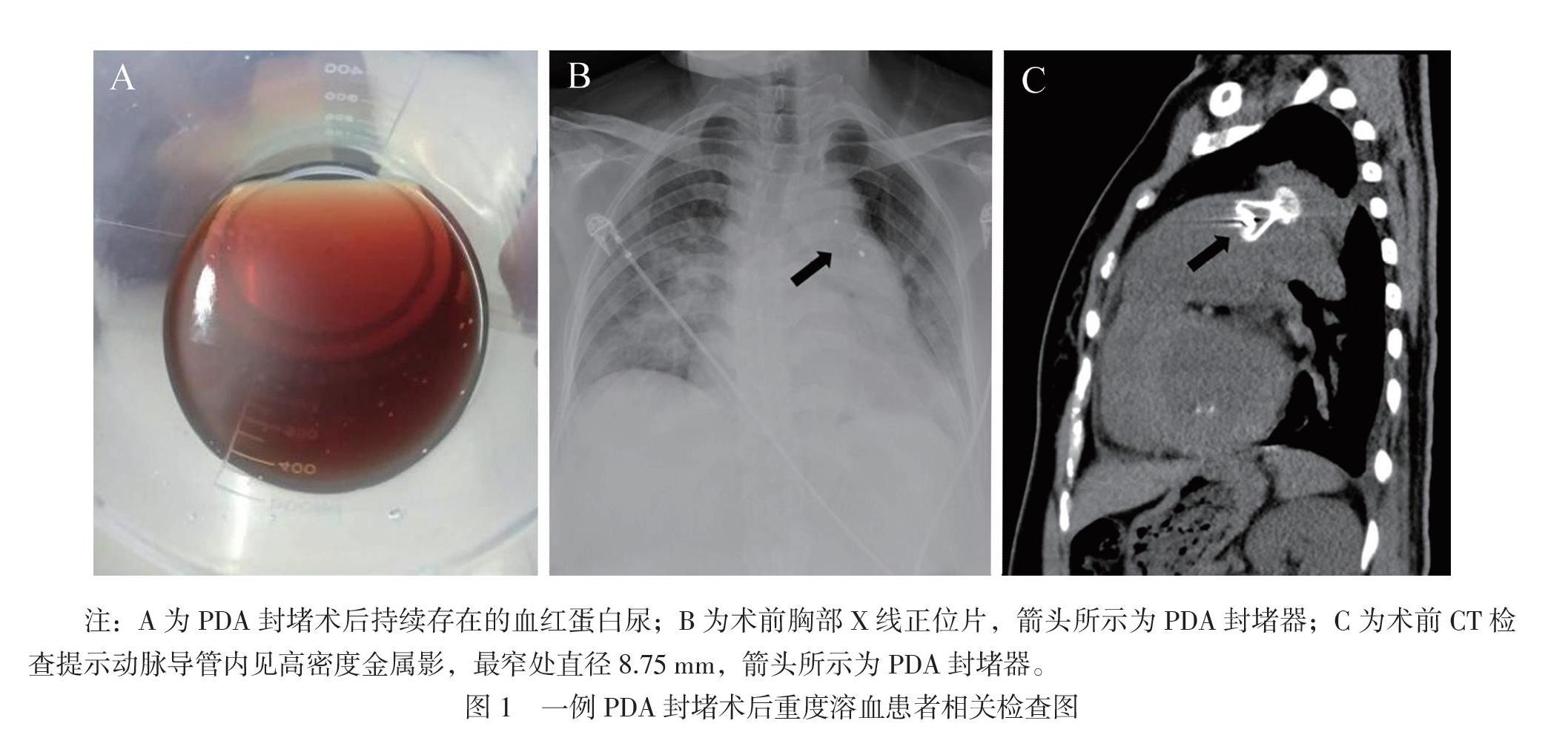
患者女,46岁。因出现黄疸、酱油色样尿2周于2019年5月16日入院。入院前2周患者因PDA(窗型)于外院行經皮PDA封堵术,术后当晚即出现酱油色样尿(图1A),考虑诊断为封堵术后机械性溶血,予对症治疗(具体治疗方案不详)后,酱油色样尿未见明显好转,遂转至我院。患者既往史及家族史等均无特殊。
体格检查:体温 36.7℃,脉搏101次/分,呼吸 22次/分,血压186/110 mm Hg (1 mm Hg = 0.133 kPa)。颜面部浮肿并黄染,心界向左下扩大,心律整齐,胸骨左缘第二肋间可闻及收缩期Ⅲ/ 6级吹风样杂音,双下肢凹陷性水肿,其余心、肺等查体未见明显异常。……