基于风力发电的表贴式永磁电机转矩脉动抑制与测试
2021-09-13沈秋英
沈秋英
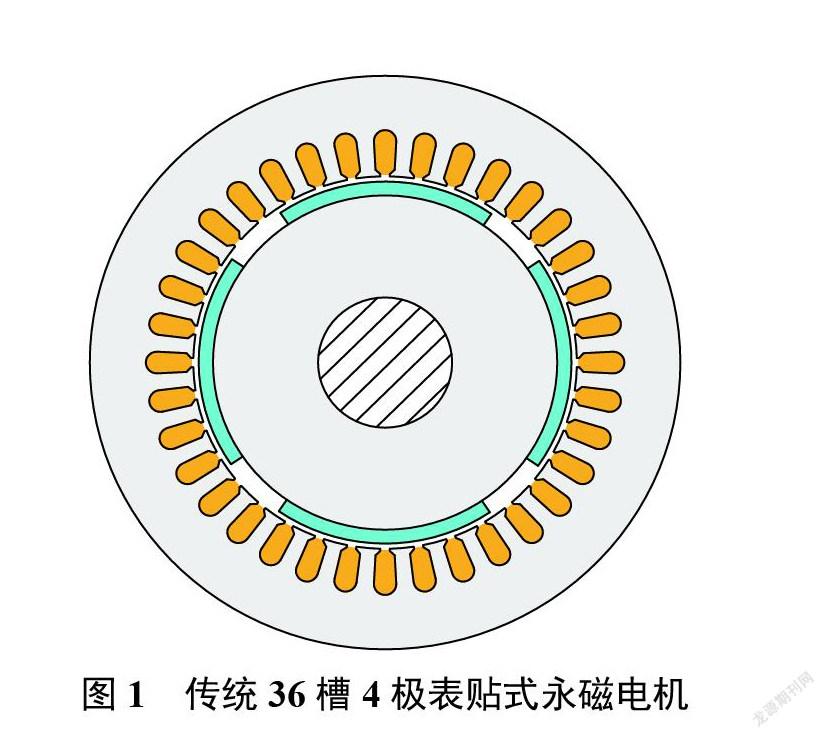

摘要:齿槽转矩是永磁电机所特有的特性,它是由永磁体和有槽铁心相互作用而产生的。该文提出永磁体轴向分段和周向分段两种分段方式,并基于这两种方法,提出一种有效的齿槽转矩抑制措施。首先,推导电机齿槽转矩的解析表达式;然后基于所推导的公式,得到轴向分段和周向分段的关键尺寸;为进一步降低齿槽转矩,该文将这两种方式进行组合运用。为验证上述分析,以一台36槽4极表贴式电机为例,进行有限元计算。为进一步验证理论分析的正确性,该文制作样机并对电机的齿槽转矩进行实验验证。研究结果表明:当采用两种方式相组合时,电机的齿槽转矩由13.4 N ·m 降低到3.4 N·m,降低74.6%。
关键词:永磁电机;齿槽转矩;永磁体分段;抑制
中图分类号: TM351;TM341文献标志码: A文章编号:1674–5124(2021)12–0136–06
Torque ripple reduction and testing of surface mounted permanent magnet motor based on wind power supply
SHEN Qiuying
(State Grid Suzhou Power Supply Company, Suzhou 215000,China)
Abstract: Cogging torque is a type of torque generated by the interaction of permanent magnet (PM) and slotted core, which specially exists in PM motors. In general, cogging torque has no effect on output torque, only to lead to torque ripples, acoustic noise and vibration. In this paper, two kinds of PM skewing, namely skewing along axial direction and skewing along circumferential direction, are adopted to reduce the cogging torque. Firstly, the analytical model of cogging torque is acquired based on co-energy method. Secondly, according the proposed model, the key dimensions of the skewing are obtained. Then, in order to further reduce the cogging torque, skewing both along axial and circumferential direction is adopted. Besides, in order to verify above analyses, finite element method is used by setting the 36-slot, 4-pole surface mounted PM motor as an example. In order to further verify the correctness of the theoretical analysis, a prototype was made and the cogging torque of the motor was experimentally verified. It is found that using the skewing both along axial and circumferential direction can reduce the cogging torque by 74.6%, namely cogging torque is reduced from 13.4 N ·m to 3.4 N ·m.
Keywords: permanent magnet motor; cogging torque; permanent magnet segment; reduction
0引言
齒槽转矩是永磁电机所特有的特性,它是由永磁体和有槽铁心相互作用而产生的[1]。一般而言,齿槽转矩对电机的输出转矩没有作用,它只会引起转矩脉动,同时也会导致振动和噪声。因此,需要对其进行抑制。
国内外学者针对永磁电机齿槽转矩抑制和测试做了许多的工作[2-8],其中在抑制方面的研究工作主要从定子侧和转子侧分别展开。改变定子侧尺寸实际上就是改变气隙磁导分布,从而达到抑制齿槽转矩的目的;而改变转子侧则本质上是通过改变永磁体剩磁密度的空间分布,从而抑制齿槽转矩。
改变定子侧的抑制措施可进一步分为:辅助槽、不等齿宽、不等槽宽、斜槽、优化槽口宽度[1-3]等。……
