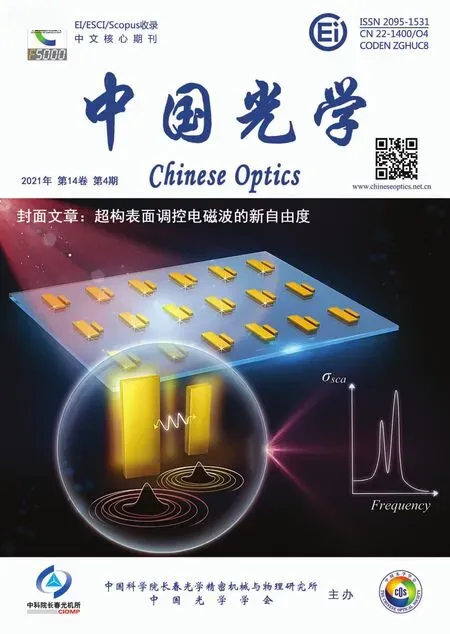
Diverse surface wavessupported by bianisotropic meta surfaces
2021-09-03YOUOuboGAOWenlongLIUYachaoXIANGYuanjiangZHANGShuang
YOU Ou-bo,GAOWen-long,LIU Ya-chao,XIANG Yuan-jiang,ZHANG Shuang,2 *
(1. Department of Physics,The University of Hong Kong, Hong Kong China;2. Department of Electrical & Electronic Engineering,The University of Hong Kong, Hong Kong China;3.School of Physicsand Electronics, Hunan University,Changsha 410082,China;4. Department of Physics, Paderborn University,WarburgerStraße 100, 33098 Paderborn,Germany;5. Instituteof Microscale Optoelectronics,Shenzhen University,Shenzhen 518060,China)
Abstract:Surface waves supported by structured metallic surfaces,i.e.metasurfaces,have drawn wide attention recently.They are promising for various applications ranging from integrated photonic circuits to imaging and bio-sensing in various frequency regimes.In this work,we show that surface states with diverse polarization configurations can be supported by a metasurface consisting of a single layer of bianisotropic metamaterial elements.The structure possesses D2d symmetry, which includes mirror symmetry in the xz and yz plane,and C2 rotational symmetry along y=±x axis.Due to this unique symmetry,the metasuface supports both transverse electric(TE)and transverse magnetic(TM) waves along kx and ky directions,while a purely longitudinal mode and an elliptically polarized transverse electromagnetic(TEM) mode along ky=±kx directions.The versatility of the surface modes on the metasurface may lead to new surface wave phenomena and device applications.
Key words:surface plasmon; metasurface; bianisotropy;transverse electric;transverse magnetic
1 Introduction
Surface plasmon polaritons(SPPs),due to their tight confinement to a metal/dielectric interface and large wave vectors, represent an important platform for various applications ranging from integrated photonic circuits to sensing applications[1-2].However,at optical frequencies,due to the significant ohmic loss of metals,the applications of SPPs suffer from the short propagation lengths.At longer wavelengths,the loss of SPPs is significantly reduced at the cost of poor confinement of the SPPs in the dielectric material.In 2004,Pendry proposed the concept of spoof plasmon that could be supported by a corrugated metallic surface with an effective plasma frequency determined by the geometries of the metallic structures[3],which was subsequently experimentally verified[4].This new scheme greatly improves the confinement of surface waves to the structured surfaces,and has attracted tremendous interests from the community of photonics. Various explorations have been carried out based on spoof plasmons,including rainbow slow light trapping effect[5-6],focusing of terahertz waves[7],terahertz subwavelength waveguides[8],and terahertz sensing[9].
Indeed,structured surfaces(or metasurfaces)can be engineered to provide more diverse functionalities that go beyond confinement of surface waves,such as wavefront and amplitude control[10-18],enhanced and tailored nonlinear optical processes[19-23],resulting in a wide range of applications including imaging, holography and bio-sensing[24-30].These new functionabilitiescan arisefrom judiciousengineering of the unit cells, benefitting from the unconventional electromagnetic responses of complex metamaterial designs such as artificial magnetism,hyperbolicity,chirality and bianisotropy[31-38].Bianisotropy refers to a cross coupling between electric and magnetic responses along orthogonal directions.It can exist in structures that lack inversion symmetry but with preserved mirror symmetry.Bianisotropic metamaterials have shown some highly intriguing phenomena such as asymmetric absorption[39-40], optical spin-orbit coupling[41],and topological optical effects[42].In the past decade, biansotropy has been employed for designing topological metamaterials,which have shown interesting phenomena such as Fermi arc states and transverse spin of bulk optical modes[43-46].Compared to three dimensional bulk metamaterials, the ultrathin nature of bianisotropic metasurfaces could lead to more practical applications due to its low fabrication cost and highly compact physical sizes.In this work,we experimentally investigate the surface states supported by a bianisotropic metasurface and showcase a number of interesting effects– the existence of both TE and TM surface modes along certain directions[47],while helical transverse electromagnetic mode and longitudinal mode in some other directions.
2 Results and discussion
The configuration of the metasurface is illustrated in Fig.1(a). Each unit cell of the metasurface consists of a saddle-shaped metallic loop.The same unit cell,when arranged in a three dimensional array,forms a type-I ideal Weyl metamaterial,as demonstrated previously[43].Here we are interested in a metasurface consisting of a single layer of such structure,and therefore the bulk property is not well defined.Each unit cell can be considered as two perpendicular split ring resonatorswith opposite orientation of the openings.The structure possesses D2dsymmetry, which includes mirror symmetry in thexzandyzplane,and C2rotational symmetry alongy= ±xaxis.The fundamental resonant mode of the unit cell is a combination of electrical dipole moment and magnetic dipole moment,each of which can be excited by both an electric field or a magnetic field oriented in thex−yplane.

Fig.1 (a)The schematic of the single-layer metasurface.Every unit cell consists of a saddle-shaped metallic inclusion possessing D2d point symmetry embedded in the dielectric substrate whose relative permittivity is 2.2.The period of the metasurface along kx or ky is p.(b)The band structure of the metasurface.The 1st,2nd,3rd bands and light cone are plotted in yellow,red, blue and green,respectively.(c)The dispersions of the surface modes along ky=0 direction.The modes along this direction corresponding to the 1st and 2nd bands can be regarded as electric plasmon and magnetic plasmon,respectively.(d)The dispersions of the surface modes along ky=kx direction.The modes along this direction for the1st and 2nd bandscan be regarded as transversemode (elliptically polarized)and longitudinal mode, respectively图1 (a)单层超构表面示意图。每一个单元都由在介电常数为2.2的基底中的拥有D2d 点群对称性的马鞍形金属内嵌物构成。该超构表面沿kx 或ky 方向的周期是p;(b)该表面的能带结构。第1、2、3条能带以及光锥分别由黄色、红色、蓝色以及绿色标出;(c)该超构表面沿着ky=0 方向的色散。其中第1、2条能带在这个方向的模场分别是电等离子体激元以及磁等离子体激元;(d)该超构表面沿着ky=kx 方向的色散。其中第1、2条能带在这个方向的模场分别是横电磁模(椭偏)以及纵模
The band structure of the metasurface is shown in Fig.1(b).There exist multiple bands in the system,with some bands located very close to the light cone (for example,the blue one).Here we are interested in the 1stand 2ndmodes(yellow and red)with larger wave numbers.Due to the D2dsymmetry of the system, the wave propagation alongxandydirectionscan berelated to each other by simply a rotation ofπ about thekx=±kyaxis.In order to have a clearer view of the dispersions of the surface waves,we plot the dispersions along thekx/kydirection in Fig.1(c).The two lowest modes,labelled electric and magnetic plasmon in the figure,exhibit the typical surface plasmon dispersion features, i.e. an approximately linear dispersion at lower frequency,and the dispersion gradually become flat when approaching the effective plasma frequency[3].We further plot the dispersions of the surface modes alongkx=±kydirections,as shown in Fig. 1(d). These 1stand 2ndmodes are TEM and longitudinal modes,respectively.Interestingly, these two surface modes become degenerate at the corner of the Brillounin zone,i.e.M point.As will be explained later,this degeneracy arisesfrom the D2dsymmetry of the system.
The existence of TE and TM modes can be analyzed through the point group symmetry.For modes alongkx/kydirection,they must satisfy the mirror symmetry Mx/yaboutyzorxzplane.The eigen values ofM′are ±1.ForM′=+1,the normal E field with respect to mirror plane will cancel out when integrated over the unit cell,while the parallel E field remains.Meanwhile,the H field,which is a pseudo vector field, behaves in the opposite way.Therefore this represents a TM mode.TheM′=−1 mode,on the other hand,represents a TE mode based on a similar analysis.We further carry out full wave simulation,and present the field plotsof thexpropagating modes in thexzcross-section plane cutting through the center of the unit cell in Fig.2.For point ① on 1stmode in Fig.1(c), the electric field is aligned alongydirection,which is perpendicular to the propagation plane(Fig.2(a)),whereas the magnetic field lies in the propagation plane having bothxandzcomponents(Fig.2(b)).This confirms that 1stmode is not just a TE mode but also a magnetic surface plasmon mode, which is distinct from the conventional surface plasmon mode.It is interesting to note that the electric and magnetic field components are mostly confined to the top and bottom surfaces,respectively.On the other hand, the field distributions(Fig.2(c)and 2(d))of point②on 2ndmode show opposite configuration as that of TE mode. Namely,the electric field lies in the propagation plane and the magnetic field is perpendicular to it,which represent the main features of conventional TM polarized surface plasmon modes.The presence of both TE and TM polarized surface plasmon modes can be attributed to the fact that the unit cell of the bianisotropic metasurface supports both electric and magnetic resonances.

Fig.2 Field distributionsof surface plasmon modespropagating along x direction.On theleft,theschematic of theunit cell illustrating the plane in which the fields are plotted is shown.(a, b)The E and H field distributions for point①on 1st mode in Fig.1 (c).(c,d)The E and H fields for point②on 2nd mode.kx of point①and ②is fixed at π/2p, where p is the period along x and y directions图2 沿着x 方向传播的表面等离子体激元的场分布。场分布所在截面的位置在最左边的结构单元示意图中标出;(a,b)在图1 (c)中第1个模式上的点①处E 和H 分布;(c,d)在图1 (c)中第2 个模式上的点②处E和H 分布。点①和②处的kx 等于π/2p,p是沿x 和y 方向的结构周期
However,away fromkx/kydirections, the surface plasmon modes are not exactly TE and TM modes anymore, but generally a hybridization between them.Interestingly,alongkx=±kydirections, this hybridization leads to a complete re-arrangement of the field components,and the longitudinal mode and TEM mode emerge.The existence of the longitudinal mode and TEM can also be analyzed through the symmetry of the point group with respect to this direction.As the metasurface has C2symmetry alongkx=±kydirections, the eigen values of C2are ±1.For the C2=+1 mode,if we rotate the field byπabout the symmetry axis,we will get the samefield.Thismeans that all thefield components,both E and H perpendicular to the symmetry axis will cancel out when integrated over the unit cell,while fields components parallel to the symmetry axis remains, and therefore this corresponds to a longitudinal mode.For the C2= −1 mode,the situation is opposite, i.e. all longitudinal components cancel out while transverse components remain,which corresponds to a TEM mode.This is illustrated by the fields shown in Fig.3.Fig.3(a)and 3(b)show the distribution of the electric and magnetic fields of point③(kx=ky=π/2p)in Fig.1(d),respectively,in a cross section plane perpendicular to the propagation direction.It is observed that both the E and H fields primarily lie in the plane,while the longitudinal components of the fields at different locations are opposite and cancel out,leading to an overall TEM mode.It is interesting to note that both the E and H fields rotate anticlockwise with time in the plane,i.e.the TEM mode is elliptically polarized.On the other hand,the distribution of E and H fieldsof point④,as illustrated in Fig.3(c)and 3(d)respectively,are primarily aligned along the propagation direction.Thus,it is confirmed that 1stmode is a pure longitudinal mode with both longitudinal E and longitudinal H components.We further look into the field distributionsof thetwo points⑤ and ⑥in Fig.1(d)close to M point in a horizontal plane(xyplane)cutting through the center of the unit cell,as shown by Fig.3(e−h).The fields clearly show that the two modes can be related to each other through the following symmetry operations:a rotation of 90°in thexyplane about the center of the unit cell,followed by a mirror symmetry inzdirection,which are consistent with the D2dsymmetry of the metasurface structure.Thus,this symmetry argument explains the degeneracy between the two modes at M point as shown in Fig.1(d).

Fig.3 Field distributions of surface plasmon modes propagating along kx=ky direction.(a, b)Field distributions of 1st mode at point ③ (kx=ky= π/2p)in Fig.1(d).The simulated E(a)and H(b)field distributions in the plane perpendicular to the propagation direction,corresponding to the cutting plane shown in the schematic above.In both plots, the overall field distribution lie in the plane,indicating that this is a TEM mode.(c,d)Field distributions of 2nd mode at point ④ (kx=ky =π/2p)in Fig.1(d).The simulated E(c)and H(d)field distributions in the plane perpendicular to the propagation direction,corresponding to the cutting plane shown in the schematic above.In both plots,the overall field distributions are out of plane(along the propagation direction),indicating that this is a pure longitudinal mode with both longitudinal components of E and H fields.(e-h)Field distributions of points⑤and ⑥ in Fig.1(d),closing to the M point(phase advance is 170°),for a horizontal xy plane cutting through the center of the unit cell,as indicated by the schematic above.(e,f)correspond to the E and H field distributions of point⑤,and(g, h)correspond to E and H field distributions of point⑥.It is observed that the two modes are related to each other through an in-plane rotation of 90°about the center of the unit cell,followed by a mirror symmetry in z direction图3 沿kx=ky 方向的表面等离子体激元模式的场分布。(a, b)图1 (d)中第1 个模式在点③处(kx=ky = π/2p)的场分布。仿真得到的在垂直传播方向的面上的E(a)和H (b)场分布,截面位置显示在上方示意图中。在两个图中,总体的场分布都在面内,证明了这是一个横电磁模。(c,d)图1(d)中第2 个模式在点④处(kx=ky = π/2p)的场分布。仿真得到的在垂直传播方向的面上的E(c)和H (d)场分布,截面位置显示在上方示意图中。在两个图中,总体的场分布都指向面外(沿着传播方向),证明了这是一个同时拥有电场和磁场的纵模。(e-h)图1(d)中非常接近M 点的⑤和⑥处的穿过结构单元中心的xy 截面处的场分布,(e,f)分别代表了点⑤处的E和H 场分布;(g, h)分别代表了点⑥处的E和H场分布。通过一个面内关于……