青光安Ⅱ号方对诱导损伤的RGC-5细胞中NF-κB/HIF-1α通路相关细胞因子的影响
2021-08-23姚小磊时健刘倩宏陈立浩侯念婷
姚小磊 时健 刘倩宏 陈立浩 侯念婷
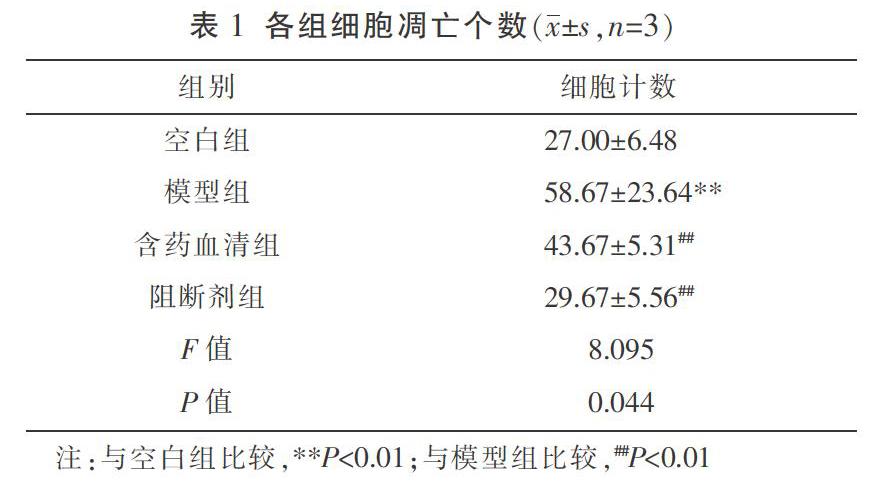
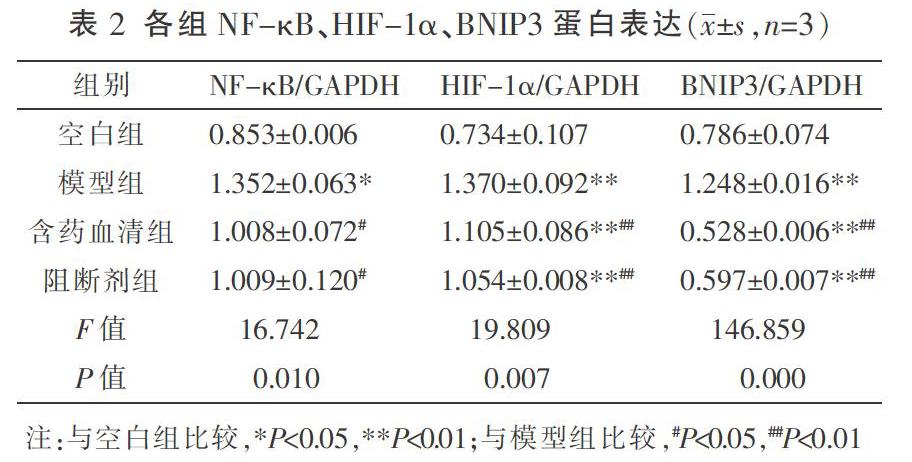
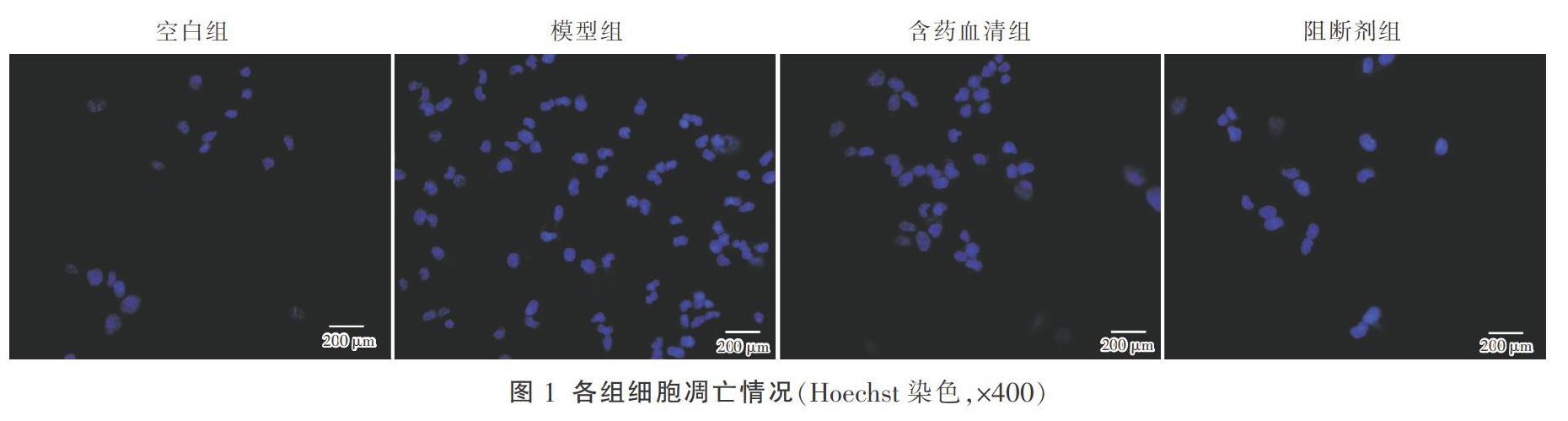
〔摘要〕 目的 觀察青光安Ⅱ号方对谷氨酸诱导损伤的RGC-5细胞中核因子κB(nuclear factor kappa-B, NF-κB)、低氧诱导因子-1α(hypoxia inducible factor-1,HIF-1α)、BCL2/腺病毒E1B相互作用蛋白3(BCL2/adenovirus E1B 19kDa interacting protein 3, BNIP3)、超氧化物歧化酶(superoxide dismutase, SOD)及丙二醛(malondialdehyde, MDA)的影响。方法 体外培养RGC-5细胞,分为4组:空白组、模型组、含药血清组和阻断剂组。模型组、含药血清组和阻断剂组予以谷氨酸诱导细胞损伤,模拟青光眼对神经节细胞的损伤,含药血清组加入青光安Ⅱ号方含药血清,阻断剂组加入KC7F2进行HIF-1α通路的阻断。以CCK-8法摸索含药血浆以及谷氨酸的最佳干预浓度;采用Hoechst法检测各组细胞的凋亡情况;Western blot检测NF-κB、HIF-1α、BNIP3蛋白表达情况;比色法检测SOD、MDA的表达情况。结果 CCK8法确定青光安Ⅱ号方5倍组含药血清为实验量,确定谷氨酸的最佳干预浓度为200 μM。与空白组比较,模型组NF-κB、HIF-1α、BNIP3、SOD、MDA表达显著升高(P<0.05);与模型组比较,含药血清组、阻断剂组NF-κB、HIF-1α、BNIP3和SOD的表达显著降低(P<0.05);含药血清组与阻断剂组的NF-κB、HIF-1α、BNIP3、SOD及MDA差异均无统计学意义(P>0.05)。结论 青光安Ⅱ号方对NF-κB具有抑制作用,进而抑制了HIF-1α相关通路的激活,减弱了由于氧化应激所致RGC-5细胞的凋亡,对RGC具有保护作用。
〔关键词〕 青光眼;青光安Ⅱ号方;视网膜神经节细胞;核因子κB;低氧诱导因子-1α;BCL2/腺病毒E1B相互作用蛋白3;超氧化物歧化酶;丙二醛
〔中图分类号〕R276.7 〔文献标志码〕A 〔文章编号〕doi:10.3969/j.issn.1674-070X.2021.07.004
〔Abstract〕 Objective To observe the effects of Qingguangan Ⅱ Formula on nuclear factor kappa-B (NF-κB), hypoxia inducible factor-1 (HIF-1α), BCL2/adenovirus E1B 19kDa interacting protein 3 (BNIP3), superoxide dismutase (SOD) and malondialdehyde (MDA) in RGC-5 cells injury induced by glutamate. Methods The RGC-5 cells cultured in vitro were divided into 4 groups: blank group, model group, drug-containing serum group and blocker group. Glutamic acid was added to model group, drug-containing serum group and blocker group to simulate retinal ganglion cell damage caused by glaucoma, and Qingguangan Ⅱ Formula serum was added to drug-containing serum group, and the blocker group was added with KC7F2 to block the HIF-1α pathway. The CCK-8 method was used to find optimal intervention concentration of drug-containing plasma and glutamate; Hoechst method was used to detect the apoptosis of cells in each group; Western blot was used to detect the expression of NF-κB, HIF-1α, BNIP3; colorimetry was used to detect the expression of SOD and MDA. Results CCK8 method determined 5 times serum content as the Qingguangan Ⅱ Formula experimental amount, and the optimal intervention concentration of glutamate was 200 μM. Compared with blank group, the expression of NF-κB, HIF-1α, BNIP3, SOD and MDA increased significantly in the model group (P<0.05); compared with the model group, the expression of NF-κB, HIF-1α, BNIP3 and SOD in the drug-containing serum group and blocker group significantly decreased (P<0.05) ; there was no statistically significant difference between NF-κB, HIF-1α, BNIP3, SOD and MDA in drug-containing serum group and blocker group (P>0.05). Conclusion Qingguangan II Formula has an inhibitory effect on NF-κB, thereby inhibiting the activation of HIF-1α related pathways, reducing the apoptosis of RGC-5 cells caused by oxidative stress, it also has a protective effect on RGC.
〔Keywords〕 Qingguangan Ⅱ Formula; retinal ganglion cell; nuclear factor kappa-B; hypoxia inducible factor-1; BCL2/adenovirus E1B 19 kDa interacting protein 3; superoxide dismutase; malondialdehyde
青光眼為导致人类失明的三大眼类疾病之一。调查显示,2020年全球青光眼患病人数高达7 600万,其中我国占2 100万,位居世界之首[1],目前,超过40岁以上人群青光眼的总患病康复率仅有1.5%~3.6%[2],治疗方案主要以控制眼压来保存视力,但是青光眼导致的视神经损伤却不可逆,且没有较好的视神经保护方案。彭清华教授通过多年临床经验总结出“青光安Ⅱ号方”,研究表明其有较好的临床疗效,尤其对青光眼术后仍存在视力下降的患者,有较好的视神经保护效应[3],但其具体的机制并不清楚。……