43个丝瓜种质资源枯萎病抗性的鉴定与评价
2021-08-14林永胜张武君周先治陈阳张玉灿
林永胜 张武君 周先治 陈阳 张玉灿
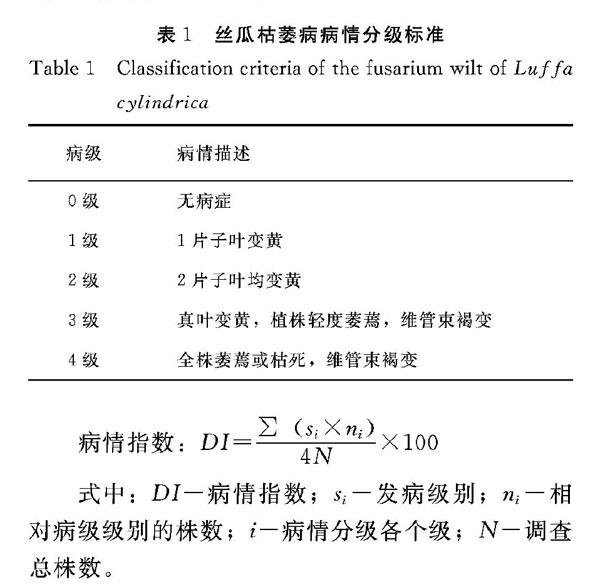
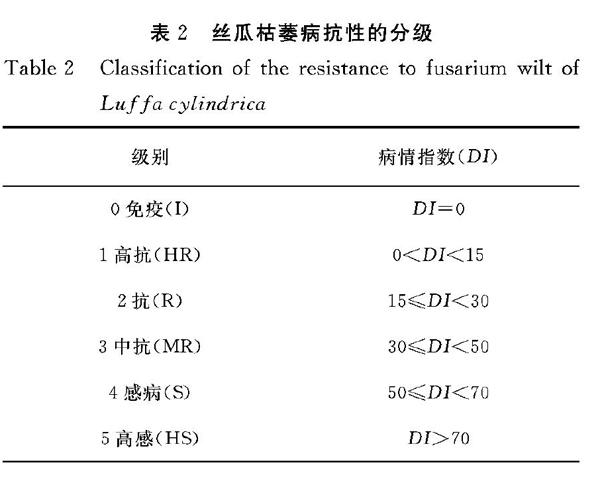
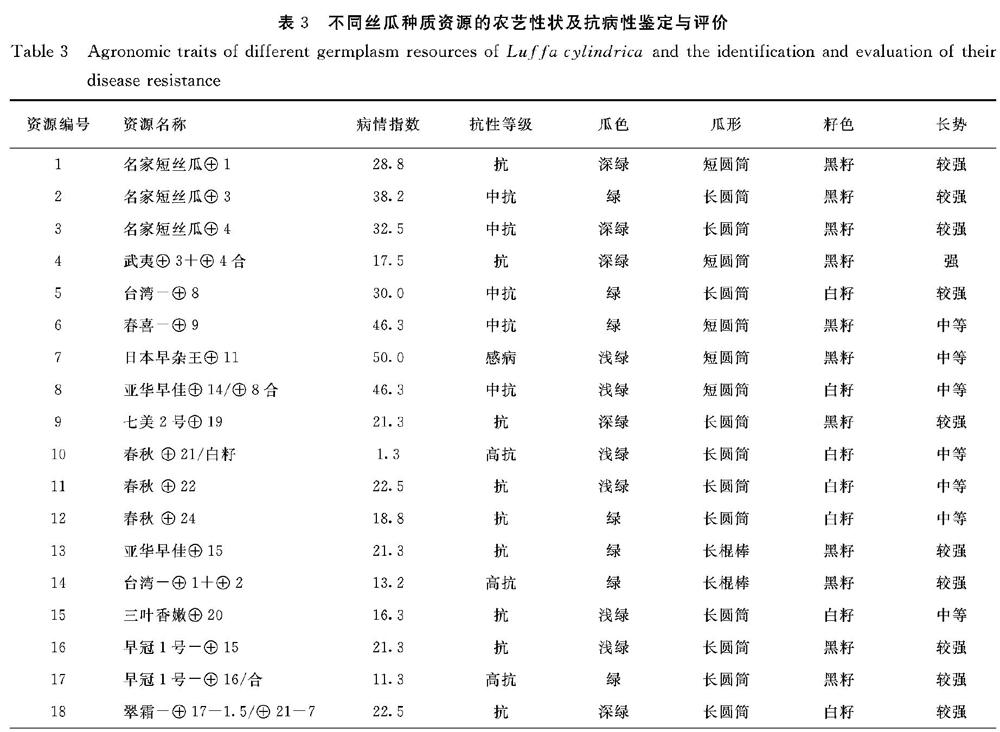
摘 要:为了选育出抗病性强的丝瓜新品种,课题组从国内外收集了43个丝瓜种质资源,采用室内人工接菌的方法对其进行枯萎病抗性鉴定与评价,结果表明:春秋⊕21/白籽、2012-2-1-⊕5选、2012-2-4-⊕9-5、七美-⊕10、2012-2-1-⊕5选和2012-2-4-⊕9-5等6个丝瓜种质资源对枯萎病表现为高抗,三叶香嫩⊕20、翠霜-⊕19-2.5.6、绿优-⊕13/深绿等21个丝瓜种质资源对枯萎病表现为抗病,台湾-⊕8、名家短丝瓜⊕4、2012-2-⊕3选等12个丝瓜种质资源对枯萎病表现为中抗,日本早杂王⊕11、2012-2-⊕1-2.3、09-1-⊕1等4个丝瓜种质资源对枯萎病表现为感病。综合以上分析表明43个丝瓜种质资源中有27个种质资源对枯萎病表现为抗级以上,占总数的62.8%。
关键词:丝瓜品种资源;丝瓜枯萎病;抗病性;鉴定;评价
中图分类号:S 641.2 文献标志码:A 文章编号:0253-2301(2021)05-0028-05
DOI: 10.13651/j.cnki.fjnykj.2021.05.006
Identification and Evaluation of the Resistance of 43 Luffa CylindricaGermplasm Resources to Fusarium Wilt
LIN Yong-sheng, ZHANG Wu-jun, ZHOU Xian-zhi, CHEN Yang, ZHANG Yu-can*
(Institute of Agricultural Biological Resources, Fujian Academy of Agricultural Sciences, Fuzhou, Fujian 350003, China)
Abstract: In order to breed the new varieties of Luffa cylindrica with strong disease resistance, 43 germplasm resources of Luffa cylindrica were collected from home and abroad by the research team, and the method of indoor artificial inoculation was used to identify and evaluate their resistance to fusarium wilt. The results showed that: the 6 germplasm resources of Luffa cylindrica including Chunqiu ⊕21/ baizi, 2012-2-1-⊕5 xuan, 2012-2-4-⊕9-5, Qimei-⊕10, 2012-2-1-⊕5 xuan, and 2012-2-4-⊕9-5 showed high resistance to fusarium wilt; the 21 germplasm resources of Luffa cylindrica, such as Sanyexiangnen ⊕20, Cuishuang -⊕19-2.5.6, Lvyou -⊕13/ shenlv, etc., showed resistance to fusarium wilt; the 12 germplasm resources of Luffa cylindrica, such as Taiwan -⊕8, Mingjiaduansigua ⊕4, and 2012-2-⊕3 xuan, etc., showed moderate resistance to fusarium wilt; and the 4 germplasm resources of Luffa cylindrica, such as Japan Zaozawang⊕11, 2012-2-⊕1-2.3, and 09-1-⊕1, etc., were susceptible to fusarium wilt. Based on the above analysis, 27 of the 43 germplasm resources of Luffa cylindrica showed higher resistance to fusarium wilt, accounting for 62.8% of the total.
Key words: Germplasm resources of Luffa cylindrica;Fusarium wilt;Disease resistance;Identification;Evaluation
絲瓜Luffa cylindrica在我国南方地区栽培历史悠久,在全国各地均有种植,是我国夏秋季的主要蔬菜种类之一。枯萎病是丝瓜生产上的主要病害之一,又称蔓割病、萎凋病,是一种世界性的瓜类土传病害,对丝瓜的产量与品质影响很大。该病害是由尖镰孢丝瓜专化型Fusarium oxysporum Schl. f.sp.luffae Kwai Suzki et Kawai侵染所致[1],病原菌会不断进化出新的生理小种,且能以菌核、厚垣孢子在土壤、病残体、种子中越冬,在土壤中腐生性强,能存活5年或更长的时间,使得枯萎病的防治非常困难[2]。化学防治效果普遍不佳,且大量使用容易造成环境污染和农药残留超标[3-7];与禾本科和豆科作物轮作虽然效果好,但福建省耕地面积有限,且禾本科和豆科非福建省主栽作物品种,田间实施可操作性不大[8-10];土壤改良、高温消毒和无土栽培等措施虽能有效减轻瓜类枯萎病的危害[11-13],但通常成本较高,其田间实际应用情况较少;为此,选育和种植抗病品种是目前防治该病最有效、最经济的措施。……