盆底超声在评估产后压力性尿失禁康复治疗的应用价值
2021-07-29吴彩云
吴彩云
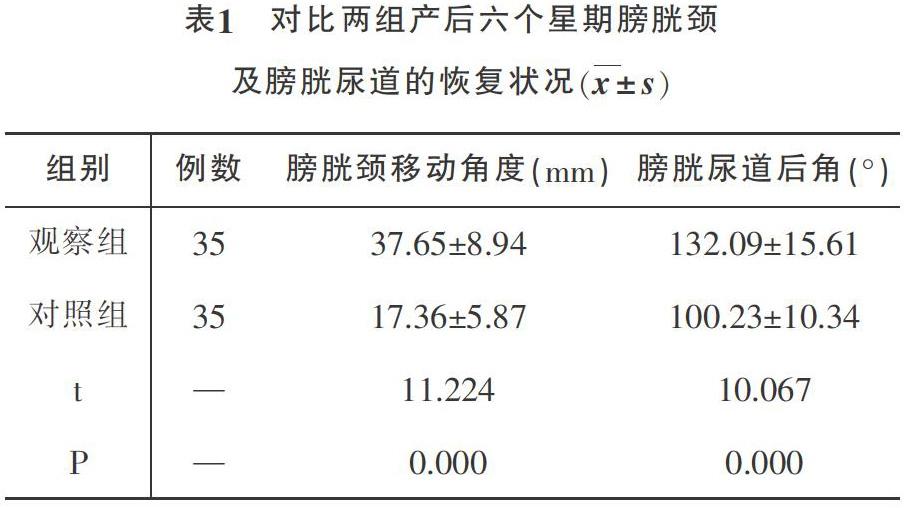
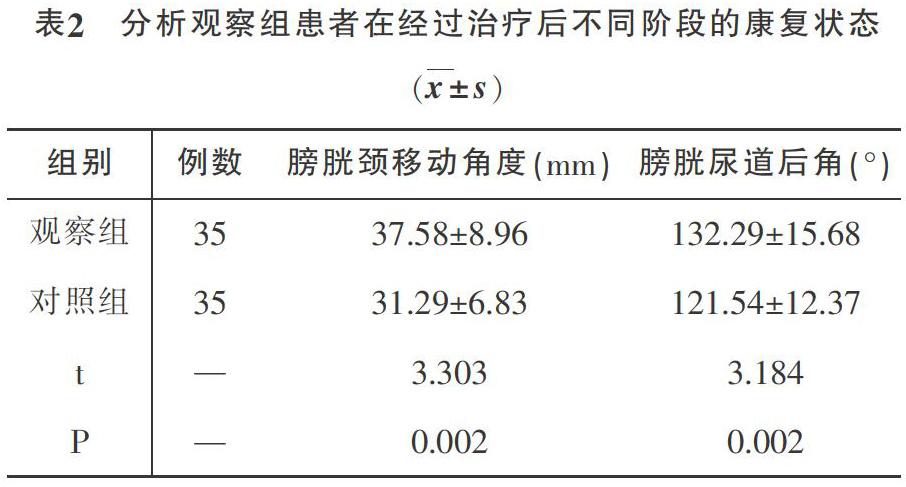
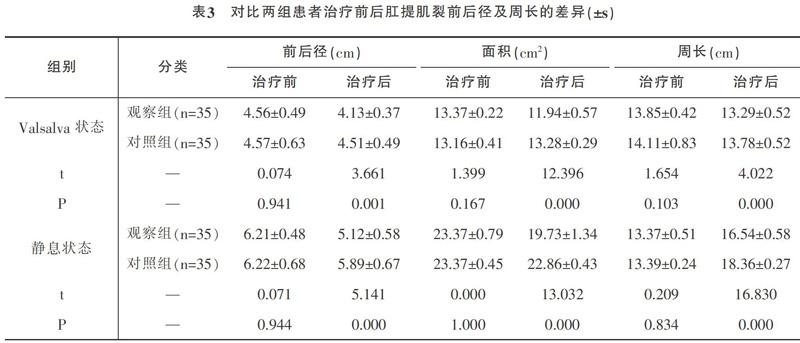
摘要:目的:分析盆底超聲在评估产后压力性尿失禁康复治疗的应用价值。方法:选择本院于2020年6月至2021年4月接收的产后压力性尿失禁患者35例为观察组,另外选择同期我院接收的经产泌尿系统病患35例为对照组,两组均实施盆底超声检测。对比两组产后六个星期膀胱颈及膀胱尿道的恢复状况,并且分析观察组患者在经过治疗后不同阶段的康复状态,同时对比两组患者治疗前后肛提肌裂前后径及周长的差异。结果:观察组和对照组之间的膀胱颈移动角度以及膀胱尿道后角之间的各项指标对比差异较大,组间数据差异较大,具有统计学意义(P<0.05);观察组和对照组之间在经过六个星期的治疗后膀胱颈移动角度、膀胱尿道后角分别为(37.58±8.96)mm、(132.29±15.68)°,已经得到相应的缓解。而在治疗后的第十二个星期患者的盆底功能康复,膀胱颈移动角度、膀胱尿道后角分别为(31.29±6.83)mm、(121.54±12.37)°,组间数据差异较大,具有统计学意义(P<0.05);两组患者在接受治疗前对比无明显差异,而观察组患者在治疗后肛提肌裂前后径及周长的改善状况整体优于对照组,组间数据差异较大,具有统计学意义(P<0.05)。结论:盆底超声在评估产后压力性尿失禁的应用当中,能够明确判断患者盆底状态,对于是否需要接受治疗有着清晰直观的判断结果,同时通过肛提肌裂孔的形态、结构及大小准确分析盆底功能受损的状况,值得临床推广。
关键词:盆底超声;产后;压力性尿失禁
中图分类号:R445.1文献标识码:BDOI:10?郾3969/j.issn.1001-0270.2021.03.07
Abstract: Objective: To analyze the application value of pelvic floor ultrasound in the evaluation of postpartum stress urinary incontinence rehabilitation treatment. Methods: A total of 35 patients with postpartum stress urinary incontinence admitted to our hospital from June 2020 to April 2021 were selected as the observation group, and 35 patients with transobstetric urinary system admitted to our hospital during the same period were selected as the control group, and pelvic floor ultrasound detection was performed in both groups. The recovery status of the bladder neck and urinary bladder and urethra was compared between the two groups at 6 weeks postpartum, and the recovery status of patients in the observation group at different stages after treatment was analyzed. At the same time, the diameter and circumference of the levator ANI fission before and after treatment were compared between the two groups. Results: There were significant differences in the movement Angle of bladder neck and the posterior Angle of bladder and urethra between the observation group and the control group, with statistical significance (P < 0.05). Between observation group and control group after six weeks after the treatment of bladder neck movement Angle, and bladder, urethra, after Angle respectively (37.58 + 8.96) mm, (132.29-15.68) °, have corresponding mitigation, and 12 weeks after treatment in patients with pelvic floor functional rehabilitation after bladder neck movement Angle, and bladder, urethra, Angle respectively (31.29 + 6.83) mm, (121.54-12.37) °, significantly improved its status is, data differences between groups, statistically significant (P < 0.05); There was no significant difference between the two groups before treatment, while the improvement of the diameter and circumference of the levator ANI fission in the observation group after treatment was better than that in the control group on the whole, with significant difference between the groups (P < 0.05). Conclusion: In the application of pelvic floor ultrasound in the evaluation of postpartum stress urinary incontinence, the pelvic floor status of patients can be clearly judged, and the need for treatment can be clearly and intuitively judged. At the same time, the shape of the levator ANI hiatus can be determined
Key Words: Pelvic floor ultrasound; Postpartum; Stress urinary incontinence
压力性尿失禁是指当患者打喷嚏、咳嗽、大便或者腹压增高时,尿液不由自主地从尿道内漏出。产后压力性尿失禁是继发于妊娠产后的压力性尿失禁,主要由于妊娠期女性膀胱尿道连接部位移动度增加、尿道解剖结构发生缺陷、盆底组织松弛等。在妊娠过程中胎儿逐渐发育长大,胎儿体重增加、羊水增多,对盆底的肌肉、筋膜的压迫逐渐加强。孕妇妊娠期激素水平、内分泌、自身的变化、子宫相关韧带的变化,加之分娩过程中胎儿先露部较长时间的压迫等,使得盆底肌肉和筋膜过度伸展而弹性降低,常伴随盆底纤维的部分断裂。另外,产褥期过早地进行较强的重体力劳动,便秘、长时间负重及久站等,使受损的盆底肌肉、筋膜未得到及时恢复,持续受损会引起或加重产后压力性尿失禁。……
