不同密度胡桃楸次生林枯落物和土壤持水特性的研究
2021-07-20刘忠玲刘建明胡伟祁永会
刘忠玲 刘建明 胡伟 祁永会
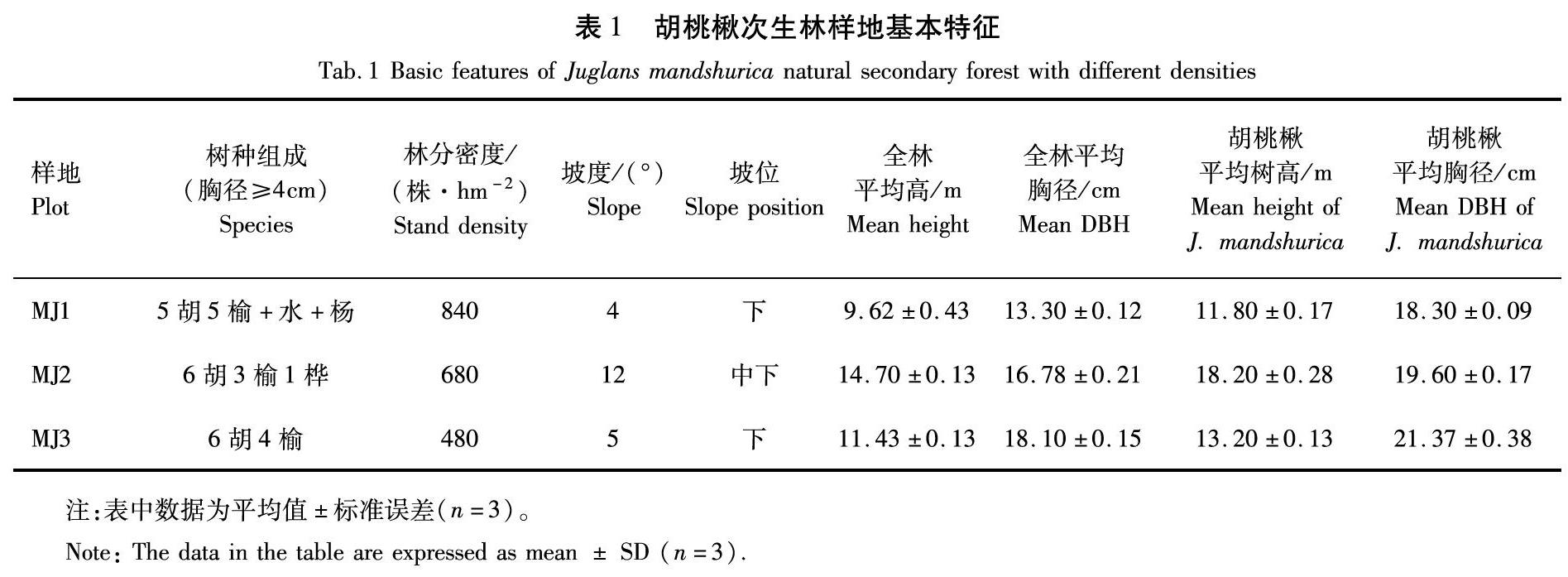

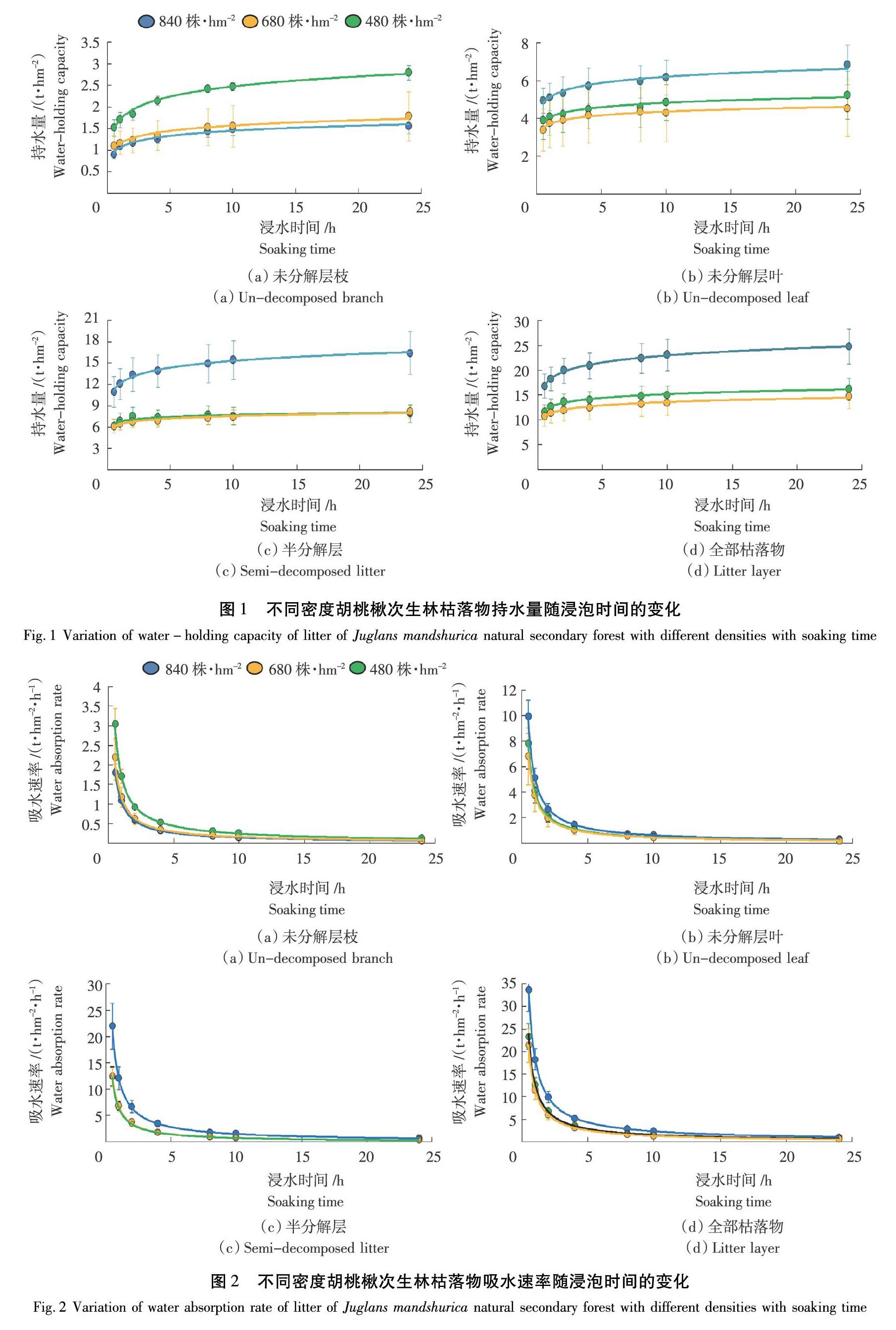
摘 要:为探讨林分密度对胡桃楸次生林水源涵养功能的影響,以阿什河源头的帽儿山地区不同密度(840、680、480株/hm2)的胡桃楸次生林为研究对象,测定枯落物层的厚度和蓄积量,并采用室内浸泡法对枯落物持水量进行测定,采用环刀法对土壤持水量进行测定。结果表明:不同密度的胡桃楸天然次生林枯落物厚度、蓄积量、有效拦蓄量差异均不显著(P>0.05),枯落物厚度为3.2~3.9 cm,蓄积量为6.33~8.57 t/hm2,有效拦蓄量为4.39~10.44 t/hm2。枯落物持水量与浸水时间呈对数函数关系(R2>0.988 1),吸水速率与浸水时间呈幂函数关系(R2>0.999 9)。在0~30 cm土壤深度,不同密度的林分土壤容重均值、非毛管孔隙度和有效持水量有显著差异(P<0.05),土壤容重变化范围为0.88~1.06 g/cm3,随土层深度增加而增加,土壤有效持水量范围为117.78~230.52 t/hm2。840株/hm2和680株/hm2的林分地表层有效持水量分别显著高于480株/hm2的林分71%和89%(P<0.05)。综合不同密度的胡桃楸次生林枯落物层和土壤层的持水特性,密度为840株/hm2和680株/hm2的林分蓄水能力较好。
关键词:森林水文;持水特性;枯落物;土壤;胡桃楸
中图分类号:S715.7 文献标识码:A 文章编号:1006-8023(2021)03-0052-08
Abstract:In order to explore the impacts of stand density on the water conservation function of Juglans mandshurica natural second forest, the thickness and storage of litter layer were measured in different densities (840, 680 and 480 trees/hm2) of Juglans mandshurica natural second forest in Maoershan area at the source of Ashe river. The waterholding capacity of litter was measured by indoor soaking method and the soil waterholding capacity were measured by cutting method. The results showed that: there was no significant difference in litter thickness, storage and effective waterinterception capacity of Juglans mandshurica natural secondary forest with different densities (P>0.05), the litter thickness was 3.2~3.9 cm, and the litter storage was 6.33~8.57 t/hm2, the effective waterinterception capacity was 4.39~10.44 t/hm2. Waterholding capacity of litter had a logarithmic relation with soaking time (R2>0.988 1), and water absorption rate showed a power function with soaking time (R2>0.999 9). The soil bulk density, noncapillary porosity and effective waterholding capacity with different densities were significantly different (P<0.05) in 0~30 depth, soil bulk density was 0.88~1.06 g/cm3, increased with the deepening of soil, the soil effective waterholding capacity was 117.78~230.52 t/hm2. The effective waterholding capacity of 840 trees /hm2 and 680 trees/hm2 were 71% and 89% higher than that of 480 trees/hm2 respectively (P<0.05). Based on the waterholding characteristics of litter layer and soil layer of Juglans mandshurica secondary forest with different densities, the stands with densities of 840 trees/hm2 and 680 trees/hm2 had better waterholding capacity.
Keywords:Forest hydrology; waterholding characteristics; litter; soil; Juglans mandshurica
0 引言
枯落物层是降水在林地表面最先接触到的部分,具有涵养水源、拦蓄降水、维持土壤湿度和防止土壤溅蚀等功能[1]。土壤层中的毛管孔隙和非毛管孔隙能够促进雨水的下渗,不但能供给植物水分,且能把多余的水分存储起来或通过渗流汇入溪流中,充分体现了森林涵养水源保持水土的功能[2]。阿什河发源于黑龙江省尚志市帽儿山镇尖石砬子,是松花江上游右岸的一级支流,其源头林分的水源涵养功能对松花江径流量有重要影响[3]。帽儿山林场位于阿什河源头,天然林占森林面积85%以上,胡桃楸(Juglans mandshurica)为天然次生林群落的最重要植物[4]。
森林经营影响森林结构,从而影响森林生态功能[5],同一林型在不同密度条件下枯落物和土壤持水能力不同[6-9]。部分研究认为……