奥希替尼一线治疗EGFR突变阳性的局部晚期或转移性非小细胞肺癌的成本-效用分析
2021-07-12康朔贾海红刘国强
康朔 贾海红 刘国强
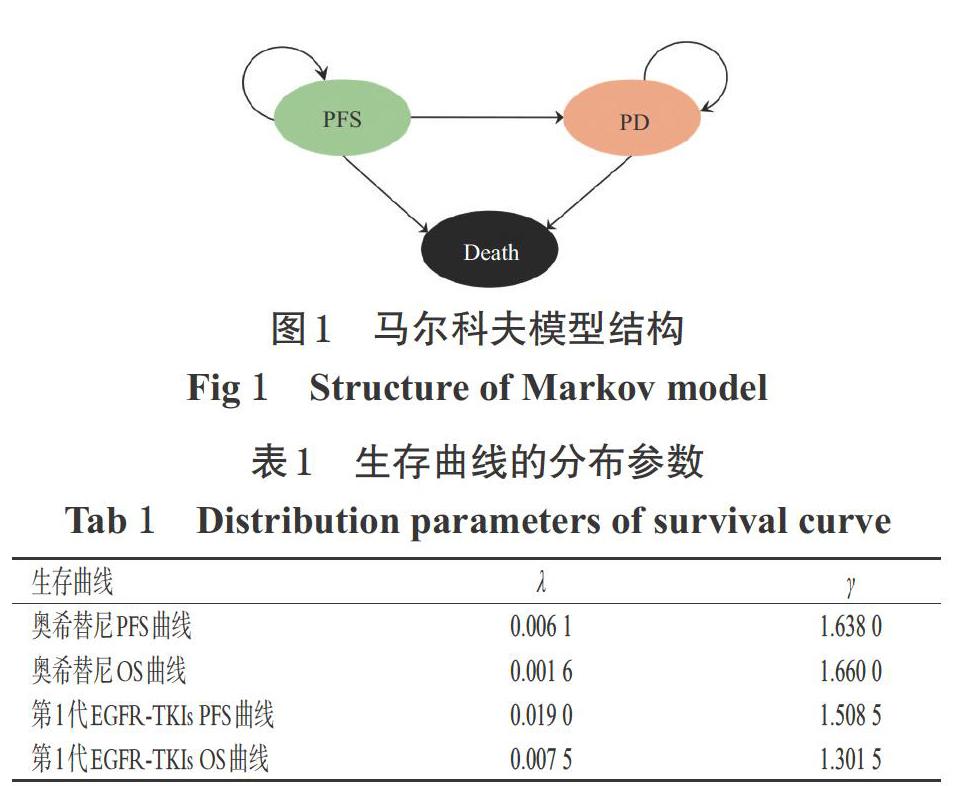
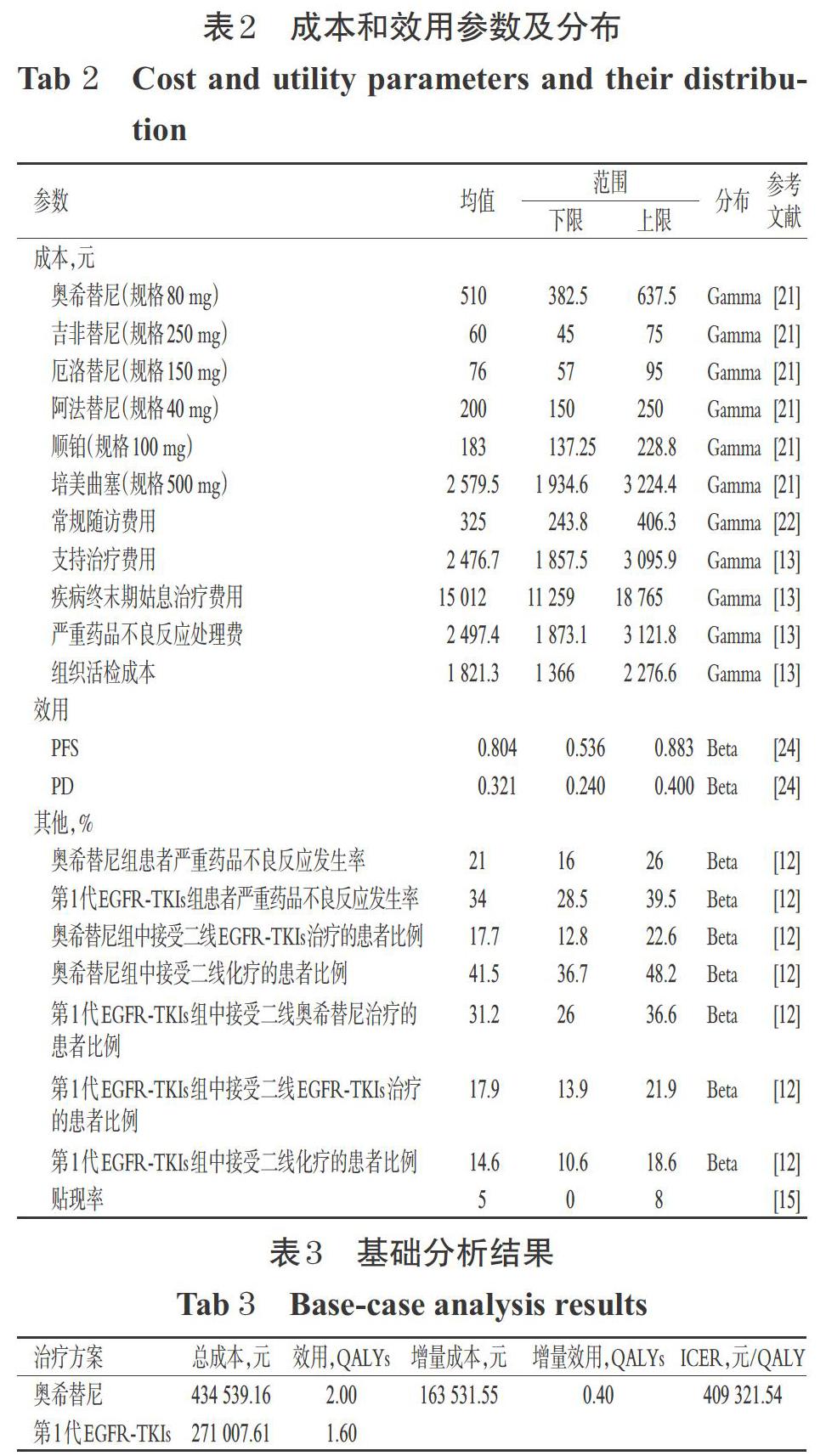
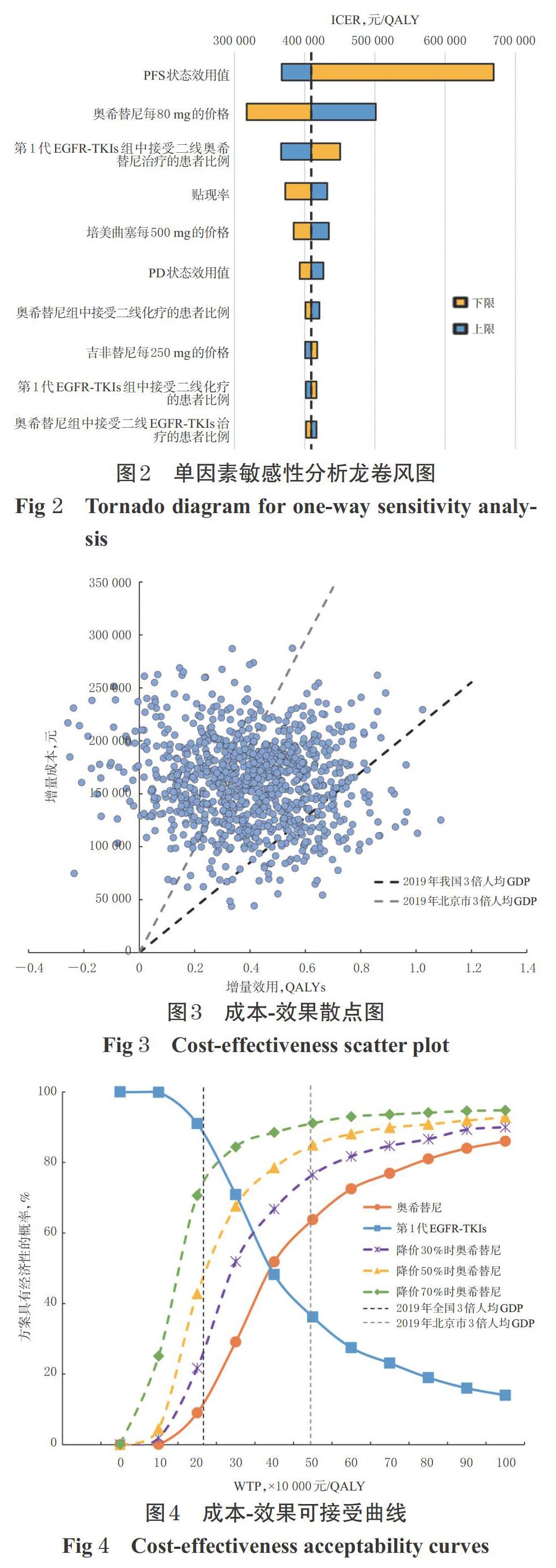
摘 要 目的:評价奥希替尼对比第1代表皮生长因子受体酪氨酸激酶抑制(EGFR-TKIs)一线治疗表皮生长因子受体(EGFR)编码基因突变阳性的局部晚期或转移性非小细胞肺癌(NSCLC)的经济性,为我国医疗卫生决策提供循证依据。方法:从卫生体系角度出发,利用FLAURA研究中的患者生存数据和已发表的文献数据建立马尔科夫模型,模拟EGFR突变阳性的局部晚期NSCLC患者10年的直接医疗成本和质量调整生命年(QALY),模型循环周期为3周,贴现率为5%。采用单因素敏感性分析和概率敏感性分析评价参数变化对模型结果稳定性的影响。结果:基础分析中,奥希替尼对比第1代EGFR-TKIs可多获得0.40 QALYs,增量成本为163 531.55元,增量成本-效用比(ICER)为409 321.54元/QALY,高于我国的意愿支付阈值[2019年我国3倍人均国内生产总值(GDP)212 676元/QALY]。单因素敏感性分析结果显示,无进展生存状态的效用值和奥希替尼的价格对ICER值影响最大。概率敏感性分析结果显示,在我国现有的意愿支付阈值下,奥希替尼具有经济性的概率为11.00%;当奥希替尼分别降价30%、50%、70%时,其在意愿支付阈值为212 676元/QALY时具有经济性的概率分别为26.20%、47.40%、74.30%。结论:当采用2019年我国3倍人均GDP作为判断标准时,奥希替尼对比第1代EGFR-TKIs一线治疗EGFR突变阳性的局部晚期或转移性NSCLC不具有经济性;适当的降价可提高其经济性。
关键词 奥希替尼;非小细胞肺癌;EGFR突变阳性;成本-效用分析
ABSTRACT OBJECTIVE:To evaluate the economics of osimertinib versus first-generation EGFR-TKIs in the first-line treatment of EGFR mutation-positive locally advanced or metastatic non-small cell lung cancer (NSCLC), and to provide evidence-based reference for medical and healthy decision-making in China. METHODS: From respective of health care system, Markov model was developed by using patientsurvival data and published literature datato simulate 10 years of direct medical costs and quality-adjusted life years (QALY)for EGFR mutation-positive locally advanced or metastatic NSCLC patients, with a model cycle length of 3 weeks, and the discount rate of 5%. One-way sensitivity analysis and probabilistic sensitivity analysis were used to evaluate the effects of parameter changes on the stability of the model results. RESULTS:In the base-case analysis, compared with the first-generation EGFR-TKIs, osimertinib could obtain 0.40 QALYs more, with an incremental cost of 163 531.55 yuan and an incremental cost-utility ratio (ICER) of 409 321.54 yuan/QALY, which was higher than the willingness-to-pay (WTP) threshold in China (3 times per capita GDP in China in 2019 of 212 676 yuan/QALY). The results of one-way sensitivity analysis showed that the utility value of progression-free survival status and the price of osimertinib had the greatest impact on ICER. The results of probability sensitivity analysis showed that the probability of osimertinib to be cost-effective was 11.00% at the WTP threshold in China. When the price of osimertinib decreased by 30%, 50% and 70%, the probability of osimertinib to be cost-effective was 26.20%, 47.40%, and 74.30% at the WTP threshold of 212 676 yuan/QALY, respectively. CONCLUSIONS: When Chinese 3 times per capita GDP in 2019 is used as the criterion for judgment, osimertinib is not economical compared with the first-generation EGFR-TKIs in first-line treatment of locally advanced or metastatic NSCLC with EGFR mutation-positive. Appropriate price reduction can improve its economy.
KEYWORDS Osimertinib; Non-small cell lung cancer; EGFR mutation-positive; Cost-utility analysis
2016年全球疾病负担研究(GBD 2016)结果显示,肺癌是世界范围内疾病负担最重的非传染性疾病之一[1]。据全国肿瘤登记中心的统计数据显示,肺癌是我国发病率和病死率最高的恶性肿瘤,其中非小细胞肺癌(NSCLC)为最常见的亚型,约占肺癌患者总数的85%~90%[2-5]。……