基底负偏压对Ti-Si-N涂层组织和性能的影响
2021-07-11舒应军刘双武张虎
舒应军 刘双武 张虎
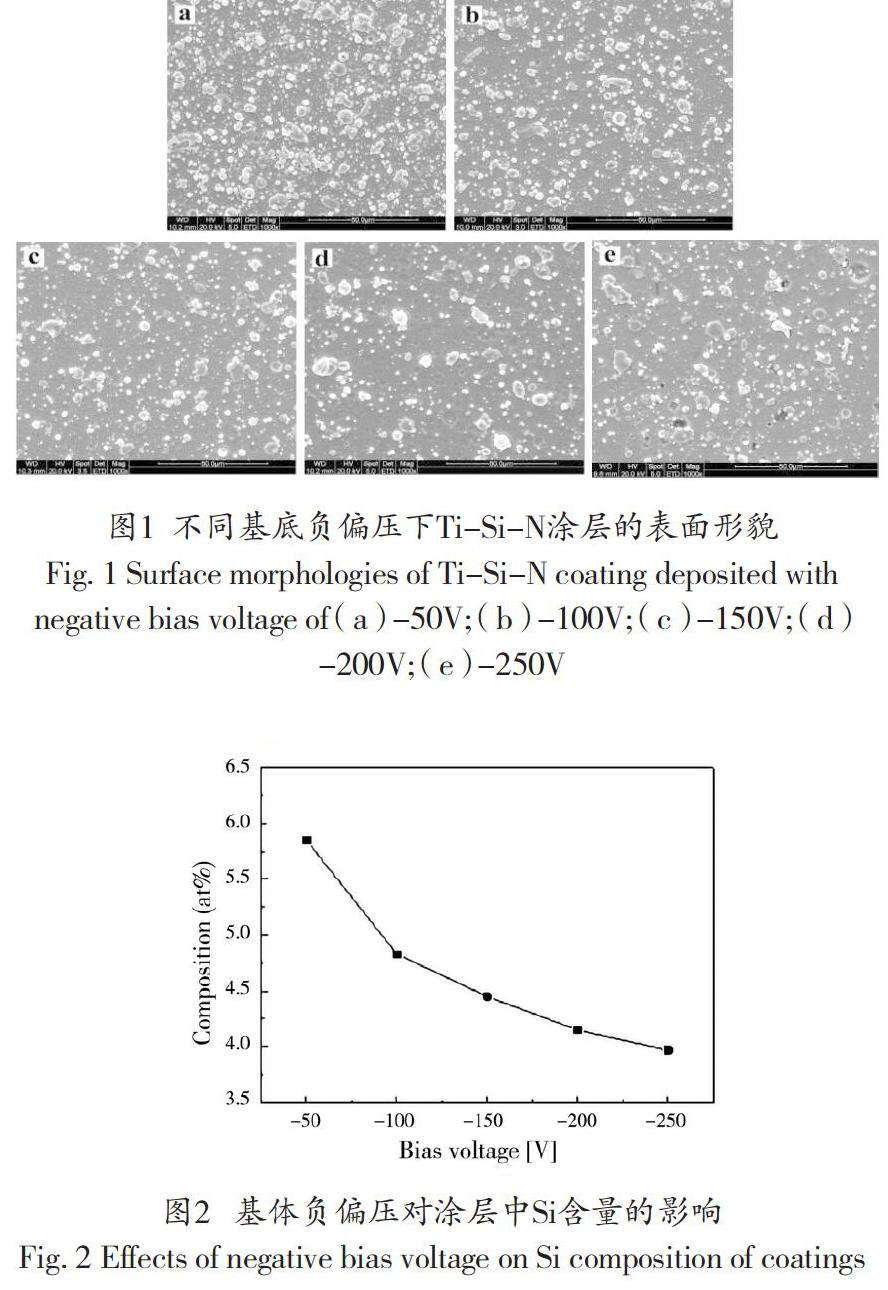
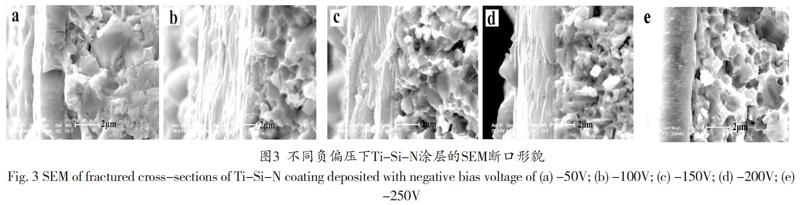
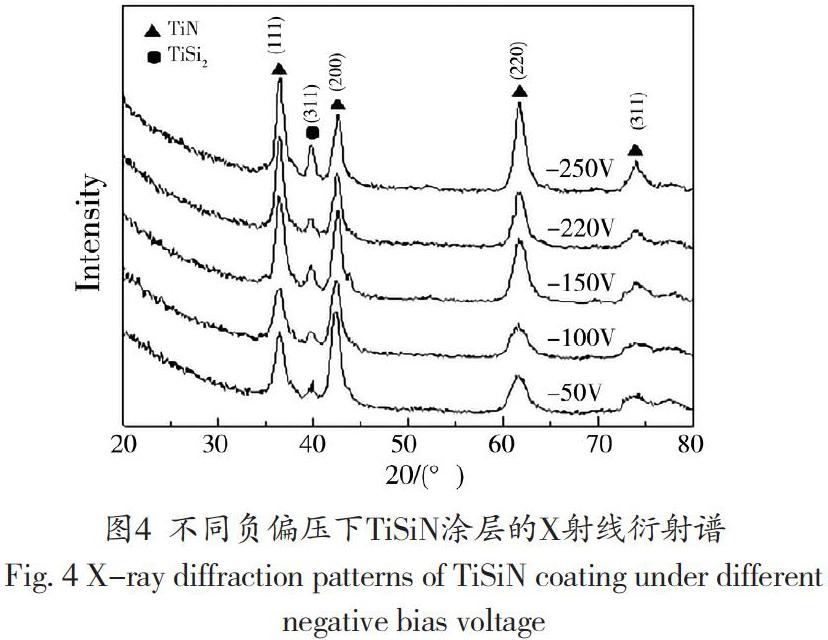
摘 要:采用多弧离子镀技术在Ti(C, N)金属陶瓷基体上沉积了TiSiN涂层,用X射线衍射仪、扫描电镜、显微硬度仪和划痕仪等实验手段研究了基底偏压对TiSiN涂层的表面形貌、成分、涂层物相和力学性能的影响。结果表明,基底偏压可增加荷能离子的速度,提高荷能离子的能量,并强化离子束对已沉积涂层的溅射作用,减少了涂层表面溶滴的数量,有利于获得致密的涂层材料。随着基底偏压的增加,(200)方向上衍射强度降低,而(111)方向增强,TiSi2的(311)方向的相对衍射强度略有增大。基底偏压的增加也提高了涂层的沉积温度,致使涂层晶粒有所增大。基底负偏压过高容易在晶粒间形成针状孔洞,从而恶化了涂层的力学性能。当基底偏压为-200V时,涂层具有良好的力学性能。
关键词:Ti-Si-N涂层;基底负偏压;多弧离子镀;微观组织;力学性能
中图分类号:TG174.4 文献标识码:A 文章编号:1001-5922(2021)04-0069-04
Abstract:The TiSiN coatings were deposited on the surface of Ti(C, N)-based cermet by multi-arc ion plating method. The effects of substrate bias on the surface morphology, composition, phase and mechanical properties of TiSiN coating were studied by means of X-ray diffraction, scanning electron microscope , microhardness tester and scratch tester. The results show that negative bias voltage can increase the velocity of charged ions, increase the energy of charged ions, and strengthen the sputtering effect of ion beam on the deposited coating, reduce the number of droplets on the coating surface, which is beneficial to obtain dense coating. With the increase of negative bias voltage, the diffraction intensity decreases in the direction of (200), increases in the direction of (111), and increases slightly in the direction of (311) of TiSi2. The increase of negative bias voltage also increases the deposition temperature of coating, resulting in the increase of coating grains. Too high negative bias voltage can easily form needle-like holes in the grains, which will deteriorate the mechanical properties of the coating. When the substrat enegative bias is -200V, the coating has good mechanical properties.
Key words:Ti-Si-N coating; substrate negative bias; multi-arc ion plating; microstructure; mechanical properties
0 前言
由于TiSiN涂層具有硬度高、抗高温氧化性能好、摩擦系数小、弹性模量高、与基体结合力强等特点,得到广泛关注[1-6]。目前的研究主要集中在调整涂层中合金元素的含量[3]、多层复合[1,6-9]、界面调控[10-13]等方面。上述微观效应导致薄膜宏观使役性能的改变,如内应力控制[14-16]、结构致密化[15]、和膜/基结合强度改善等。
文献[6]研究了Ti1-xSixN/CrAlN复合图层中随着Si含量的增加,涂层的硬度由27GPa增加到35GPa,但是涂层的高温热稳定性却有所下降。
文献[14]研究了基体负偏压对涂层内应力和硬度的影响,分析表明,对于低Si含量的涂层,随着负偏压的增大,晶粒度逐渐减小,硬度先升后降,弹性模量的变化不大;对于高Si含量的涂层随着负偏压的增加,晶粒度增大,硬度和弹性模量随着升高。……
