藏党参提取物对胶原诱导性关节炎模型大鼠的影响及机制研究
2021-06-15赵静郭睿博罗布占堆丁亚丽普珍董海谢红军
赵静 郭睿博 罗布占堆 丁亚丽 普珍 董海 谢红军


中圖分类号 R285 文献标志码 A 文章编号 1001-0408(2021)08-0967-07
DOI 10.6039/j.issn.1001-0408.2021.08.12
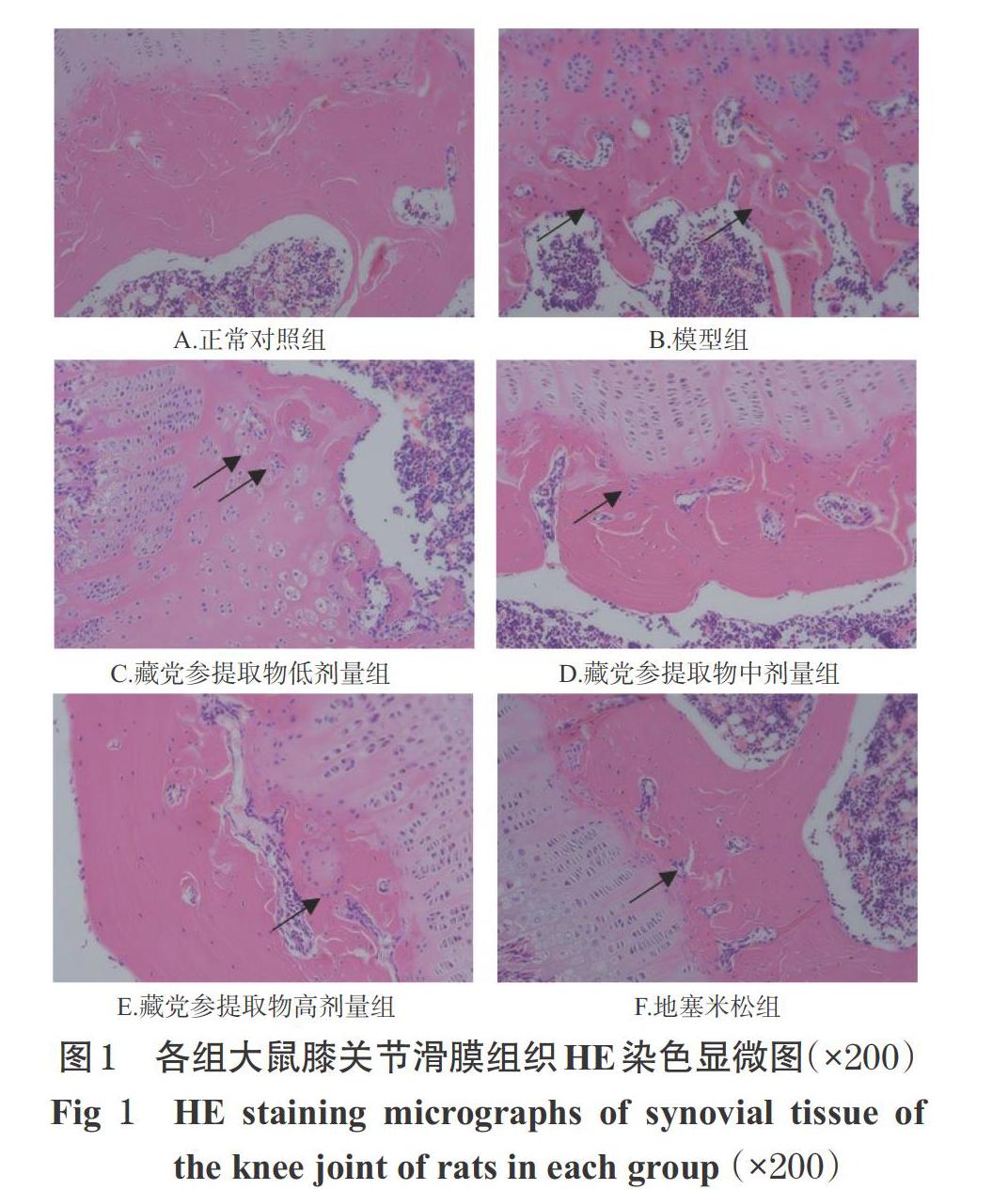
摘 要 目的:研究藏党参提取物(以下简称“ZDS”)对胶原诱导性关节炎(CIA)模型大鼠的影响及机制。方法:在48只大鼠中随机选8只作为正常对照组(生理盐水),剩余40只大鼠建立CIA模型。造模成功后,将其随机分为模型组(生理盐水),ZDS低、中、高剂量组(0.44、0.88、1.76 g/kg,以生药量计)和地塞米松组(阳性对照,0.002 5 g/kg),每组8只。灌胃给药,灌胃体积为400 μL,每天1次,连续28天。分别于给药前(0天)及给药7、14、21、28天后称定大鼠体质量,并进行关节炎指数评分;末次给药后,观察大鼠膝关节滑膜组织病理变化,测定其胸腺指数、脾指数、血清中炎症因子[白细胞介素1β(IL-1β)、肿瘤坏死因子α(TNF-α)、IL-6]水平以及膝关节滑膜组织中核因子κB(NF-κB) p65、磷酸化NF-κB p65(p-NF-κB p65)、NF-κB抑制蛋白(IκB)、磷酸化IκB(p-IκB)蛋白表达水平。结果:与正常对照组比较,模型组大鼠体质量(给药14、21、28天)显著降低(P<0.05),关节炎指数评分(给药前及给药不同时间)显著升高(P<0.05),关节滑膜组织病理损伤明显,胸腺指数、脾指数、炎症因子水平以及p-NF-κB p65、p-IκB蛋白的表达水平均显著升高(P<0.05),IκB蛋白的表达水平显著降低(P<0.05)。与模型组比较,ZDS低剂量组大鼠IL-1β水平显著降低(P<0.05);ZDS中、高剂量组和地塞米松组大鼠的体质量(给药21、28天)均显著增加(P<0.05),关节炎指数评分(给药14、21、28天)均显著降低(P<0.05),关节滑膜组织病理损伤明显减轻,胸腺指数、脾指数、炎症因子水平以及p-NF-κB p65、p-IκB蛋白的表达水平均显著降低(P<0.05),IκB蛋白的表达水平均显著升高(P<0.05)。结论:ZDS对CIA模型大鼠具有一定的改善作用,其机制可能与抑制NF-κB信号通路有关。
关键词 类风湿关节炎;藏党参;提取物;胶原诱导性关节炎;核因子κB信号通路;大鼠
Effects of Tibetan Codonopsis tralictrifolia Extract on Collagen-induced Arthritis Model Rats and Its Mechanism Study
ZHAO Jing1,GUO Ruibo2,Luobuzhandui1,DING Yali1,PU Zhen1,DONG Hai1,XIE Hongjun1(1. Medical College, Tibet University, Lhasa 850000, China; 2. School of Pharmacy, Liaoning University of TCM, Liaoning Dalian 116600, China)
ABSTRACT OBJECTIVE: To study the effects of Tibetan Codonopsis tralictrifolia extract (called “ZDS” for short) on collagen-induced arthritis (CIA) model rats and its mechanism. METHODS: Eight of 48 rats were randomly selected as normal control group (normal saline), and the remaining 40 rats were used to establish CIA model. After successful modeling, the rats were randomly divided into model group (normal saline), ZDS low-dose, medium-dose and high-dose groups (0.44, 0.88, 1.76 g/kg, by crude drug), dexamethasone group (positive control, 0.002 5 g/kg), with 8 rats in each group. They were given relevant medicine intragastrically, the volume of 400 μL, once a day, for consecutive 28 days. The body weight of rats were weighed before medication (0 d), 7, 14, 21 and 28 days after medication; and arthritis indexes were scored. The pathological changes of the knee joint synoviual tissue were observed after last medication. The thymus index, spleen index, the levels of serum inflammatory factors (IL-1β, TNF-α, IL-6), protein expressions of NF-κB p65, p-NF-κB p65, IκB and p-IκB in synovial tissue were detected. RESULTS: Compared with normal control group, the body weight (14, 21, 28 days after administration) of rats in model group was significantly reduced (P<0.05); the arthritis index score (before administration and different administration time) was significantly increased (P<0.05); the joint synovial tissue was pathologically damaged; the thymus and spleen index, inflammation factor level, the protein expression of p-NF-κB p65 and p-IκB were increased significantly (P<0.05), while the protein expression of IκB was decreased significantly (P<0.05). Compared with model group, the level of IL-1β was decreased significantly in ZDS low-dose group (P<0.05). Body weight of rats (21, 28 days after administration) were increased significantly in ZDS medium-dose and high-dose groups, dexamethasone group (P<0.05), while arthritis index score (14, 21, 28 days after administration) was decreased significantly (P<0.05). The pathological damage of joint synovial tissue was significantly relieved; thymus and spleen index, inflammation factor level, the protein expression of p-NF-κB p65 and p-IκB were significantly reduced, while the protein expression of IκB was significantly increased (P<0.05). CONCLUSIONS: ZDS can improve CIA model rats to some extent, and its mechanism may be related to the inhibition of NF-κB signaling pathway.
KEYWORDS Rheumatoid arthritis; Codonopsis tralictrifolia; Extract; Collagen-induced arthritis; NF-κB signaling pathway; Rat
类风湿性关节炎(RA)是一种常见的慢性、炎症性、系统性自身免疫性疾病,以关节及其组织非化脓性炎症为主要特征,终致关节的各种组织以及多脏器损害[1]。RA的基本病理特征为关节慢性滑膜炎、滑膜细胞增殖、炎性细胞浸润及血管翳的形成,以及可侵及下层的软骨或骨,可造成关节破坏甚至功能丧失[2-3]。RA的发病机制复杂,涉及机体的多条信号转导途径,其中核因子κB(NF-κB)被认为是重要的炎症信号通路,对RA的发生与发展具有核心的调节作用[4]。目前,临床……
