B10白铜表面超疏水膜的制备及其耐腐蚀性能研究
2021-05-24武家艳刘平陈小红周洪雷
武家艳 刘平 陈小红 周洪雷
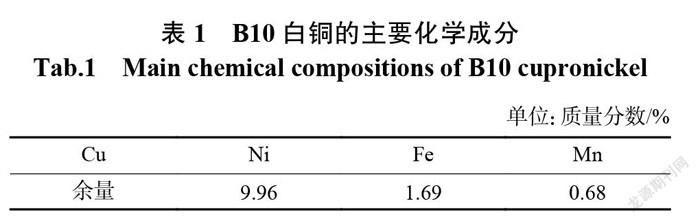
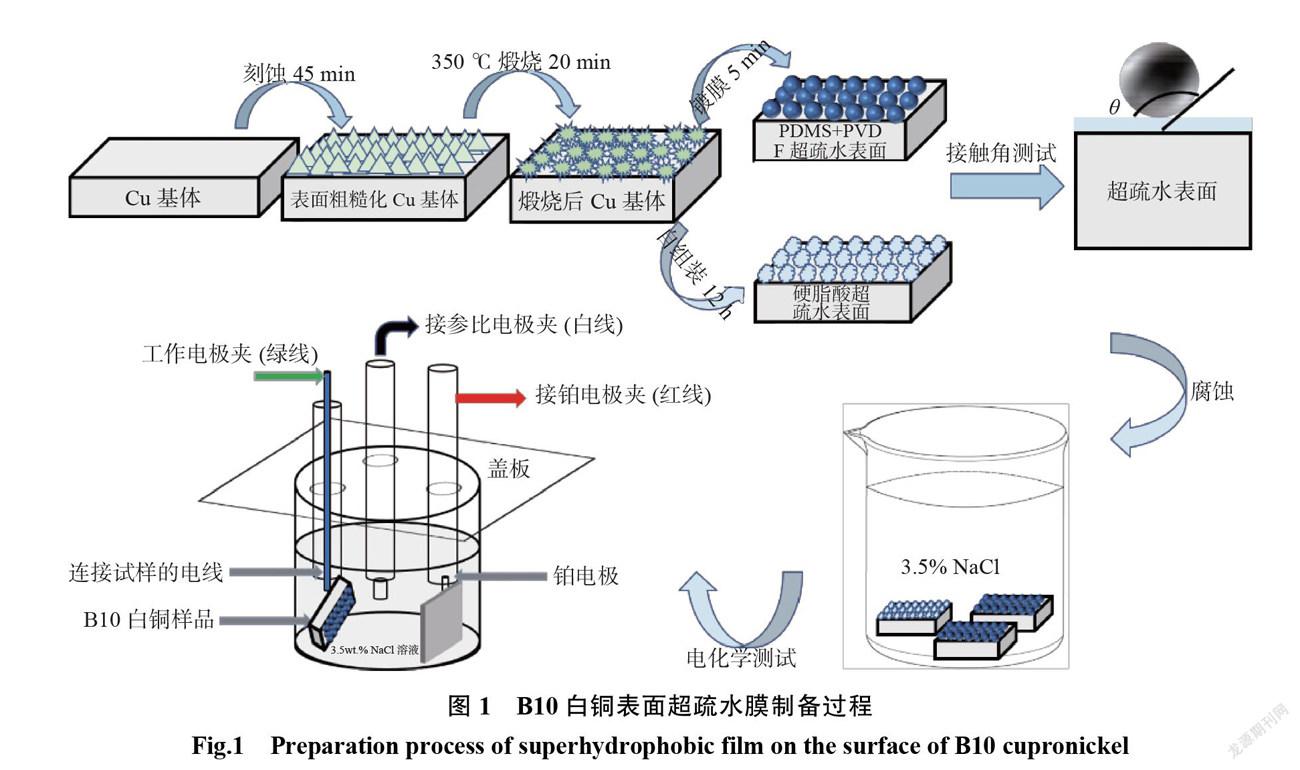
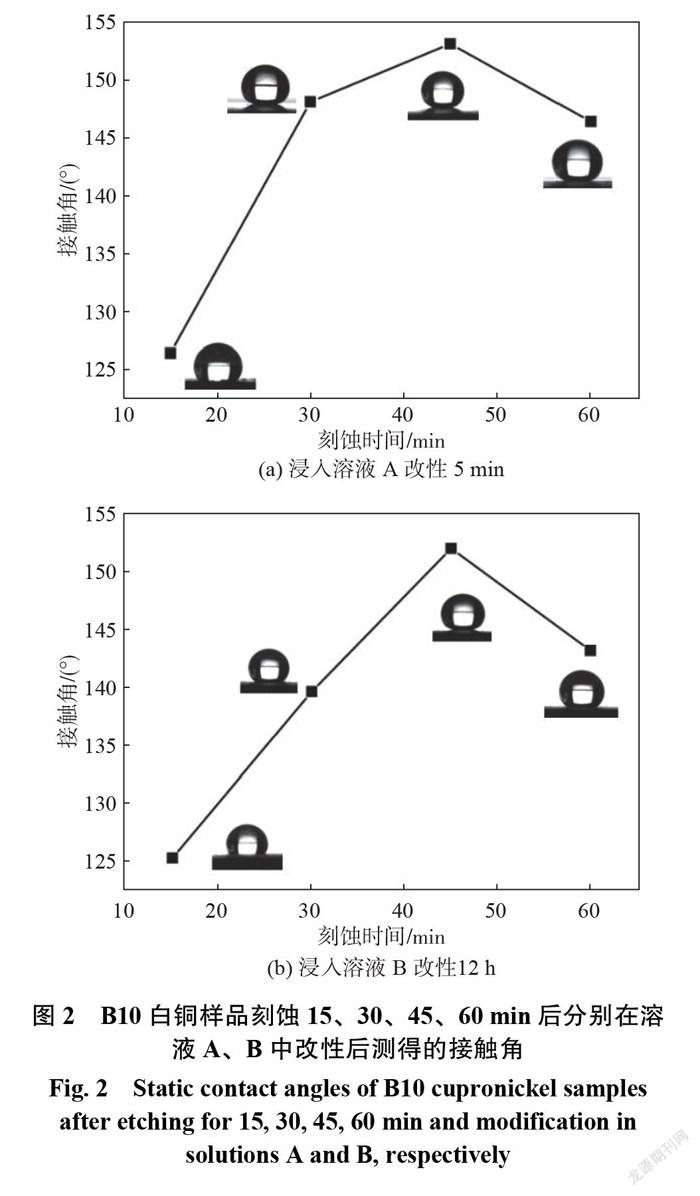
摘要:以 B10白铜为基底,采用刻蚀、煅烧和表面改性的方法制备了超疏水膜,采用 K100- MK2型张力仪测量超疏水膜的接触角,采用扫描电子显微镜观察超疏水膜的表面形貌,采用电化学工作站测试超疏水膜在3.5% NaCl(%表示质量分数)水溶液中的耐腐蚀性能。结果表明,刻蚀、煅烧后的 B10白铜样品分别在溶液 A 中改性5 min、在溶液 B 中改性12 h 后,得到的两种超疏水膜的接触角可分别达到153.2°和151.5°。将两种超疏水膜分别在3.5% NaCl 水溶液中腐蚀10 d 后,与裸 B10白铜相比,仍表现出较好的耐腐蚀持久性。该方法为制备具有抗腐蚀和自清洁性能的超疏水表面提供了一条有效途径,可用于金属材料的表面改性。
关键词: B10白铜;超疏水;表面改性;接触角;耐腐蚀
中图分类号: TG 164.23 文献标志码: A
Research on the Preparation and Corrosion Resistance of Superhydrophobic Film on B10 Cupronickel
WU Jiayan, LIU Ping, CHEN Xiaohong, ZHOU Honglei
(School ofMaterials and Chemistry , University of Shanghai for
Science and Technology, Shanghai 200093, China)
Abstract: Superhydrophobic films were prepared on B10 cupronickel substrate by etching, calcination and surface modification. The water contact angle of the superhydrophobic film was measured by K100- MK2 tensiometer, the superhydrophobic film morphology was observed by scanning electron microscope, and the superhydrophobic film' corrosion performance in 3.5% NaCl (% represents mass fraction) aqueous solution was tested by electrochemical workstation. The results show that, B10 cupronickel samples after etching , calcining: the contact angles of the superhydrophobic film modified by solution A for 5 min can reach 153.2° and modified by solution B for 12 h can reach 151.5°, respectively. After corrosion in 3.5% NaCl aqueous solution for 10 days, the two superhydrophobic films still show better corrosion durability than that of bare B10 cupronickel. This method provides an effective way to prepare of superhydrophobic surfaces with corrosion resistance and self-cleaning properties, and can be used in the surface modification ofmetallic materials.
Keywords: B10 cupronickel ; superhydrophobic ; surface modification; contact angle ; corrosion resistance
B10白銅由于其良好的耐海水腐蚀性能、较强的抗氯离子能力和较好的综合力学性能,在船舶排水管路、海上电厂冷热交换器和海水淡化等方面有广泛的应用[1-3]。但因海水中氯离子和微生物的作用, B10白铜仍会发生严重腐蚀,因此,提高其在潮湿环境下的耐腐蚀性能至关重要[4-6]。有研究表明,减少金属基体与腐蚀介质的接触是一种非常有效的防腐蚀方法[7-9]。
受自然界超疏水植物的启发,发现一定的润湿角可以产生疏水效果,而润湿角又与材料表面粗糙度有关[10-13]。所以研究人员尝试利用技术手段在基体表面构建微纳米超疏水结构,并证明建立超疏水表面是堵塞腐蚀性介质的一种非常有效的方法[14-17]。……