多维度干预对康复期精神分裂症患者认知及社会功能的影响
2021-03-22张伟
张伟
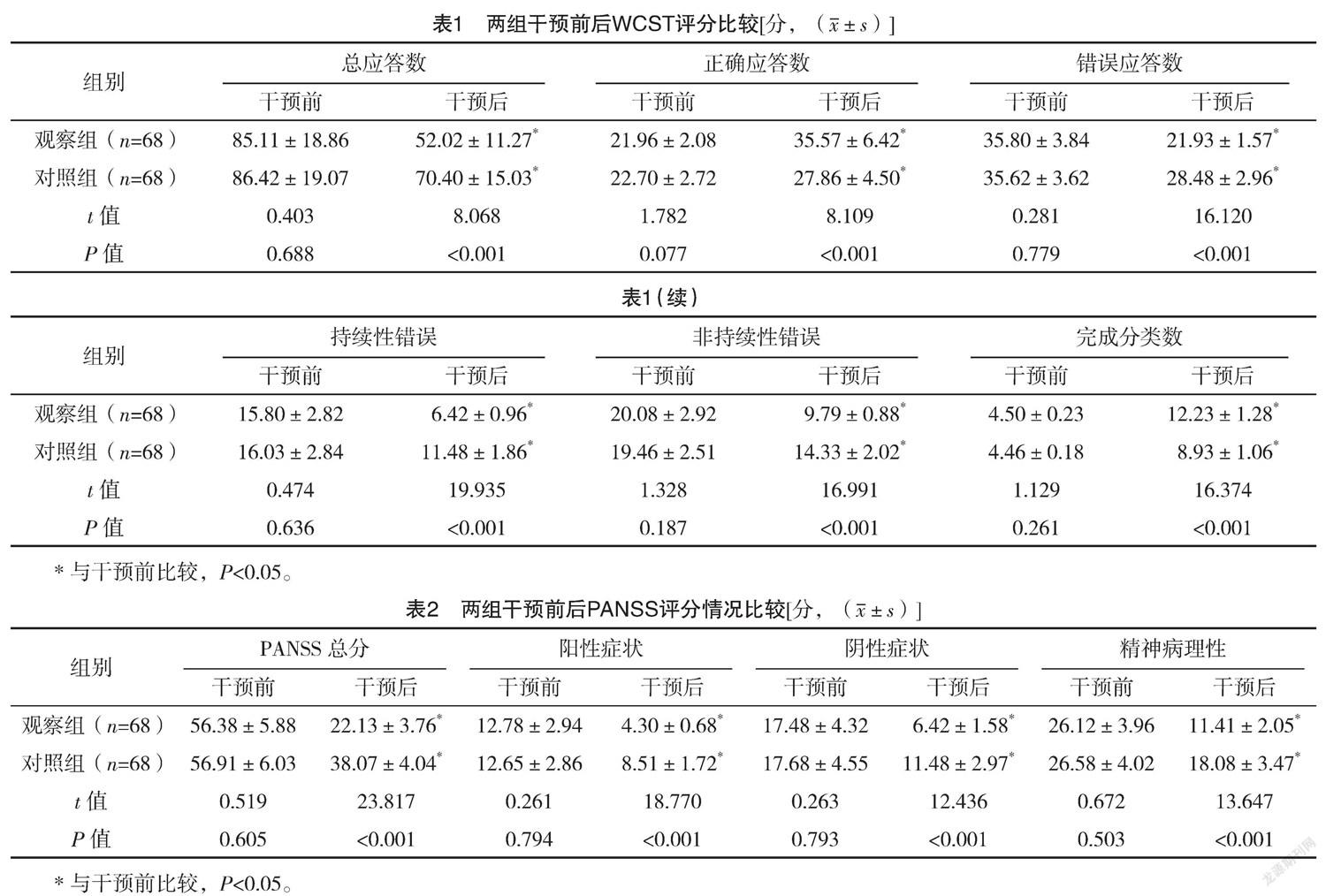
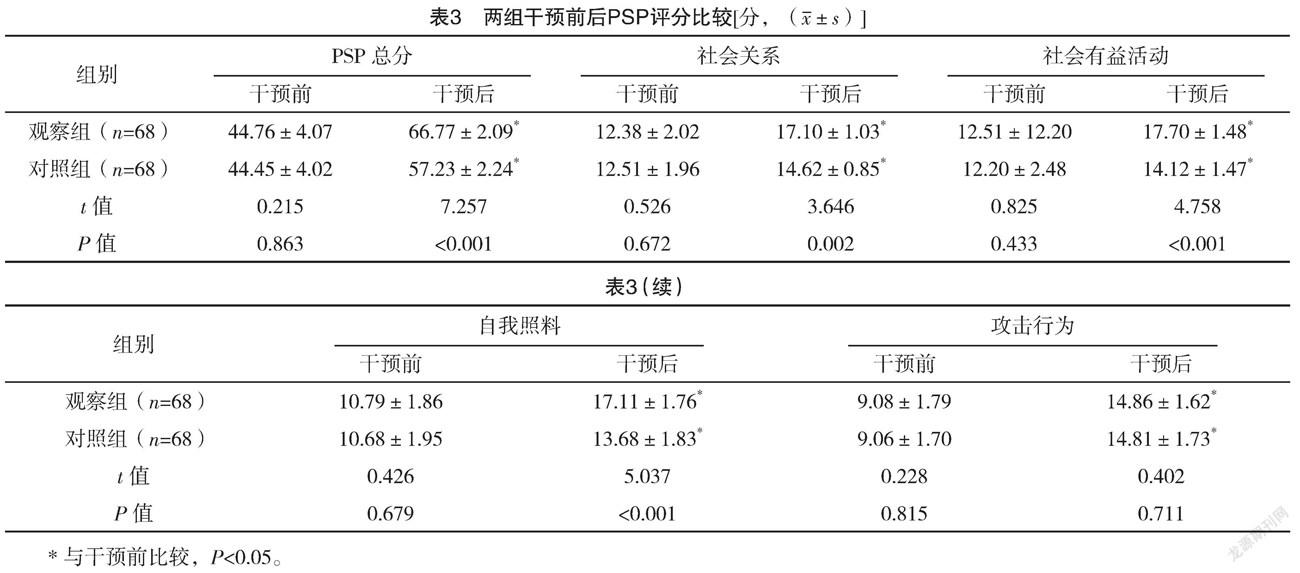
【摘要】 目的:探討多维度干预对康复期精神分裂症患者认知及社会功能的影响。方法:选取2018年1月-2019年6月在本院治疗的136例康复期精神分裂症患者为研究对象。随机将患者分为对照组和观察组,每组68例。对照组采取常规治疗,观察组应用多维度干预。比较两组干预前后的认知功能、精神症状、社会功能的影响。结果:干预前,两组WCST评分、PANSS评分、PSP评分比较,差异均无统计学意义(P>0.05)。干预后,观察组总应答数、错误应答数、持续性错误、非持续性错误评分均低于对照组,正确应答数和完成分类数评分均高于对照组,差异均有统计学意义(P<0.05)。干预后,观察组PANSS总分、阳性症状和阴性症状、精神病理性评分均低于对照组,差异均有统计学意义(P<0.05)。干预后,观察组PSP总分、社会关系、社会有益活动和自我照料评分均高于对照组,差异均有统计学意义(P<0.05);干预后,两组攻击行为评分比较,差异无统计学意义(P>0.05)。结论:对康复期精神分裂症患者采取多维度干预可有效地改善患者的认知功能和社会功能,提高患者的康复效果。
【关键词】 多维度干预 精神分裂症 认知功能 社会功能
Effects of Multi-dimensional Intervention on Cognition and Social Function of Patients with Schizophrenia in Rehabilitation Period/ZHANG Wei. //Medical Innovation of China, 2021, 18(29): -180
[Abstract] Objective: To explore the effects of multi-dimensional intervention on cognition and social function of patients with schizophrenia in rehabilitation period. Method: A total of 136 convalescent schizophrenia patients treated in our hospital from January 2018 to June 2019 were selected as the study subjects. The patients were randomly divided into control group and observation group, 68 cases in each group. The control group received conventional treatment, the observation group received multi-dimensional intervention. The cognitive function, mental symptoms and social function of the two groups were compared before and after the intervention. Result: Before the intervention, comparison of WCST scores, PANSS scores and PSP scores between the two groups, there were no significant differences (P>0.05). After intervention, the total response number, error response number, persistent error and non-persistent error scores of the observation group were lower than those of the control group, the scores of correct response number and completed classification number were higher than those of the control group, the differences were statistically significant (P<0.05). After intervention, the total PANSS score, positive and negative symptoms, psychopathology scores of the observation group were lower than those of the control group, the differences were statistically significant (P<0.05). After intervention, the total score of PSP, social relations, socially beneficial activities and self-care scores of the observation group were higher than those of the control group, the differences were statistically significant (P<0.05). After intervention, comparison of the aggressive behavior scores of the two groups, there was no significant difference (P>0.05). Conclusion: Multi-dimensional interventions for patients with schizophrenia during the rehabilitation period can effectively improve the cognitive function and social function of the patients, and improve the rehabilitation efficacy of the patients.
[Key words] Multi-dimensional intervention Schizophrenia Cognitive function Social function
First-authors address: The Mental Health Center of Zaozhuang, Zaozhuang 277103, China
doi:10.3969/j.issn.1674-4985.2021.29.044
精神分裂症属于较为常见的严重精神疾病,其临床表现包含阳性和阴性症状、认知功能、情感、行为等多方面障碍[1-2]。有学者研究指出精神分裂症具有反复发作、治疗周期长的特点[3]。临床上多数患者使用药物治疗,但部分患者仍存在精神症状、认知功能和社会功能下降的情况,且长期服用药物会引发患者各种负性情绪,降低治疗依从性,造成后续治疗较差[4-5]。另有学者发现重返社区技能训练可有效地从药物、心理、家庭、社会及健康教育等多方面干预患者的治疗效果[6],改善患者对疾病认知需求,减少疾病恶化的可能性。故本研究分析多维度干预对康复期精神分裂症患者认知、疗效及社会功能的影响。现报……