趋化因子CXCL13及其受体CXCR5在1型糖尿病DPNP中的作用机制
2021-03-18周泽麟李巧云李雅汪雯赵忠球梅之南
周泽麟?李巧云?李雅?汪雯?赵忠球?梅之南
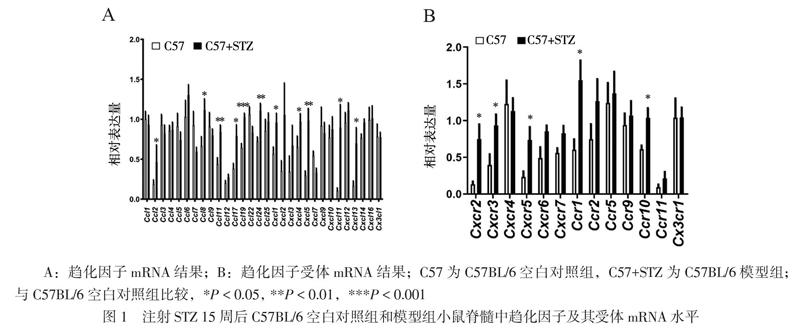
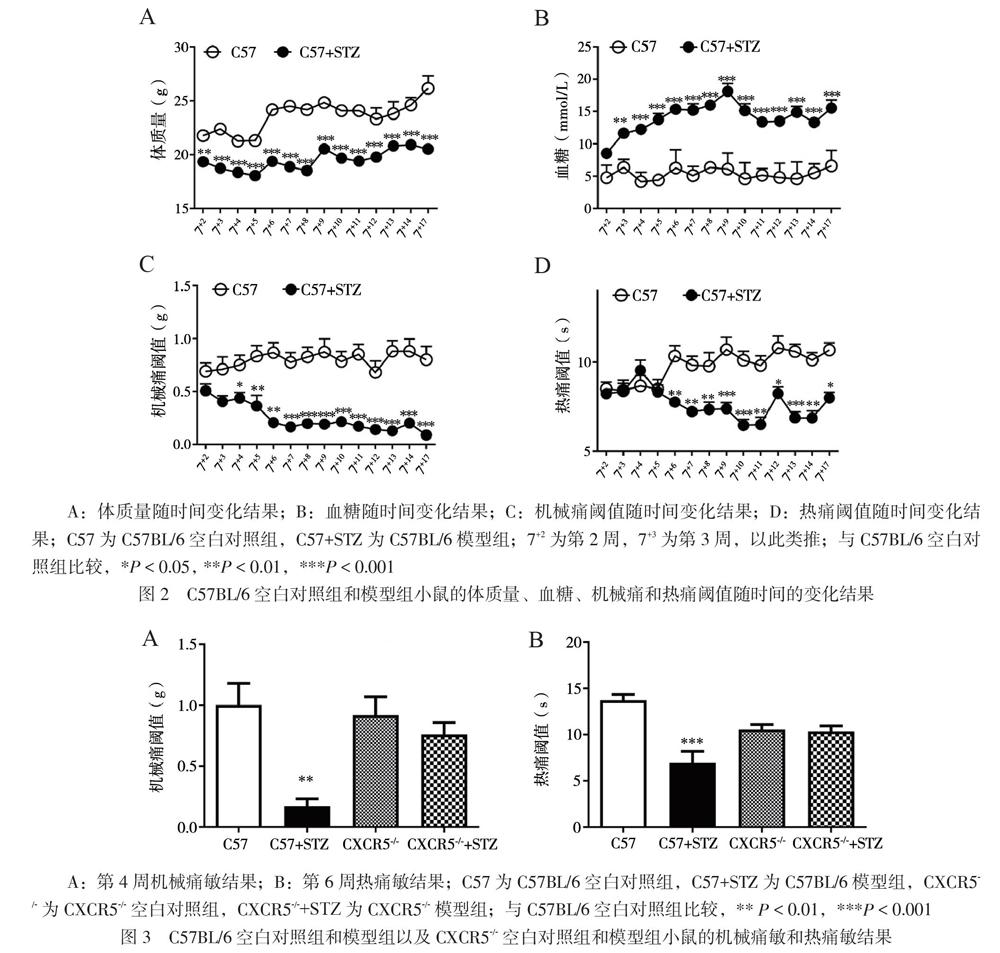
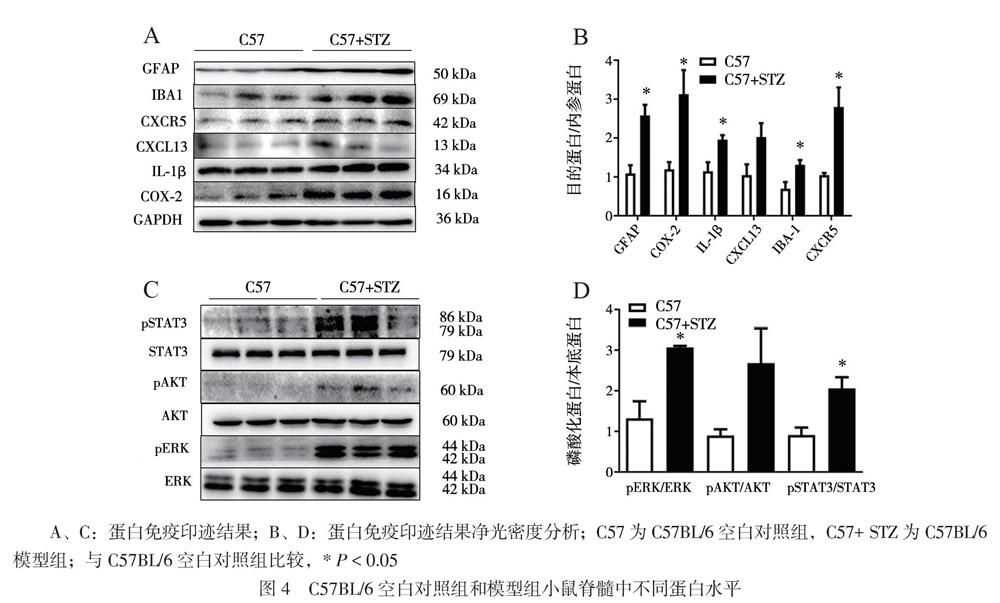
【摘要】目的 探討趋化因子CXCL13及其受体CXCR5在1型糖尿病引发的糖尿病性周围神经病理性疼痛(DPNP)中的作用机制。方法 将36只C57BL/6小鼠随机分为C57BL/6空白对照组和C57BL/6模型组(每组18只)。C57BL/6模型组采用腹腔注射链脲佐菌素(60 mg/kg)构建1型糖尿病模型。每周观测小鼠的体质量、血糖、机械痛和热痛阈值。于第15周检测2组脊髓中趋化因子、趋化因子受体和促炎因子水平的变化以及血清中炎症因子的变化。在上述试验基础上,再分别取12只C57BL/6小鼠和12只CXCR5-/-小鼠按前述方法分别设立对照组和模型组(每组6只),于第4周检测各组机械痛敏、第6周检测热痛敏。结果 C57BL/6模型组小鼠的脊髓中CXCL13和CXCR5等趋化因子及其受体的mRNA明显上调(P均< 0.05)。C57BL/6模型组小鼠血糖升高、体质量减少,第4周的机械痛阈值降低、第6周的热痛阈值降低(P均< 0.05),但CXCR5-/-模型组小鼠机械痛和热痛阈值无变化。与C57BL/6空白对照组比较,C57BL/6模型组小鼠的星形胶质细胞标志物胶质纤维酸性蛋白、小型胶质细胞标志物离子钙结合衔接分子1以及炎症因子标志物环氧化酶-2、IL-1β以及磷酸化的丝裂原活化蛋白激酶(ERK)和信号转导和转录激活因子3(STAT3)的水平升高(P均< 0.05);血清中炎症因子IL-6、TNF-α和IL-1β蛋白水平升高(P均< 0.01)。结论 趋化因子CXCL13及其受体CXCR5的激活或可促使1型糖尿病DPNP的发生,相关机制可能是通过激活胶质细胞与磷酸化的ERK、STAT3和炎症因子表达实现的。
【关键词】CXCL13;CXCR5;1型糖尿病;糖尿病性周围神经病理性疼痛;胶质细胞
Role and mechanism of chemokine CXCL13 and its receptor CXCR5 in type 1 diabetic neuropathic pain Zhou Zelin, Li Qiaoyun, Li Ya, Wang Wen, Zhao Zhongqiu, Mei Zhinan. School of Pharmacy, South-Central University for Nationalities, Wuhan 430074, China
Corresponding author, Mei Zhinan, E-mail: meizhinan@ 163. com
【Abstract】Objective To explore the role of chemokine CXCL13 and its receptor CXCR5 in diabetic peripheral neuropathic pain (DPNP) induced by type 1 diabetes. Methods Thirty six C57BL/6 mice were randomly divided into the C57BL/6 blank control group (n = 18) and C57BL/6 model group (n = 18). The animals in the model group were intraperitoneally injected with streptozotocin (60 mg/kg) for consecutive 4 days to induce DPNP. The body weight, blood glucose level and pain threshold were observed every week in two groups. After 15 weeks, the expression changes of chemokine CXCL13, chemokine receptor Cxcr5 and pro-inflammatory factors at the mRNA and protein levels in the spinal cord tissue were detected in two groups. Twelve C57BL/6 mice and 12 CXCR5-/- mice were randomly divided into the blank control group (both n = 6) and model group (both n = 6). The experimental procedures and detection indexes were the same as those of 36 C57BL/6 mice. Results The expression levels of CXCL13 and its receptor CXCR5 mRNA in the C57BL/6 model group were significantly higher than those in the C57BL/6 blank control group (both P < 0.05). Compared with the C57BL/6 blank control group, the blood glucose level was significantly higher and the body mass was remarkably less in the C57BL/6 model group (both P < 0.05). In the C57BL/6 model group, threshold of mechanical abnormal pain decreased at the 4th week, and threshold hot pain was decreased at the 6th week. CXCR5-/- mice did not show significant changes in pain sensitivity. In the C57BL/6 model group, astrocyte-specific glial fibrillary acidic protein (GFAP) and microglia marker ionized calcium binding adapter molecule 1 (IBA1) in the spinal cord tissues were activated. Compared with the C57BL/6 blank control group, the expression levels of COX-2, IL-1β, phosphorylated extracellular signal-regulated kinase (pERK), phosphorylated protein kinase B (pAKT) and phosphorylated signal transducer and activator of transcription 3 (pSTAT3) were remarkably up-regulated, and the serum levels of IL-6、 TNF-α and IL-1β were significantly increased (all P < 0.05). Conclusions CXCL13 and CXCR5 can induce DPNP of type 1 diabetic, probably by activating the glial cells, pERK, pSTAT3 and inflammatory factors.
【Key words】CXCL13;CXCR5;Type 1 diabetes;Diabetic peripheral neuropathic pain;Glial cells
糖尿病是一种常见的代谢性疾病,可引发许多相關并发症。糖尿病性周围神经病理性疼痛(DPNP)是一种慢性疼痛综合征,机械痛和热痛觉过敏是其主要临床表现[1-2]。糖尿病神经病变的发病机制十分复杂,目前认为,趋化因子通过脊髓中不同形式的神经元-胶质细胞相互作用来引发DPNP[3]。最近有研究表明,趋化因子参与2型糖尿病DPNP的发病过程[4]。在外周组织炎症和神经损伤引起的慢性疼痛的病理过程中,趋化因子CXCL13及其受体CXCR5(CXCL13/CXCR5)参与了三叉神经痛和脊髓神经结扎(SNL)诱发的神经病理性疼痛[5]。本课题组的前期研究表明,在db/db小鼠模型中,CXCL13/CXCR5有引发2型糖尿病DPNP的作用[6]。但是,1型糖尿病引起的DPNP与CXCL13 /CXCR5的关系我们尚未见报道。……