营养支持干预对晚期卵巢癌患者营养状况及癌性厌食的改善作用
2021-03-15陈云陈玲玲王凯
陈云 陈玲玲 王凯
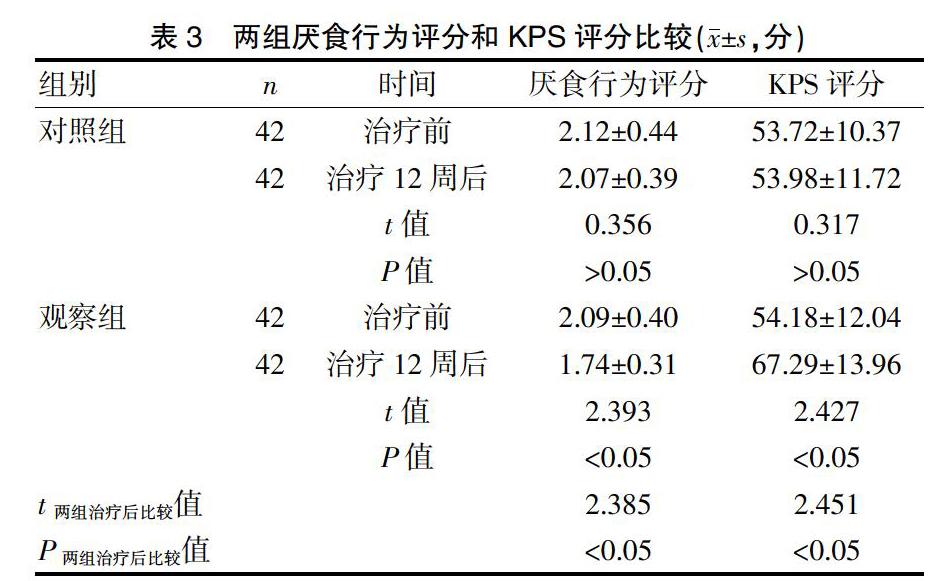
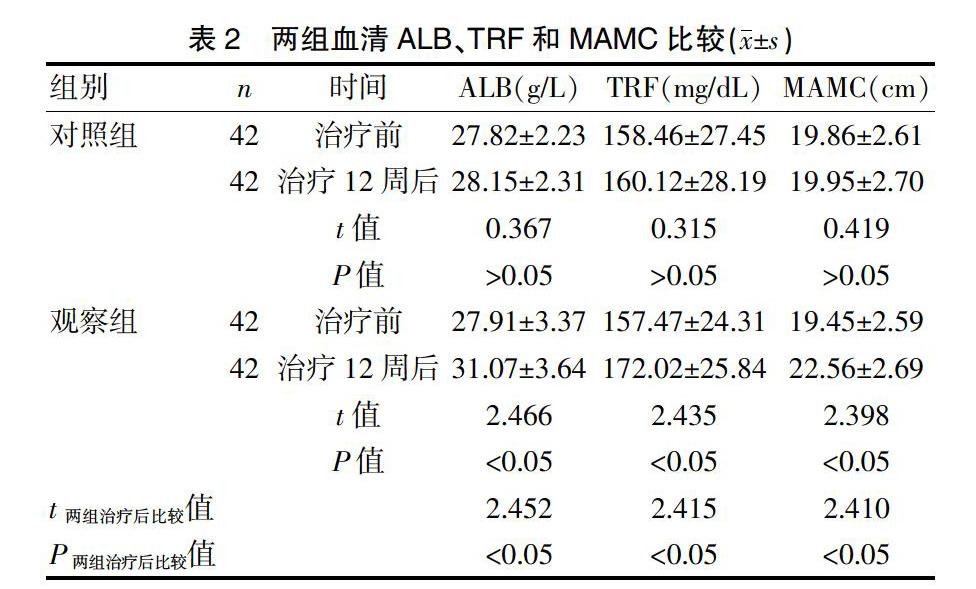
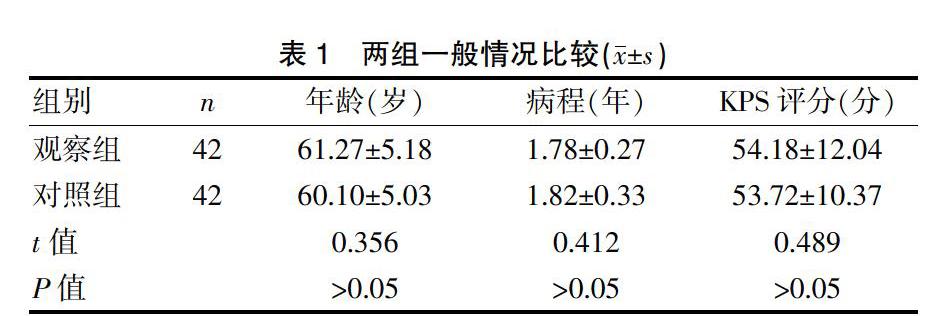
[摘要] 目的 探讨营养支持干预对晚期卵巢癌患者营养状况及癌性厌食的改善作用。 方法 选取2017年3月至2019年7月我院门诊就诊晚期卵巢癌患者84例,随机分为观察组和对照组,每组各42例。对照组予以常规抗肿瘤治疗及普通膳食治療,观察组在对照组基础上予以营养支持治疗,两组均治疗12周。观察两组治疗前后营养状况[血清清蛋白(ALB)、转铁蛋白(TRF)和上臂三头肌肌围(MAMC)]、厌食行为评分及体力状况KPS评分的变化。结果 治疗12周后,观察组患者血清ALB、TRF水平和MAMC较治疗前显著上升(P<0.05),而对照组患者治疗前后无明显变化(P>0.05),且治疗后观察组血清ALB、TRF水平和MAMC明显高于对照组(P<0.05);同时观察组患者厌食行为评分较治疗前显著下降,KPS评分较治疗前显著上升(P<0.05),而对照组患者治疗前后变化不明显(P>0.05),且治疗后观察组患者厌食行为评分低于对照组,KPS评分高于对照组(P<0.05)。 结论 营养支持干预用于晚期卵巢癌患者不仅可改善其营养状况,减少营养不良发生;而且还能降低癌性厌食评分,改善其食欲,提高其体力状况。
[关键词] 晚期卵巢癌;营养支持干预;营养状况;癌性厌食
[Abstract] Objective To explore the improvement effect of nutritional support intervention on the nutritional status and cancer-related anorexia of patients with advanced ovarian cancer. Methods Eighty-four patients with advanced ovarian cancer who were admitted in the outpatient clinic of our hospital from March 2017 to July 2019 were randomly divided into observation group and control group, with 42 cases in each group. The control group received conventional anti-tumor treatment and ordinary dietary treatment, and the observation group received nutritional support treatment on the basis of treatment in the control group. Both groups were treated for 12 weeks. The changes of nutritional status [serum albumin (ALB), transferrin (TRF) and upper arm triceps muscle circumference (MAMC)], anorexia behavior score and physical status KPS score before and after treatment in both groups were observed. Results After 12 weeks of treatment, the serum ALB, TRF and MAMC of the observation group were significantly higher than those before treatment(P<0.05), while the control group had no significant change before and after treatment(P>0.05). The serum ALB, TRB and MAMC of the observation group after treatment were significantly higher than those of the control group(P<0.05). The anorexia behavior score of the observation group was significantly lower, and the KPS score was significantly higher than before(P<0.05). While the control group had no significant change before and after treatment(P>0.05). And the anorexia score of the observation group was lower than that of the control group after treatment, and the KPS score was higher than that of the control group(P<0.05). Conclusion Nutritional support interventions for patients with advanced ovarian cancer can not only improve their nutritional status and reduce the incidence of malnutrition, but also reduce the cancer-related anorexia score, improve their appetite and their physical status.
[Key words] Advanced ovarian cancer; Nutrition support intervention; Nutritional status; Cancer-related anorexia
卵巢癌是一种妇科较常見的恶性肿瘤,近年来其发病率逐年提升,且有年轻化趋势。因卵巢癌患者起病较隐匿,早期诊断较困难,发现时大部分患者已到晚期[1-2]。晚期卵巢癌多合并代谢异常,患者本身能耗增加和机体自身的特殊应激状态,大部分患者合并程度不同的营养不良和厌食状况,部分患者病情严重时可出现恶液质,使患者抵抗力和免疫力下降,生存时间缩短[3-4]。有研究显示,晚期肿瘤患者的病情往往无法逆转,单纯抗肿瘤治疗患者获益不多,往往会加重其病情,缩短生存期,而营养支持则可改善晚期肿瘤患者的营养状态,对改善患者的预后具有一定作用[5-6]。本研究旨在分析营养支持干预改善晚期卵巢癌患者的营养状况和癌性厌食的作用,现报道如下。……
