阶段性心理干预联合经颅磁刺激对卒中后抑郁患者的临床应用价值
2021-01-28谌美清喻春梅黄芳
谌美清 喻春梅 黄芳
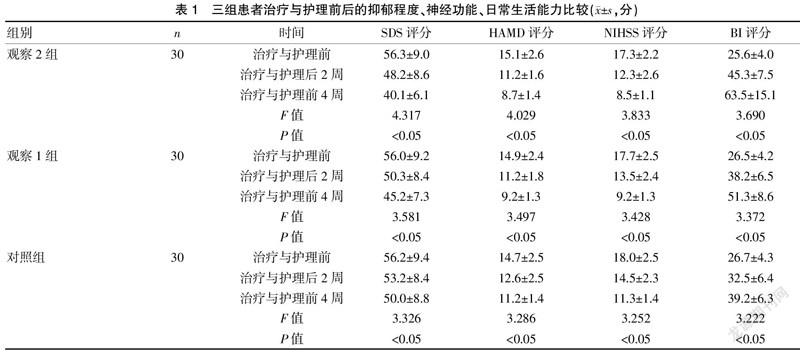
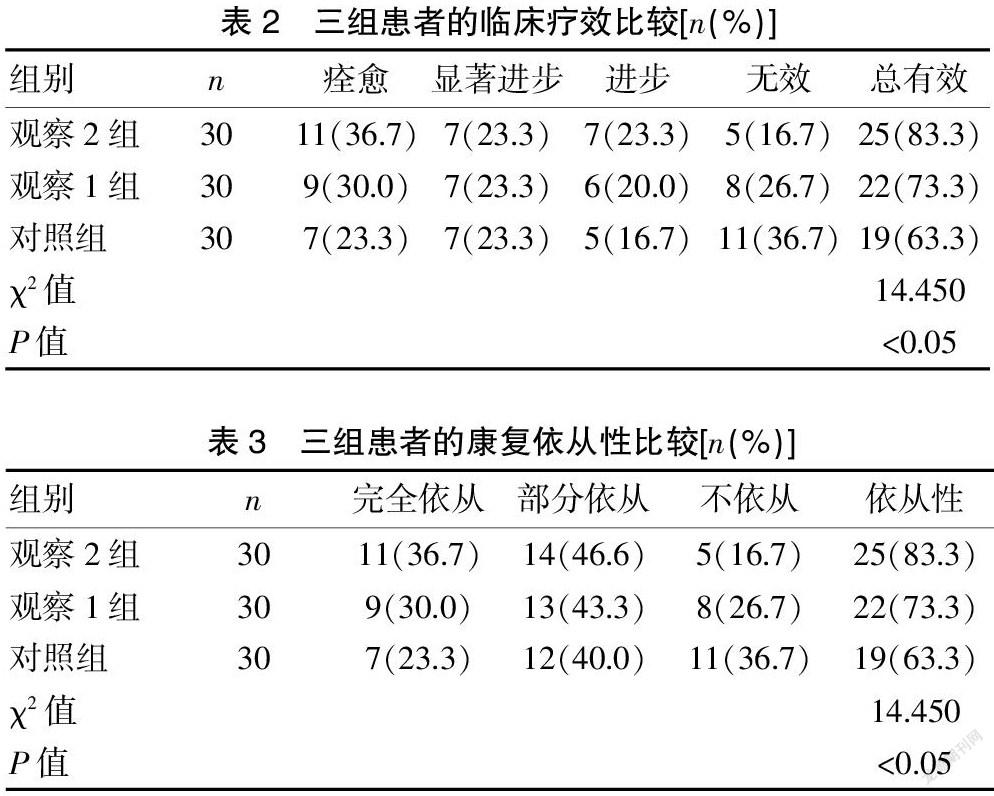
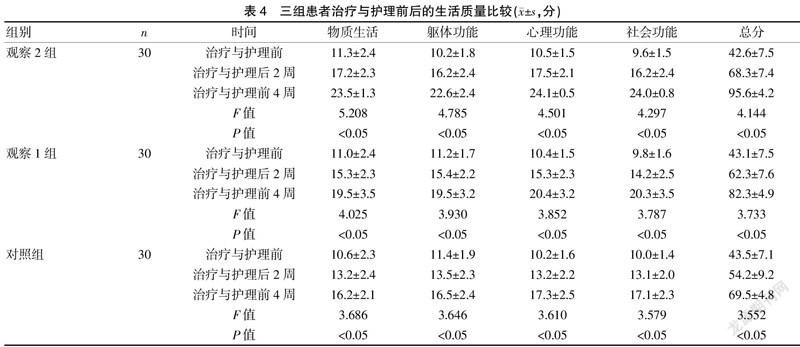
[摘要] 目的 探討卒中后抑郁患者经颅磁刺激联合阶段性心理干预的临床应用价值。 方法 选取2020年3月至2021年3月收治的脑卒中后抑郁的患者90例,以住院号顺序随机分为对照组、观察1组、观察2组三组,每组各30例,对照组接受常规药物治疗及一般护理,观察1组在常规护理的条件下配合经颅磁刺激治疗,观察2组做阶段性心理护理联合经颅磁刺激治疗,然后统计分析三组患者的抑郁程度、神经功能、日常生活能力、临床疗效、生活质量。 结果 观察2组、观察1组患者治疗与护理后2周、4周较治疗与护理前的SDS评分、HAMD评分、NIHSS评分降低幅度、BI评分升高幅度均显著高于对照组(P<0.05)。观察2组、观察1组患者的总有效率为83.3%、73.3%,显著高于对照组的63.3%(P<0.05)。观察2组、观察1组患者的康复依从性为83.3%、73.3%,显著高于对照组的63.3%(P<0.05)。观察2组、观察1组患者治疗与护理后2周、4周较治疗与护理前的物质生活、躯体、心理、社会功能评分及GQOLI-74总分升高幅度均显著高于对照组(P<0.05)。 结论 卒中后抑郁患者经颅磁刺激联合阶段性心理干预的临床应用价值较高。
[关键词] 卒中后抑郁;常规康复训练;经颅磁刺激;阶段性心理干预
[中图分类号] R473.7 [文献标识码] B [文章编号] 1673-9701(2021)33-0180-05
[Abstract] Objective To explore the clinical application value of transcranial magnetic stimulation combined with staged psychological intervention in patients with post-stroke depression. Methods Ninety patients with post-stroke depression admitted from March 2020 to March 2021 were selected and randomly divided into three groups in the order of hospitalization number,namely,the control group,the observation 1 group and the observation 2 group,with 30 cases in each group. The control group received conventional medication and general nursing, the observation 1 group was treated with transcranial magnetic stimulation on the basis of conventional nursing, and the observation 2 group was treated with staged psychological nursing combined with transcranial magnetic stimulation. The degree of depression, neurological function, activity of daily living, clinical efficacy and quality of life of the patients in the three groups were statistically analyzed. Results At 2 weeks and 4 weeks after treatment and nursing, the decrease range of Self-rating depression scale (SDS) score, Hamilton depression scale(HAMD) score, National institute of health stroke scale (NIHSS) score and increase range of Barthel index (BI) score in the observation 2 group and the observation 1 group were significantly higher than those in the control group when compared with those before treatment and nursing(P<0.05).The total effective rate of patients in the observation 2 group and the observation 1 group was 83.3% and 73.3% respectively, which was significantly higher than 63.3% in the control group(P<0.05).The rehabilitation compliance rate of patients in the observation 2 group and the observation 1 group was 83.3% and 73.3% respectively, which was significantly higher than 63.3% in the control group(P<0.05).At 2 weeks and 4 weeks after treatment and nursing, the increase in physical life, somatic, psychological and social function scores and the total score of Generic Quality of Life Inventory-74(GQOLI-74) of patients in the observation 2 group and the observation 1 group were significantly higher than that in the control group when compared with that before treatment and nursing(P<0.05). Conclusion The transcranial magnetic stimulation combined with staged psychological intervention is of high value in the clinical treatment of patients with post-stroke depression.
[Key words] Post-stroke depression; Conventional rehabilitation training; Transcranial magnetic stimulation; Staged psychological intervention
卒中后抑郁是卒中的一个并发症,在临床较为常见,卒中后很多的患者会出现抑郁的情况,据国家统计,卒中后抑郁的发生率为30%~50%。抑郁产生的原因很多,脑卒中后患者会面临着很严重的经济压力。这两种情况都可能会导致卒中后的抑郁的产生。另外,卒中后的抑郁也与病理、生理的改变有关,目前认为卒中后的抑郁和额叶-基底节环路受到了破坏后,脑中5-羟色胺、去甲肾,或者是多巴胺的神经传导出现障碍,导致卒中后抑郁的产生。相关医学研究表明[1],卒中后抑郁有40%的发病率,对患者的神经功能恢复及日常生活造成严重的不良影响,需要临床积极采取有效措施对患者的临床症状进行缓解,对其生活质量进行改善。……