细菌培养及药敏试验在复发性尿路感染患者中的应用
2021-01-28李琳
李琳
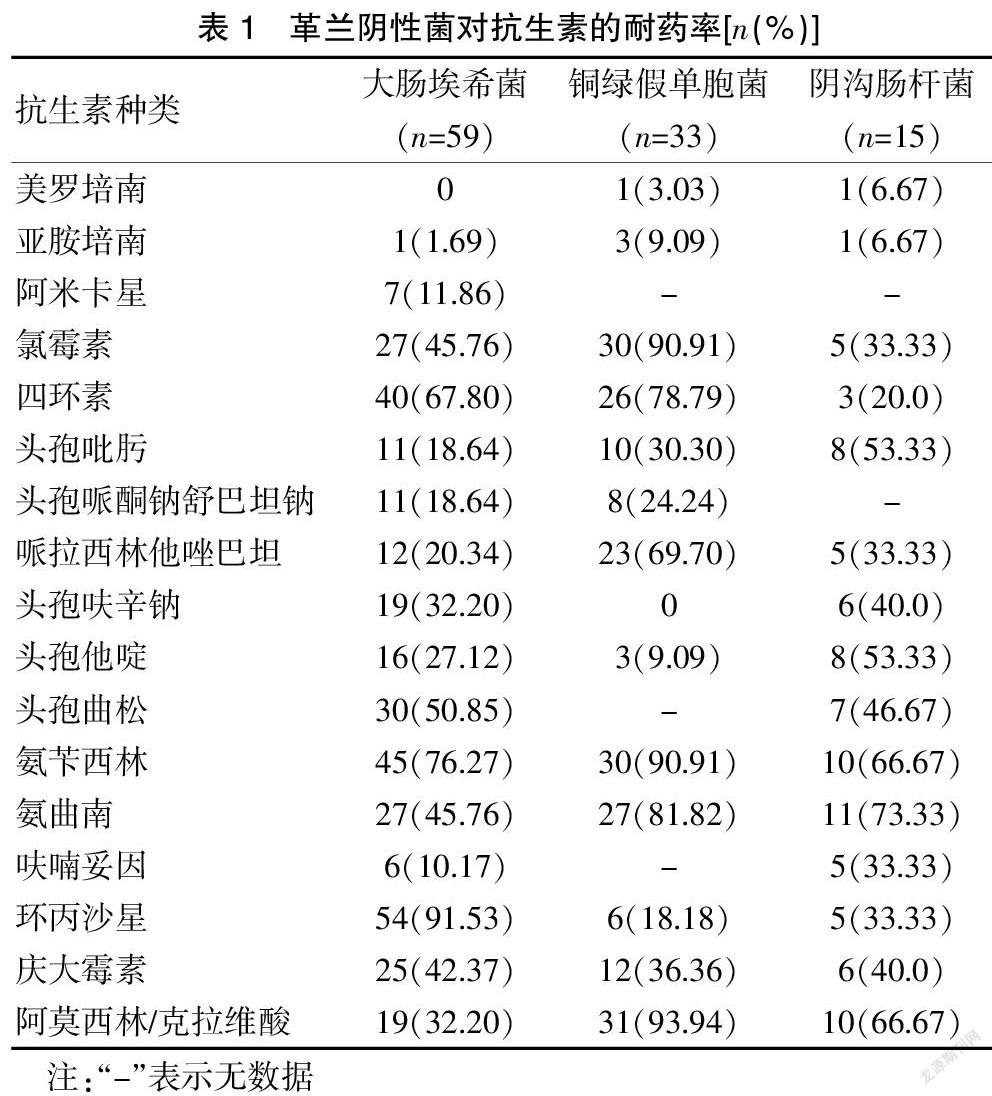


[摘要] 目的 探讨细菌培养、药敏试验在复发性尿路感染中的应用价值。方法 在我院泌尿外科于2015年3月至2017年8月收诊的复发性尿路感染患者中选出400例为研究对象,对全部患者采集中段尿标本进行细菌培养,并对病原菌进行药敏试验,根据试验结果采用长期疗程方案治疗,收集细菌培养、药敏试验的结果及治疗效果。结果 本组400例患者经细菌培养共培养出183株(45.75%)病原菌,其中116株(63.39%)革兰阴性菌,67株(36.61%)革兰阳性菌,革兰阴性菌的检出率明显高于革兰阳性菌,差异有统计学意义(P<0.05)。药敏试验显示,革兰阴性菌普遍对美罗培南、亚胺培南敏感,但对头孢菌素类、氨基糖苷类、喹诺酮类药物的耐药率较高;革兰阳性菌对红霉素、克林霉素、阿米卡星、利福平、环丙沙星等药物的耐药率较高,但对替考拉宁、万古霉素的耐药率较低。本组400例患者痊愈356例,好转40例,治疗总有效率为99.0%,在治愈的356例患者中,其中160例难治性尿路感染患者的治疗期、巩固期和总疗程的治疗时间,均长于196例普通型尿路感染患者(P<0.05);在维持期的治疗时间比较上,差异无统计学意义(P>0.05)。结论 复发性尿路感染患者的病原菌以革兰阴性菌为主,而不同病原菌对各类抗生素的耐药率不同,进行规范的细菌培养和药敏试验有助于指导临床治疗,提高治疗效果。
[关键词] 复发性尿路感染;细菌培养;药敏试验;治疗效果;疗程
[中图分类号] R691.3;R378 [文獻标识码] B [文章编号] 1673-9701(2021)34-0132-04
[Abstract] Objective To investigate the application value of bacterial culture and drug sensitivity test with recurrent urinary tract infection. Methods A total of 400 patients with recurrent urinary tract infection admitted to the department of urology surgery of our hospital from March 2015 to August 2017 were selected as the research objects. The midstream urine specimen of all patients were collected for bacterial culture, and drug sensitivity test was carried out on pathogenic bacteria. According to the test results, long-term treatment was adopted for collecting the results of bacterial culture, drug sensitivity test and therapeutic efficacy. Results After bacterial culture,a total of 183 strains (45.75%) of pathogenic bacteria were cultured from 400 patients in this group, including 116 strains (63.39%) of Gram-negative bacteria and 67 strains (36.61%) of Gram-positive bacteria(P<0.05). Drug sensitivity test showed that Gram-negative bacteria were generally sensitive to meropenem and imipenem, but the drug resistance rate to cephalosporins, aminoglycosides and quinolones were relatively high. Gram-positive bacteria had higher resistance rate to erythromycin, clindamycin, amikacin, rifampicin and ciprofloxacin but lower resistance rate to teicoplanin and vancomycin. Of the 400 patients in this group, 356 were cured, 40 were improved, and the total effective rate was 99.0%. Among the 356 cured patients, the treatment period, consolidation period and total course of treatment of 160 patients with refractory urinary tract infection were all longer than those of 196 patients with ordinary urinary tract infection(P<0.05). There was no statistically significant difference in the treatment time of maintenance period between groups(P>0.05). Conclusion Gram-negative bacteria are the main pathogens in patients with recurrent urinary tract infection, and different pathogens have different resistance rates to various antibiotics. Standardized bacterial culture and drug sensitivity test are helpful to guide clinical treatment and improve the therapeutic efficacy.
[Key words] Recurrent urinary tract infection; Bacterial culture; Drug sensitivity test; Therapeutic efficacy; Treatment course
尿路感染是常见的一种泌尿系统感染类疾病,发病率较高,当患者在1年内尿路感染反复发作超过3次,则诊断为复发性尿路感染[1-3]。复发性尿路感染的治疗难度大,极难彻底治愈,而长期反复使用抗生素治疗又易导致病原菌出现耐药性,并引发一系列的不良反应,影响治疗效果[4-5]。而且临床实践发现,复发性尿路感染患者的尿培养阳性率不高,又给长疗程抗生素治疗带来困难。科学的细菌培养及药敏试验有助于临床医师结合患者的病原菌、耐药问题等选择合理的用药方案,促进患者早日康复[6]。为此,本院特探讨细菌培养及药敏试验在复发性尿路感染患者中的应用价值,现报道如下。……