连续多代次种植橡胶树对土壤团聚体及土壤有机碳的影响
2021-01-13董豪茶正早张翔郭澎涛黄艳艳朱紫依王国苇
董豪 茶正早 张翔 郭澎涛 黄艳艳 朱紫依 王国苇
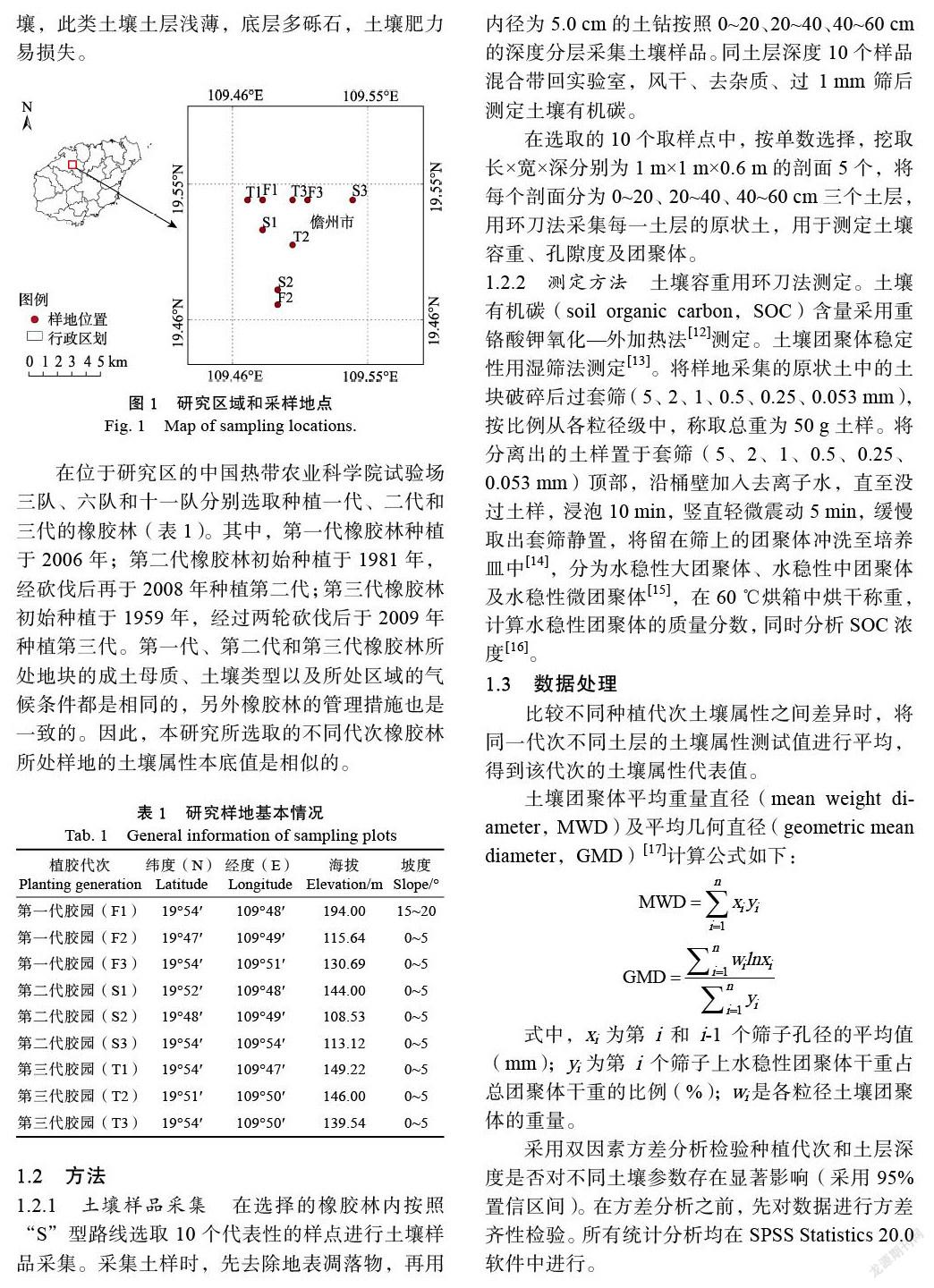
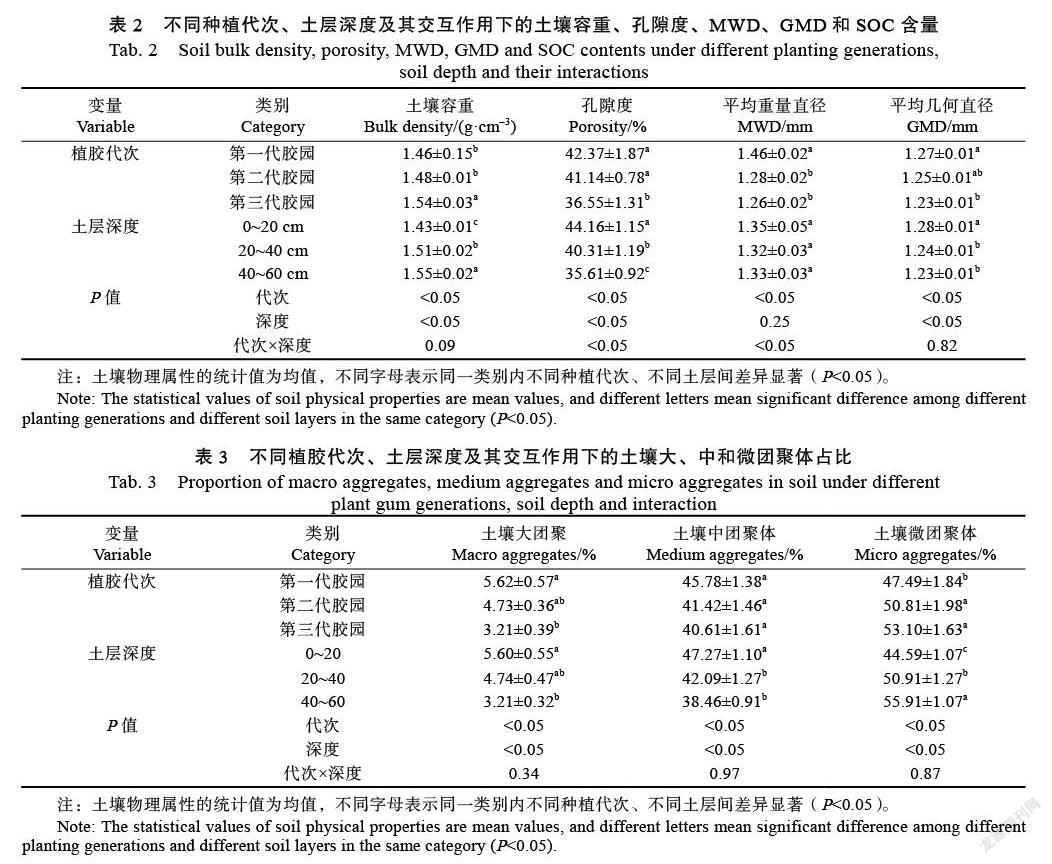
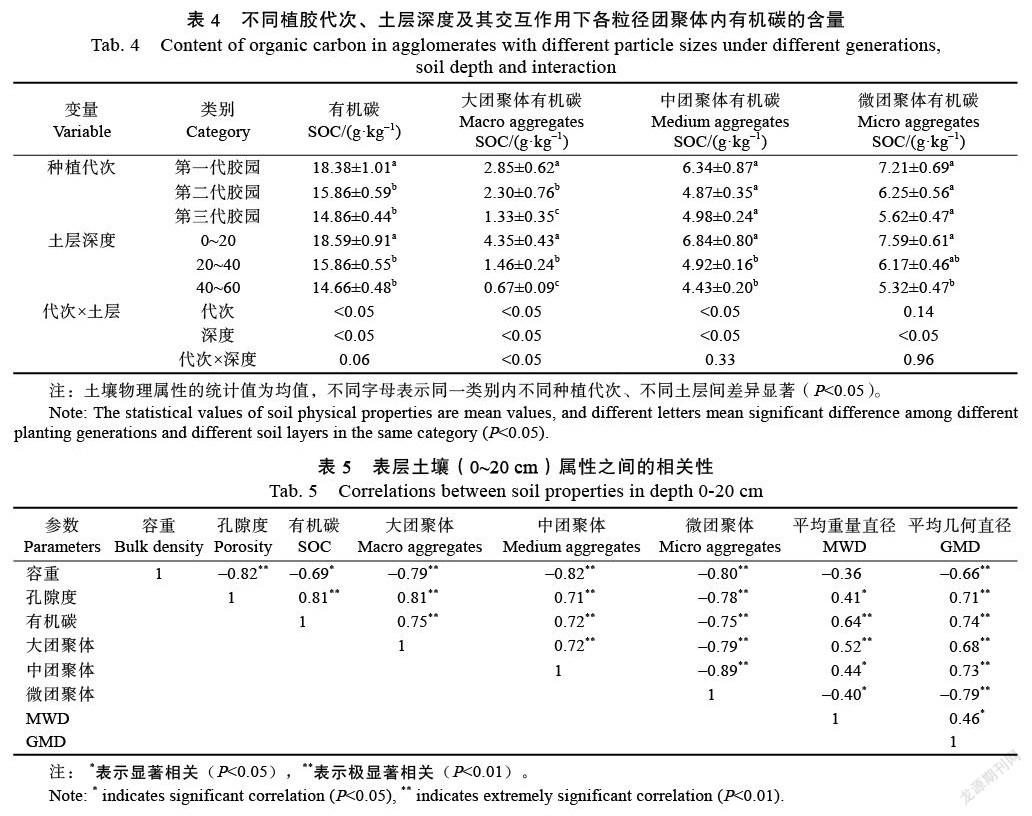
摘 要:土壤團聚体和土壤有机碳是指示土壤质量的重要指标,探究连续多代次种植橡胶对土壤团聚体和有机碳的影响可为了解橡胶园土壤质量演变规律提供理论支持。本研究采用时空互代法在海南儋州选取成土母质、土壤类型、气候条件一致的不同代次(一代、二代和三代)的橡胶园,分层(0~20 cm、20~40 cm和40~60 cm)采集土壤样品,研究土壤团聚体、容重、孔隙度和有机碳(SOC)随种植代次及土层深度的变化规律。结果表明:(1)第三代橡胶园土壤容重显著高于第一代和第二代橡胶园(P<0.05),而第一代橡胶园的土壤孔隙度、MWD和GMD均显著高于第三代橡胶园(P<0.05);在不同土层深度中,孔隙度随土层深度增加而显著降低(P<0.05)。(2)第三代橡胶园土壤大、中团聚体占比显著低于第一代橡胶园(P<0.05),不同土层间,0~20 cm土层土壤大、中团聚体占比显著高于40~60 cm(P<0.05);相反,土壤微团聚体占比表现为第一代胶园显著低于第三代橡胶园(P<0.05),微团聚体占比随土层深度增加而显著增加(P<0.05)。(3)第一代土壤总有机碳含量显著高于第三代橡胶园(P<0.05),不同土层间,0~20 cm土层有机碳含量显著高于40~60 cm土层(P<0.05);土壤大团聚体有机碳含量随种植代次和土层深度增加显著降低(P<0.05);不同土层中,0~20 cm土层土壤中、微团聚体有机碳含量均显著高于40~60 cm土层(P<0.05)。上述结果说明,连续多代次植胶后土壤出现退化趋势。
关键词:橡胶园;种植代次;土壤有机碳;团聚体稳定性;土壤退化
中图分类号:S151.9 文献标识码:A
Abstract: Soil aggregates and soil organic carbon (SOC) are important indicators of soil quality. Exploring the effects of successive multi-generation rubber planting on soil aggregates and SOC can provide theoretical support for understand-ing the evolution law of soil quality in rubber plantations. In this study, the spatial and temporal intergenerational me-thod was used to collect soil samples in layers (0–20 cm, 20–40 cm and 40–60 cm) from rubber plantations of dif-ferent generations (first generation, second generation and third generation) with the same parent material, soil type and climatic conditions in Danzhou, Hainan. The changes of soil aggregates, bulk density, porosity and organic carbon (SOC) with planting generations and soil depth were studied. Soil bulk density of the third generation was significantly higher than that of the first and second generation rubber plantations (P<0.05), and porosity, MWD and GMD of the first generation were significantly higher than that of the third generation rubber plantations (P<0.05). In different soil depth, porosity decreased significantly with the increase of soil depth (P<0.05). The proportion of large and medium aggregates in the third generation was significantly lower than that in the first generation of rubber plantation (P<0.05), and the proportion of large and medium aggregates in the 0–20 cm soil layer was significantly higher than that in the 40–60 cm soil layer (P<0.05). On the contrary, the proportion of soil microaggregates in the first generation was significantly lower than that in the third generation (P<0.05), and the proportion of microaggregates increased with the soil depth increasing (P<0.05). The soil total organic carbon content of the first generation was significantly higher than that of the third generation (P<0.05), and the soil organic carbon content of the 0–20 cm soil layer was significantly higher than that of the 40–60 cm soil layer (P<0.05). The content of organic carbon in soil aggregates decreased significantly with the increase of planting generation and soil depth (P<0.05). The organic carbon content of both medium and micro aggregates in 0–20 cm soil layer was significantly higher than that in 40–60 cm soil layer (P<0.05). The above results indicated that the soil degraded in some degree after multiple successive generations of rubber tree plantation.
Keywords: rubber plantation; planting generation; soil organic matter; aggregate stability; soil degradation
DOI: 10.3969/j.issn.1000-2561.2021.12.037
土壤团聚体在保持土壤结构稳定性方面发挥关键作用[1],而其中的水稳性大团聚体的占比更是可以指示土壤质量[2]。……