服装专卖店体验营销对顾客忠诚度的影响
2020-12-23张亚丽曲洪建
张亚丽 曲洪建
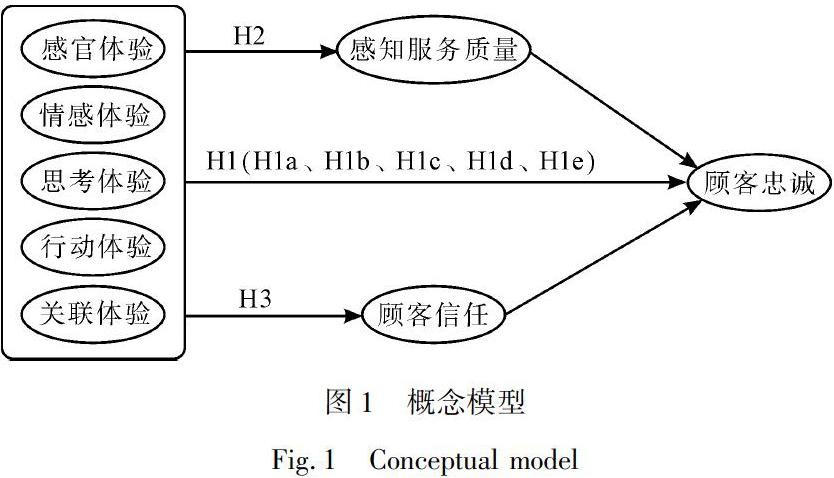
摘要: 由于传统服装专卖店难以留住顾客,文章以服务感知质量、顾客信任为中介变量,构建服装专卖店体验营销对顾客忠诚度影响的理论模型,并进行实证分析。结果表明:感官体验、情感体验、行动体验及关联体验对顾客忠诚度影响显著,思考体验对顾客忠诚度影响不显著,其影响程度大小排序为情感体验>行动体验>关联体验>感官体验;感知服务质量和顾客信任在感官体验与顾客忠诚度的关系中具有完全中介效应,在情感体验、行动体验、关联体验与顾客忠诚度的关系中具有部分中介效应。由此表明,服装专卖店体验营销具体策略对顾客忠诚度的影响程度不同,且感知服务质量和顾客信任在其中起到一定的中介作用,企业需要结合具体影响因素提出服装专卖店营销策略。
关键词: 体验营销;感知服务质量;顾客信任;顾客忠诚;营销策略
中图分类号: TS941.1
文献标志码: A
文章编号: 1001-7003(2020)11-0051-07
引用页码: 111109
Abstract: Because it is difficult for traditional clothing stores to retain customers, this paper takes perceived service quality and customer trust as mediating variables to build a theoretical model of the impact of experience marketing on customer loyalty in clothing stores, and carries out empirical analysis. The results show that: sensory experience, emotional experience, action experience and associated experience have significant impacts on customer loyalty, while thinking experience has no significant influence on customer loyalty. The order of influence degree is emotional experience>action experience>associated experience>sensory experience. Perceived service quality and customer trust have a complete mediating effect in the relationship between sensory experience and customer loyalty, and have a partial mediating effect in the relationship among emotional experience, action experience, associated experience and customer loyalty. The results indicate that, the specific strategies of experience marketing in clothing stores influence customer loyalty to different extents, and perceived service quality and customer trust play certain mediating role. Enterprises need to combine specific influencing factors to propose marketing strategies of clothing stores.
Key words: experience marketing; perceived service quality; customer trust; customer loyalty; marketing strategy
由于电子商务迅速发展,网络购物的方式越来越便捷并受到消费者的推崇,但是网购服装的质量越来越不尽人意,因此服装专卖店的发展至关重要。销售业绩分流到线上企业,实体企业销售额受到明显的影响,服装专卖店的营业额有很大幅度的下降;与此同时,消费水平的提升和消费结构优化,使得顾客购物心理产生改变,会更加关注消费过程中店铺带来的精神层面的獨特体验。这种附加价值帮助店铺给顾客带来积极情感,促使消费者产生购买决策,从而提高顾客购买该专卖店产品的几率,提高营业额[1]。因此,改变服……