心理干预对血液肿瘤患者护理满意度的影响
2020-10-21王芳
王芳

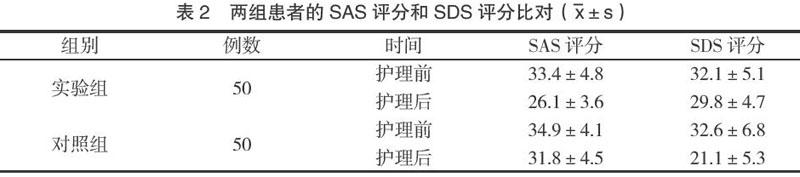
【摘 要】目的:为了探讨心理干预对血液肿瘤患者护理满意度的影响。方法:选取我院2018年6月~2019年6月收治的100例血液肿瘤患者进行研究,将其随机分为实验组和对照组,每组50例,对照组行常规护理,实验组患者在对照组的基础上行心理干预,比较护理效果。结果显示:实验组的护理满意度为94%,而对照组的护理满意度为76%,实验组与对照组之间存在显著性差异(P<0.05),且实验组的SAS评分和SDS评分均显著低于对照组(P<0.05)。结论:对血液肿瘤患者进行心理干预,可以明显改善患者的心理状态,提高患者的护理满意度,促使其尽快恢复健康,值得在临床上推广。
【关键词】 心理干预;血液肿瘤患者;护理满意度
【中图分类号】R725.5 【文献标识码】B 【文章编号】1002-8714(2020)05-0017-02
【Abstract】 Objective: The purpose of this review is to investigate the effect of psychological intervention on nursing satisfaction of patients with hematologic tumor. Methods: A total of 100 patients with hematological tumors treated in our hospital from June 2018 to June 2019 were selected for research. They were randomly divided into experimental and control groups, with 50 patients in each group. The control group received routine care. The basic upward psychological intervention to compare nursing effects.Results: The consequence showed that the nursing satisfaction of the experimental group was 94%, while that of the control group was 76%. There was a significant difference between the experimental group and the control group (P < 0.05), and the SAS score and SDS score of the experimental group were significantly lower than that of the control group (P < 0.05). Conclusion: psychological intervention for patients with blood tumor can significantly improve the psychological state of patients, the nursing satisfaction of patients, and promote their recovery as soon as possible, which is worthy of clinical promotion.
【Keywords】 Psychological intervention; Patients with hematologic tumors; Nursing satisfaction
临床上常见的血液肿瘤主要包括白血病、多发性骨髓瘤及恶性淋巴瘤等[1]。血液肿瘤难以医治,临床上主要以化疗为主要治疗手段,复发率高,并发症多且死亡率高,会给患者的身心带来巨大的伤害[2]。患上血液肿瘤的可能性有很多,或许由于接触了一些化学药物或化学物质,如油漆、苯和染发剂等,或许无意中接触了X线辐射,也可能是因为遗传因素等等。为了探讨心理干预对血液肿瘤患者护理满意度的影响,本文选取我院2018年6月~2019年6月收治的100例血液肿瘤患者作为研究对象进行研究,研究结果如下:
1 研究方法
1.1 对象选取
将我院2018年6月~2019年6月收治的100例高热惊厥患儿作为研究对象进行研究,将患者随机分为对照组和实验组两组,各50例,其中对照组男性26例,女性24例,其中最小年龄35岁,最大年龄68岁,平均年龄(48.57±5.17)岁。实验组患者中,男性27例,女性23例;其中最小年龄34岁,最大年龄69岁,平均年龄(49.23±4.71)岁。对照组与实验组的一般资料差异不显著(P>0.05),可进行后续的相关研究。