艾滋病患者合并机会性感染的临床特点和预后分析
2020-09-02惠锐玲
惠锐玲
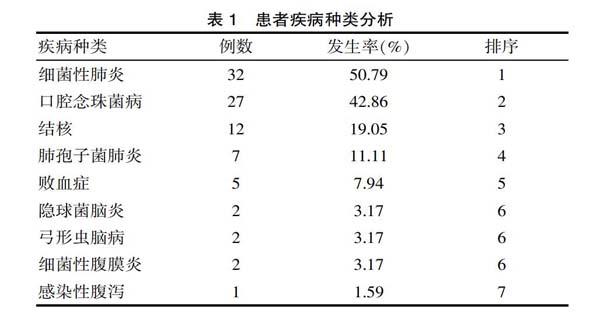
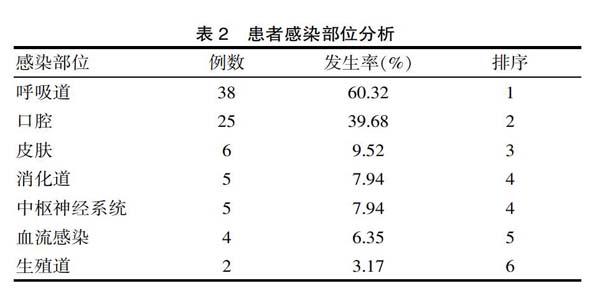
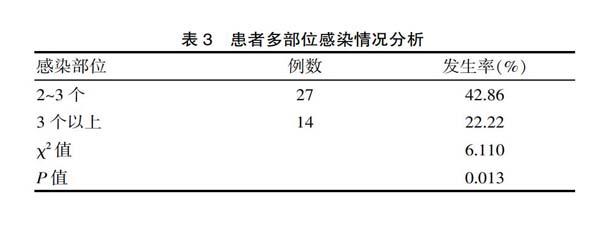
[摘要] 目的 探析艾滋病患者合并机会性感染的临床特点和预后情况。 方法 方便选择2017年9月—2019年9月该院收治的63例艾滋病合并机会性感染患者,所有患者均行病原学检查、真菌感染检查、分枝杆菌及痰涂片培养等,观察患者的疾病种类、感染部位及预后情况。结果 艾滋病患者合并机会性感染疾病种类最多的是细菌性肺炎,占比50.79%(32例);其次是口腔念珠菌,占比42.86%(27例);排名第三的疾病种类是结核,占比19.05%(12例);疾病种类最少的是感染性腹泻,占比1.59%(1例);艾滋病患者合并机会性感染感染部位最多的是呼吸道,占比60.32%(38例);其次是口腔,占比39.68%(25例);排名第三的感染部位是皮肤,占比9.52%(6例);感染部位最少的是生殖道,占比3.17%(2例);在63例艾滋病合并机会性感染患者中,多部位感染的共41例,占比65.08%,其中2~3个感染部位的发生率(42.86%)明显更多,差异有统计学意义(χ2=6.110,P<0.05)。在63例艾滋病合并机会性感染患者中,最终病死的共16例,病死率为25.40%;存活的共47例,存活率为74.60%。结论 艾滋病患者合并机会性感染的特点是复杂性和多样性,疾病种类、发生部位较多,且多个部位感染率较高,导致预后效果差,临床治疗应加强控制,挽回患者生命。
[关键词] 机会性感染;預后情况;临床特点;艾滋病
[中图分类号] R512 [文献标识码] A [文章编号] 1674-0742(2020)06(a)-0062-03
Analysis of Clinical Characteristics and Prognosis of Patients with AIDS with Opportunistic Infection
HUI Rui-ling
Department of Infectious Diseases, the First People's Hospital of Qujing, Qujing, Yunnan Province, 655000 China
[Abstract] Objective To analyze the clinical characteristics and prognosis of patients with AIDS combined with opportunistic infections. Methods Sixty-three AIDS patients with opportunistic infections who were admitted to the hospital from September 2017 to September 2019 were selected. All patients underwent pathogenic examination, fungal infection examination, mycobacteria and sputum smear culture, etc. to observe the patients' disease type, infection site and prognosis. Results Bacterial pneumonia was the most common type of opportunistic infections in AIDS patients, accounting for 50.79% (32 cases). Oral candidiasis was the most common type, accounting for 42.86% (27 cases). The third highest disease type was tuberculosis, accounting for 19.05% (12 cases); infectious diarrhea was the smallest type of disease, accounting for 1.59% (1 case); respiratory infection was the most common site for AIDS patients with opportunistic infections, accounting for 60.32% (38 cases); followed by The oral cavity accounted for 39.68% (25 cases); the third infection site was skin, accounting for 9.52% (6 cases); the smallest infection site was the reproductive tract, accounting for 3.17% (2 cases); in 63 cases of AIDS Among patients with combined opportunistic infections, there were 41 cases of multi-site infections, accounting for 65.08%. Among them, the incidence of 2-3 infected sites (42.86%) was significantly more, and the differences were statistically significant (χ2=6.110, P<0.05). Of the 63 patients with AIDS and opportunistic infections, 16 died eventually, with a mortality rate of 25.40%; 47 survived with a survival rate of 74.60%. Conclusion AIDS patients with opportunistic infections are characterized by complexity and diversity. There are many types and locations of the disease, and the infection rate in multiple locations is high, leading to poor prognosis. Clinical treatment should be strengthened to control and save patients' lives.
[Key words] Opportunistic infection; Prognosis; Clinical characteristics; AIDS
艾滋病是目前危害性较强的传染性疾病,该疾病可通过血液、母婴和性交3个渠道进行传播,其发生原因多是人类免疫缺陷病毒的感染,具有较高的病死率.近几年,随着社会经济的发展,毒品蔓延速度加快,这也在一定程度上加重了该疾病的发病率,但目前,世界医学范围内都还未提出该疾病的根治方式[1]。作为慢性传染性疾病,艾滋病的特点是对人体免疫防御系统功能进行破坏,威胁患者生命安全,合并机会性感染则会加重患者病情,增加治疗难度,成为患者病死的一大原因[2-3]。……
